AQA · GCSE · Business
Course version: 8132 · Version from Sept 2017
Business planning: analyse the benefits and drawbacks of business planning
Full specification wording
Business planning: analyse the benefits and drawbacks of business planning
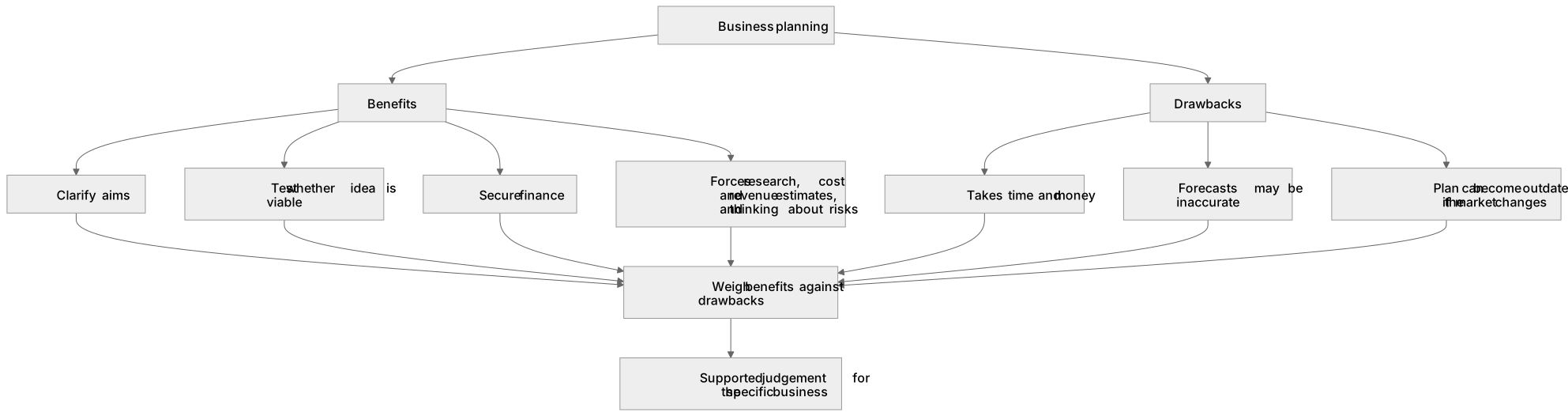
Business planning can help a start-up clarify its aims, test whether an idea is viable, and secure finance because lenders and investors often expect a plan.
Checked against the AQA 8132 specification (opens in a new tab) on .
- Point 7 of 9
- 4 key terms
Study notes
From the checked teaching notes for this specification point.
The idea
Business planning can help a start-up clarify its aims, test whether an idea is viable, and secure finance because lenders and investors often expect a plan. It also forces the owner to research the market, estimate costs and revenues, and think about risks. However, planning has drawbacks: it takes time and money, forecasts may be inaccurate, and a plan can become outdated if the market changes. For example, a plan may predict sales of 500 units per month, but if a competitor opens nearby, actual sales may be lower, making the financial forecasts unreliable. Analysis means weighing these benefits against drawbacks and reaching a supported judgement for the specific business.
What earns the marks
- States a benefit of business planning, such as helping the owner set clear objectives and make informed decisions.
- States a drawback of business planning, such as the time and cost involved or the risk that forecasts are inaccurate.
- Explains how a benefit or drawback affects the business, for example that a plan can support a loan application but may need regular updating.
- Uses a business context to illustrate the analysis, such as a small retailer whose sales forecast depends on local demand.
- Reaches a supported judgement about whether planning is worthwhile in the circumstances, weighing benefits against drawbacks.
Common mistakes and how to put them right
Listing benefits and drawbacks without linking them to the business.
Put it right: Apply each point to the context and explain the effect.
Assuming a business plan guarantees success.
Put it right: Recognise that it is a tool that can reduce risk but cannot remove uncertainty.
Ignoring the cost of planning.
Put it right: Include the time and money spent preparing and updating the plan as a drawback.
Exam tips
- For 'analyse', develop each point by explaining cause and effect rather than just naming it.
- Use connectives such as 'because', 'therefore' and 'however' to show chains of reasoning.
- Finish with a short judgement that directly answers the question and is based on the evidence you have used.
Try the lesson
The start of the Business planning: analyse the benefits and drawbacks of business planning lesson, made from checked teaching notes for this specification point.
Have a go first
Which of the following is a benefit of business planning for a start-up owner?
Listen
Business planning can help a start-up clarify its aims, test whether an idea is viable, and secure finance because lenders and investors often expect a plan. It also forces the owner to research the market, estimate costs and revenues, and think about risks. However, planning has drawbacks: it takes time and money, forecasts may be inaccurate, and a plan can become outdated if the market changes. For example, a plan may predict sales of 500 units per month, but if a competitor opens nearby, actual sales may be lower, making the financial forecasts unreliable. Analysis means weighing these benefits against drawbacks and reaching a supported judgement for the specific business. A strong answer earns marks for these points. States a benefit of business planning, such as helping the owner set clear objectives and make informed decisions. States a drawback of business planning, such as the time and cost involved or the risk that forecasts are inaccurate. Explains how a benefit or drawback affects the business, for example that a plan can support a loan application but may need regular updating. Uses a business context to illustrate the analysis, such as a small retailer whose sales forecast depends on local demand. A common slip: Listing benefits and drawbacks without linking them to the business. Instead, apply each point to the context and explain the effect. Exam tip: For 'analyse', develop each point by explaining cause and effect rather than just naming it.
See it
Key words
Say what each word means before you turn the card.
Risk management and decision making
Try answering aloud or in your head before turning the card.
Access to finance and stakeholder confidence
Try answering aloud or in your head before turning the card.
Accuracy and limitations of forecasting
Try answering aloud or in your head before turning the card.
Opportunity cost of planning time and money
Try answering aloud or in your head before turning the card.
See every definition
- Risk management and decision making
- Planning forces the owner to think about risks and helps the owner set clear objectives and make informed decisions.
- Access to finance and stakeholder confidence
- A plan can secure finance because lenders and investors often expect a plan, and it can support a loan application.
- Accuracy and limitations of forecasting
- Forecasts may be inaccurate, and a plan can become outdated if the market changes, making the financial forecasts unreliable.
- Opportunity cost of planning time and money
- Planning takes time and money, and the time and money spent preparing and updating the plan is a drawback.
Label the diagram
Some boxes have lost their names. Pick the right name for each number.
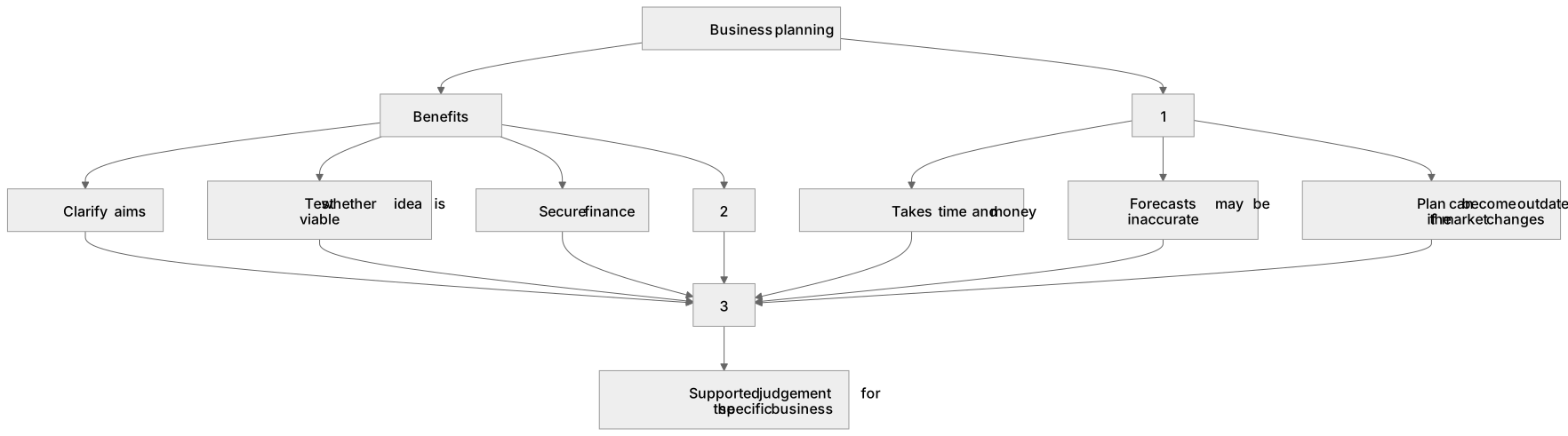
1Box 1
2Box 2
3Box 3
There is more to this lesson
The full lesson goes on to check your understanding and help you earn the marks. Create a free account to carry on, with your progress saved.
A week of Premium from your first lesson · Then the free plan continues · No card, no charge
Test your understanding of Business planning: analyse the benefits and drawbacks of business planning
Active recall beats re-reading. Take an instant quiz now to test what you’ve learned and lock it into long-term memory.
A week of Premium from your first lesson · Then the free plan continues · No card, no charge