AQA · GCSE · Business
Course version: 8132 · Version from Sept 2017
Business planning: understand the main sections of a business plan
A business plan is a written document that sets out how a business idea will be turned into a viable operation.
Checked against the AQA 8132 specification (opens in a new tab) on .
- Point 6 of 9
- 3 key terms
Study notes
From the checked teaching notes for this specification point.
The idea
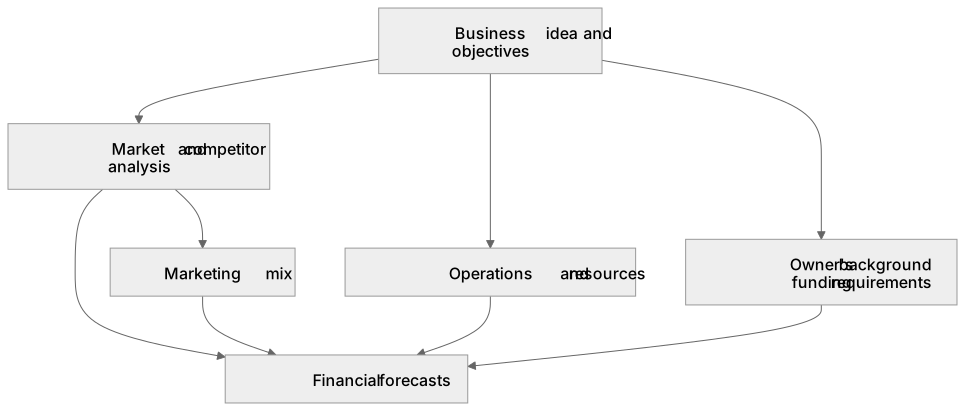
A business plan is a written document that sets out how a business idea will be turned into a viable operation. Its main sections usually include: the business idea and objectives; the market and competitor analysis; the marketing mix; operations and resources; financial forecasts; and the owner's background and funding requirements. For example, a new café plan might state its aim to break even within 12 months, describe local competitors, set prices, list equipment and staff needs, and include a cash-flow forecast showing monthly inflows and outflows. Understanding each section means knowing its purpose and how the sections connect, so the plan gives a complete picture of the proposal.
What earns the marks
- Identifies the main sections of a business plan, such as the business idea and objectives, market analysis, marketing mix, operations, financial forecasts, and owner background or funding needs.
- Explains the purpose of each section, for example that the financial forecasts show expected cash inflows and outflows and help assess whether the idea is viable.
- Shows how sections link together, such as using market research to justify pricing in the marketing mix and to support sales forecasts in the financial section.
- Applies understanding to a given business context, for example selecting the sections most relevant to a small start-up seeking a bank loan.
- Uses appropriate business terminology accurately, such as cash-flow forecast, break-even, target market and unique selling point.
Common mistakes and how to put them right
Treating the business plan as only a financial document.
Put it right: Recognise that it also covers the idea, market, marketing, operations and the owner's skills.
Listing sections without explaining their purpose.
Put it right: State what each section is for and how it helps the owner or an external stakeholder.
Confusing a cash-flow forecast with a profit forecast.
Put it right: Note that cash flow records the timing of money in and out, while profit compares total revenue with total costs over a period.
Exam tips
- Read the command word carefully: 'identify' needs brief section names, while 'explain' requires a reason or consequence for each section.
- Use a named business context from the case study to show how a section would be completed in practice.
- Link sections together in your answer to show understanding of the plan as a whole, not just a list.
Try the lesson
The start of the Business planning: understand the main sections of a business plan lesson, made from checked teaching notes for this specification point.
Have a go first
Which section of a business plan states what the business is aiming to achieve in the long term?
Listen
A business plan is a written document that sets out how a business idea will be turned into a viable operation. Its main sections usually include: the business idea and objectives; the market and competitor analysis; the marketing mix; operations and resources; financial forecasts; and the owner's background and funding requirements. For example, a new café plan might state its aim to break even within 12 months, describe local competitors, set prices, list equipment and staff needs, and include a cash-flow forecast showing monthly inflows and outflows. Understanding each section means knowing its purpose and how the sections connect, so the plan gives a complete picture of the proposal. A strong answer earns marks for these points. Identifies the main sections of a business plan, such as the business idea and objectives, market analysis, marketing mix, operations, financial forecasts, and owner background or funding needs. Explains the purpose of each section, for example that the financial forecasts show expected cash inflows and outflows and help assess whether the idea is viable. Shows how sections link together, such as using market research to justify pricing in the marketing mix and to support sales forecasts in the financial section. Applies understanding to a given business context, for example selecting the sections most relevant to a small start-up seeking a bank loan. A common slip: Treating the business plan as only a financial document. Instead, recognise that it also covers the idea, market, marketing, operations and the owner's skills. Exam tip: Read the command word carefully: 'identify' needs brief section names, while 'explain' requires a reason or consequence for each section.
See it
Key words
Say what each word means before you turn the card.
Business plan
Try answering aloud or in your head before turning the card.
Financial forecasts
Try answering aloud or in your head before turning the card.
Cash-flow forecast
Try answering aloud or in your head before turning the card.
See every definition
- Business plan
- A written document that sets out how a business idea will be turned into a viable operation.
- Financial forecasts
- A section showing expected cash inflows and outflows, helping to assess whether the idea is viable.
- Cash-flow forecast
- Records the timing of money in and out, showing monthly inflows and outflows.
Label the diagram
Some boxes have lost their names. Pick the right name for each number.
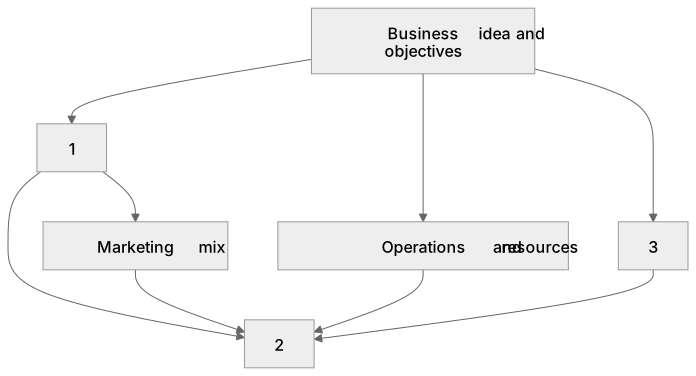
1Box 1
2Box 2
3Box 3
There is more to this lesson
The full lesson goes on to check your understanding and help you earn the marks. Create a free account to carry on, with your progress saved.
A week of Premium from your first lesson · Then the free plan continues · No card, no charge
Test your understanding of Business planning: understand the main sections of a business plan
Active recall beats re-reading. Take an instant quiz now to test what you’ve learned and lock it into long-term memory.
A week of Premium from your first lesson · Then the free plan continues · No card, no charge