AQA · GCSE · Business
Course version: 8132 · Version from Sept 2017
Business planning: Basic financial terms
Basic financial terms describe the money figures used when planning and monitoring a business.
Checked against the AQA 8132 specification (opens in a new tab) on .
- Point 3 of 9
- 4 key terms
Study notes
From the checked teaching notes for this specification point.
The idea
Basic financial terms describe the money figures used when planning and monitoring a business. Revenue is the total income from sales, calculated as price × quantity sold. Costs split into fixed costs, which do not change with output, such as rent, and variable costs, which rise with output, such as raw materials. Total costs are fixed plus variable costs. Profit is revenue minus total costs, and a negative result is a loss. Cash flow records money entering and leaving over time and differs from profit because timing and non-cash items matter. Break-even is the output at which total revenue equals total costs.
For example: Selling 500 units at £10 gives £5,000 revenue; if total costs are £4,000, profit is £1,000.
What earns the marks
- Defines revenue as total income from sales and shows it as price multiplied by quantity sold.
- Distinguishes fixed costs, which do not vary with output, from variable costs, which do, and combines them as total costs.
- Defines profit as revenue minus total costs and recognises a negative result as a loss.
- Explains that cash flow tracks money in and out over time and is not the same as profit.
- Defines break-even as the output where total revenue equals total costs and applies figures to a simple example.
Common mistakes and how to put them right
Confusing revenue with profit.
Put it right: Revenue is total sales income, while profit is revenue minus total costs.
Treating all costs as variable.
Put it right: Identify fixed costs such as rent separately from variable costs such as materials.
Assuming cash flow and profit are identical.
Put it right: Explain that timing of payments and non-cash items can make them differ.
Exam tips
- Show the formula and substitute figures before calculating so method is visible.
- Check whether a question asks for revenue, cost, profit or break-even before starting.
- Use the case study's own figures and units, such as £ or units, throughout the answer.
Try the lesson
The start of the Business planning: Basic financial terms lesson, made from checked teaching notes for this specification point.
Have a go first
Which basic financial term means the money a business receives from selling its goods or services?
Listen
Basic financial terms describe the money figures used when planning and monitoring a business. Revenue is the total income from sales, calculated as price × quantity sold. Costs split into fixed costs, which do not change with output, such as rent, and variable costs, which rise with output, such as raw materials. Total costs are fixed plus variable costs. Profit is revenue minus total costs, and a negative result is a loss. Cash flow records money entering and leaving over time and differs from profit because timing and non-cash items matter. Break-even is the output at which total revenue equals total costs. For example, selling 500 units at £10 gives £5,000 revenue; if total costs are £4,000, profit is £1,000. A strong answer earns marks for these points. Defines revenue as total income from sales and shows it as price multiplied by quantity sold. Distinguishes fixed costs, which do not vary with output, from variable costs, which do, and combines them as total costs. Defines profit as revenue minus total costs and recognises a negative result as a loss. Explains that cash flow tracks money in and out over time and is not the same as profit. A common slip: Confusing revenue with profit. Instead, revenue is total sales income, while profit is revenue minus total costs. Exam tip: Show the formula and substitute figures before calculating so method is visible.
See it
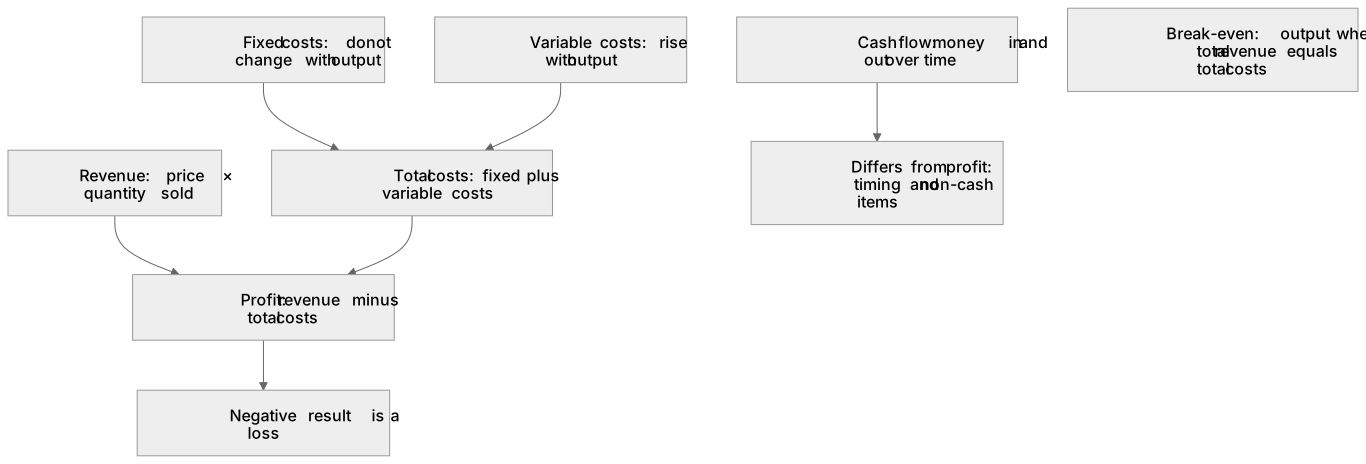
Key words
Say what each word means before you turn the card.
Revenue
Try answering aloud or in your head before turning the card.
Fixed costs
Try answering aloud or in your head before turning the card.
Variable costs
Try answering aloud or in your head before turning the card.
Break-even
Try answering aloud or in your head before turning the card.
See every definition
- Revenue
- The total income from sales, calculated as price multiplied by quantity sold.
- Fixed costs
- Costs which do not change with output, such as rent.
- Variable costs
- Costs which rise with output, such as raw materials.
- Break-even
- The output at which total revenue equals total costs.
Label the diagram
Some boxes have lost their names. Pick the right name for each number.
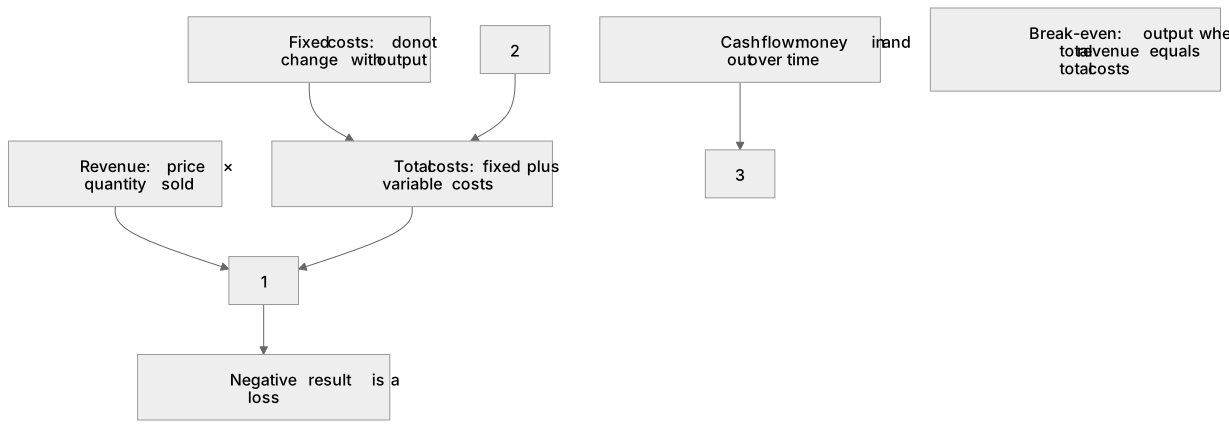
1Box 1
2Box 2
3Box 3
There is more to this lesson
The full lesson goes on to check your understanding and help you earn the marks. Create a free account to carry on, with your progress saved.
A week of Premium from your first lesson · Then the free plan continues · No card, no charge
Test your understanding of Business planning: Basic financial terms
Active recall beats re-reading. Take an instant quiz now to test what you’ve learned and lock it into long-term memory.
A week of Premium from your first lesson · Then the free plan continues · No card, no charge