AQA · GCSE · Business
Course version: 8132 · Version from Sept 2017
Complete and interpret sections of a cash flow forecast (this includes an…
Full specification wording
Cash flow: complete and interpret sections of a cash flow forecast (this includes an understanding of cash inflows and outflows, net cash flow and the opening and closing balance. Students are not expected to be able to construct an entire cash flow forecast)
A cash flow forecast predicts money entering and leaving a business month by month.
Checked against the AQA 8132 specification (opens in a new tab) on .
- Point 6 of 7
- 4 key terms
Study notes
From the checked teaching notes for this specification point.
The idea
A cash flow forecast predicts money entering and leaving a business month by month. Cash inflows are receipts such as sales revenue, loans or capital; cash outflows are payments such as wages, rent and supplier bills. Net cash flow is inflows minus outflows for that period: positive means a surplus, negative a deficit. The opening balance is cash held at the period's start; the closing balance is opening balance plus net cash flow, and it becomes the next period's opening balance. To complete a section, calculate the missing figure from the other values, then interpret: a negative closing balance signals a cash shortage needing action. You are not expected to build a whole forecast.
What earns the marks
- Correctly classify items as cash inflows (for example cash sales, bank loan received, owner's capital) or cash outflows (for example wages, rent, raw materials, loan repayments).
- Calculate net cash flow for a period as total inflows minus total outflows, showing the subtraction and labelling a negative result as a deficit.
- Calculate a closing balance as opening balance plus net cash flow, and carry that closing balance forward as the next period's opening balance.
- Rearrange the relationship to find a missing opening balance, net cash flow or inflow/outflow total when other figures are given.
- Interpret a completed section: identify months with negative net cash flow or negative closing balances and explain the liquidity problem this creates.
- Distinguish cash flow from profit, recognising that a profitable business can still run short of cash in a given month.
Common mistakes and how to put them right
Adding outflows to inflows instead of subtracting them.
Put it right by computing net cash flow as inflows minus outflows.
Treating a negative closing balance as impossible or ignoring the minus sign.
Put it right by recording it as a deficit and commenting on the cash shortage it signals.
Forgetting to carry the closing balance forward as the next opening balance.
Put it right by checking that each period's opening balance equals the previous period's closing balance.
Exam tips
- Show your working for each net cash flow and closing balance so method marks can be awarded even if an arithmetic slip occurs.
- Read the table carefully to spot which figure is missing before calculating, then use the opening balance plus net cash flow relationship.
- When asked to interpret, link a negative balance to a concrete consequence such as being unable to pay wages or suppliers on time.
Try the lesson
The start of the Cash flow: complete and interpret sections of a cash flow forecast (this includes an understanding of cash inflows and outflows, net cash flow and the opening and closing balance. Students are not expected to be able to construct an entire cash flow forecast) lesson, made from checked teaching notes for this specification point.
Have a go first
A cash flow forecast shows a month with cash inflows of £8,000 and cash outflows of £6,500. What is the net cash flow for that month?
Listen
A cash flow forecast predicts money entering and leaving a business month by month. Cash inflows are receipts such as sales revenue, loans or capital; cash outflows are payments such as wages, rent and supplier bills. Net cash flow is inflows minus outflows for that period: positive means a surplus, negative a deficit. The opening balance is cash held at the period's start; the closing balance is opening balance plus net cash flow, and it becomes the next period's opening balance. To complete a section, calculate the missing figure from the other values, then interpret: a negative closing balance signals a cash shortage needing action. You are not expected to build a whole forecast. A strong answer earns marks for these points. Correctly classify items as cash inflows (for example cash sales, bank loan received, owner's capital) or cash outflows (for example wages, rent, raw materials, loan repayments). Calculate net cash flow for a period as total inflows minus total outflows, showing the subtraction and labelling a negative result as a deficit. Calculate a closing balance as opening balance plus net cash flow, and carry that closing balance forward as the next period's opening balance. Rearrange the relationship to find a missing opening balance, net cash flow or inflow/outflow total when other figures are given. A common slip: Adding outflows to inflows instead of subtracting them. Instead, computing net cash flow as inflows minus outflows. Exam tip: Show your working for each net cash flow and closing balance so method marks can be awarded even if an arithmetic slip occurs.
See it
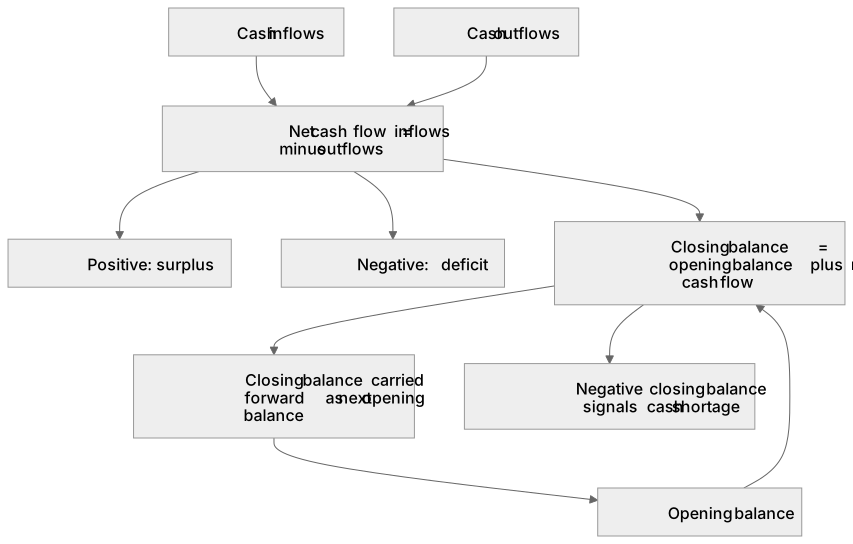
Key words
Say what each word means before you turn the card.
Cash inflows and outflows
Try answering aloud or in your head before turning the card.
Net cash flow
Try answering aloud or in your head before turning the card.
Opening and closing balances
Try answering aloud or in your head before turning the card.
Liquidity and cash shortages
Try answering aloud or in your head before turning the card.
See every definition
- Cash inflows and outflows
- Cash inflows are receipts such as sales revenue, loans or capital, while cash outflows are payments such as wages, rent and supplier bills.
- Net cash flow
- Inflows minus outflows for that period, where positive means a surplus and negative a deficit.
- Opening and closing balances
- The opening balance is cash held at the period's start, and the closing balance is opening balance plus net cash flow, becoming the next period's opening balance.
- Liquidity and cash shortages
- A negative closing balance signals a cash shortage needing action, which creates a liquidity problem.
Label the diagram
Some boxes have lost their names. Pick the right name for each number.
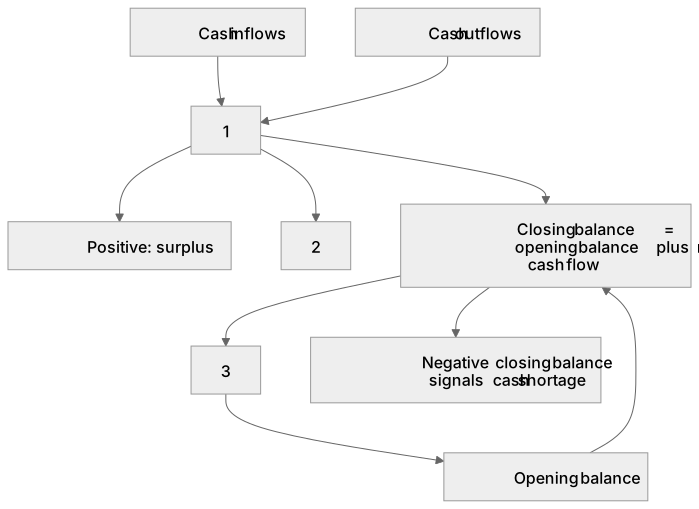
1Box 1
2Box 2
3Box 3
There is more to this lesson
The full lesson goes on to check your understanding and help you earn the marks. Create a free account to carry on, with your progress saved.
A week of Premium from your first lesson · Then the free plan continues · No card, no charge
Test your understanding of Cash flow: complete and interpret sections of a cash flow forecast (this includes an understanding of cash inflows and outflows, net cash flow and the opening and closing balance. Students are not expected to be able to construct an entire cash flow forecast)
Active recall beats re-reading. Take an instant quiz now to test what you’ve learned and lock it into long-term memory.
A week of Premium from your first lesson · Then the free plan continues · No card, no charge