AQA · GCSE · Business
Course version: 8132 · Version from Sept 2017
Evaluate possible solutions to cash flow problems, including re-scheduling…
Full specification wording
Cash flow: evaluate possible solutions to cash flow problems, including re-scheduling payments, overdrafts, reducing cash outflow, increasing cash inflow and finding new sources of finance.
When a forecast shows negative net cash flow or a negative closing balance, a business must act.
Checked against the AQA 8132 specification (opens in a new tab) on .
- Point 7 of 7
- 4 key terms
Study notes
From the checked teaching notes for this specification point.
The idea
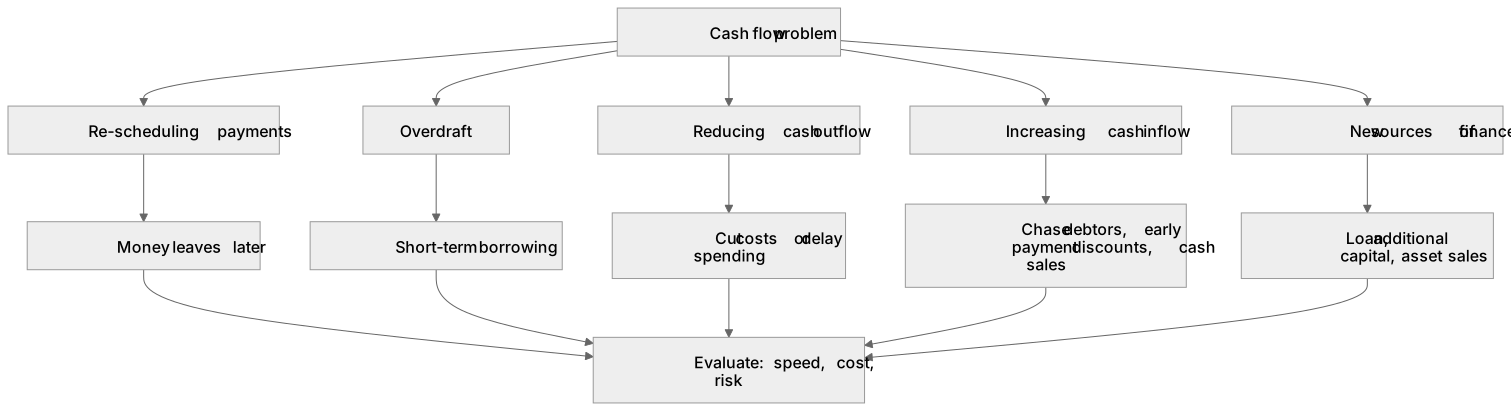
When a forecast shows negative net cash flow or a negative closing balance, a business must act. Solutions include re-scheduling payments to suppliers or lenders so money leaves later; arranging an overdraft to borrow short term on the current account; reducing cash outflow by cutting costs or delaying spending; increasing cash inflow by chasing debtors, offering discounts for early payment or boosting cash sales; and finding new sources of finance such as a loan, additional capital or asset sales. Evaluation means weighing each option's speed, cost and risk, then judging which best fits the business's situation.
For example: An overdraft is quick but carries interest and fees, whereas cutting costs may take longer but improves cash permanently.
What earns the marks
- Identify relevant solutions: re-scheduling payments, overdrafts, reducing cash outflow, increasing cash inflow and new sources of finance.
- Explain how each solution works, for example re-scheduling delays outflows while an overdraft provides short-term borrowing.
- Analyse advantages and drawbacks, such as the interest cost of an overdraft versus the flexibility it gives.
- Evaluate by weighing options against the business's circumstances and reaching a supported judgement on the best solution.
- Link solutions to the specific cash flow problem shown, for example a seasonal deficit versus a persistent one.
Common mistakes and how to put them right
Listing solutions without explaining how they solve the cash flow problem.
Put it right by linking each option to its effect on inflows, outflows or balances.
Confusing profit with cash and suggesting profit-based fixes.
Put it right by focusing on the timing of cash receipts and payments.
Giving a one-sided answer that only lists benefits.
Put it right by balancing advantages against drawbacks before judging.
Exam tips
- Use connectives such as however and therefore to build analysis and evaluation rather than description.
- Apply each solution to the context given in the case, naming the business and its specific cash problem.
- Reach a clear judgement in your conclusion, stating which solution is best and why, rather than sitting on the fence.
Try the lesson
The start of the Cash flow: evaluate possible solutions to cash flow problems, including re-scheduling payments, overdrafts, reducing cash outflow, increasing cash inflow and finding new sources of finance. lesson, made from checked teaching notes for this specification point.
Have a go first
Which action is a way of reducing cash outflow to help a business with a cash flow problem?
Listen
When a forecast shows negative net cash flow or a negative closing balance, a business must act. Solutions include re-scheduling payments to suppliers or lenders so money leaves later; arranging an overdraft to borrow short term on the current account; reducing cash outflow by cutting costs or delaying spending; increasing cash inflow by chasing debtors, offering discounts for early payment or boosting cash sales; and finding new sources of finance such as a loan, additional capital or asset sales. Evaluation means weighing each option's speed, cost and risk, then judging which best fits the business's situation. For example, an overdraft is quick but carries interest and fees, whereas cutting costs may take longer but improves cash permanently. A strong answer earns marks for these points. Identify relevant solutions: re-scheduling payments, overdrafts, reducing cash outflow, increasing cash inflow and new sources of finance. Explain how each solution works, for example re-scheduling delays outflows while an overdraft provides short-term borrowing. Analyse advantages and drawbacks, such as the interest cost of an overdraft versus the flexibility it gives. Evaluate by weighing options against the business's circumstances and reaching a supported judgement on the best solution. A common slip: Listing solutions without explaining how they solve the cash flow problem. Instead, linking each option to its effect on inflows, outflows or balances. Exam tip: Use connectives such as however and therefore to build analysis and evaluation rather than description.
See it
Key words
Say what each word means before you turn the card.
Cash flow management
Try answering aloud or in your head before turning the card.
Short-term finance
Try answering aloud or in your head before turning the card.
Cost control
Try answering aloud or in your head before turning the card.
Evaluation and judgement
Try answering aloud or in your head before turning the card.
See every definition
- Cash flow management
- Acting when a forecast shows negative net cash flow or a negative closing balance, using solutions such as re-scheduling payments, overdrafts, reducing cash outflow, increasing cash inflow and finding new sources of finance.
- Short-term finance
- Borrowing short term on the current account by arranging an overdraft, which is quick but carries interest and fees.
- Cost control
- Reducing cash outflow by cutting costs or delaying spending, which may take longer but improves cash permanently.
- Evaluation and judgement
- Weighing each option's speed, cost and risk, then judging which best fits the business's situation.
Label the diagram
Some boxes have lost their names. Pick the right name for each number.
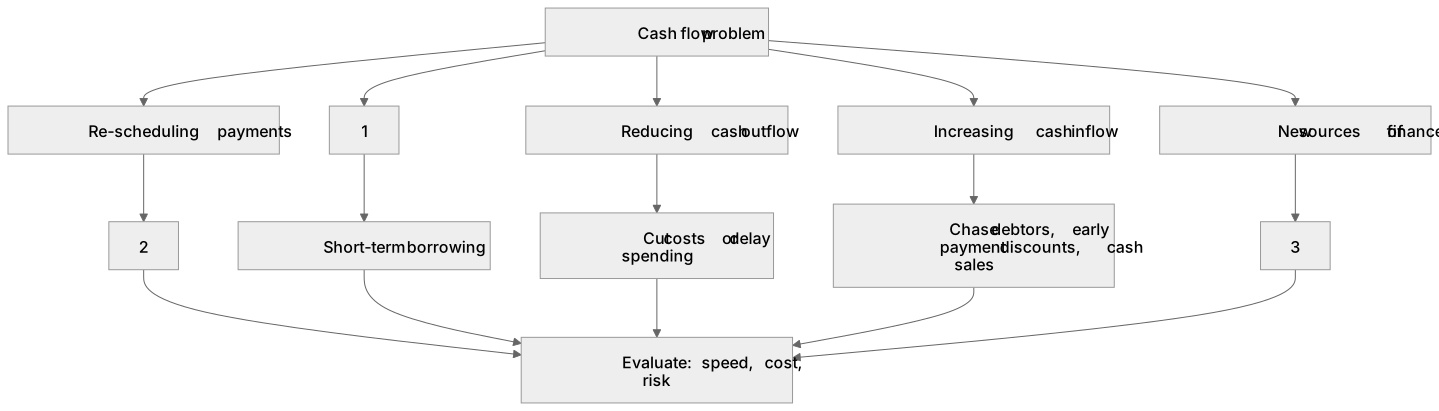
1Box 1
2Box 2
3Box 3
There is more to this lesson
The full lesson goes on to check your understanding and help you earn the marks. Create a free account to carry on, with your progress saved.
A week of Premium from your first lesson · Then the free plan continues · No card, no charge
Test your understanding of Cash flow: evaluate possible solutions to cash flow problems, including re-scheduling payments, overdrafts, reducing cash outflow, increasing cash inflow and finding new sources of finance.
Active recall beats re-reading. Take an instant quiz now to test what you’ve learned and lock it into long-term memory.
A week of Premium from your first lesson · Then the free plan continues · No card, no charge