AQA · GCSE · Business
Course version: 8132 · Version from Sept 2017
Analyse potential impacts of competition on businesses and identify…
Full specification wording
Competitive environment: analyse potential impacts of competition on businesses and identify situations when businesses face minimal or no competition
Competition affects a business through price, demand, costs and decision-making.
Checked against the AQA 8132 specification (opens in a new tab) on .
- Point 4 of 6
- 2 key terms
Study notes
From the checked teaching notes for this specification point.
The idea
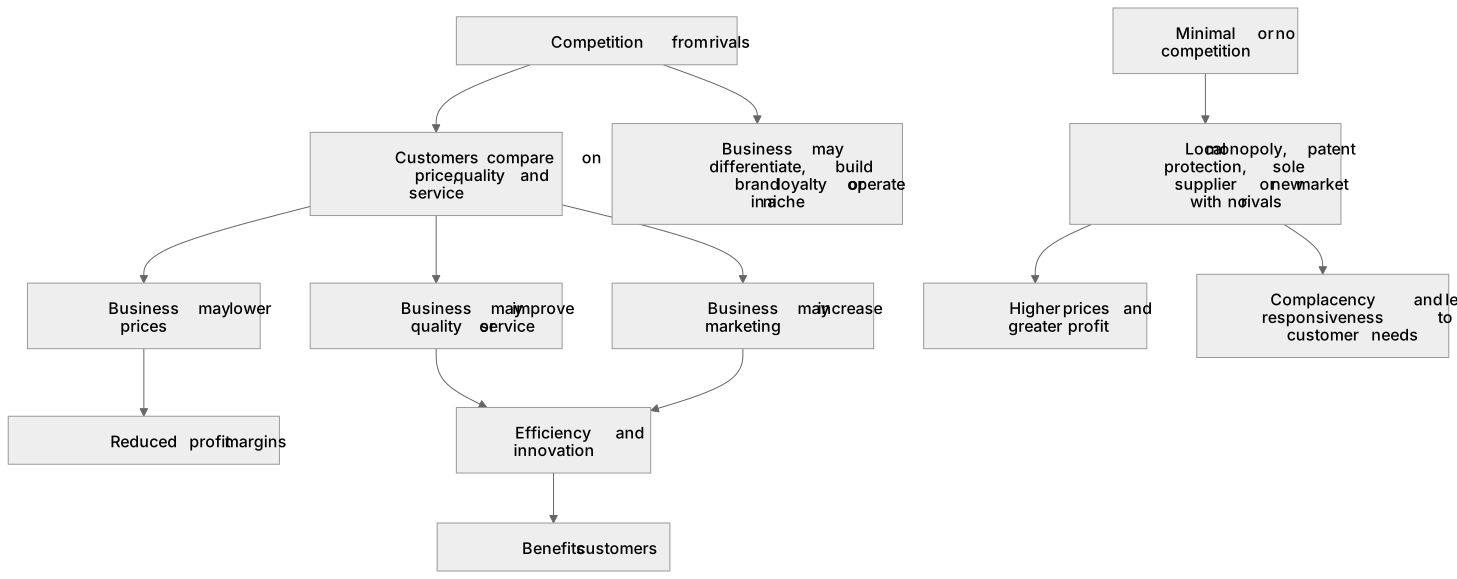
Competition affects a business through price, demand, costs and decision-making. When rivals offer similar products, customers compare on price, quality and service, so a business may lower prices, improve quality or increase marketing, which can reduce profit margins. Competition can also stimulate efficiency and innovation, benefiting customers. Conversely, a business may gain advantage by differentiating its product, building brand loyalty or operating in a niche. Some businesses face minimal or no competition: a local monopoly such as the only convenience store in a remote village; a patent-protected pharmaceutical; a sole supplier of a specialised industrial component; or a new market with no existing rivals. In these situations, the business may set higher prices and earn greater profit, but may also become complacent and less responsive to customer needs.
What earns the marks
- Explains that competition can lead to price reductions, which may lower profit margins if costs do not fall.
- Analyses how competition can drive improvements in product quality, customer service or marketing to attract and retain customers.
- Identifies that competition may encourage innovation and efficiency, benefiting customers and potentially increasing long-term competitiveness.
- Describes situations of minimal or no competition, such as a local monopoly, patent protection, sole supplier or a new market with no rivals.
- Explains that limited competition may allow higher prices and profits but can also lead to complacency and reduced customer focus.
- Applies the analysis to a given business context, considering its market, product and customer base.
Common mistakes and how to put them right
Assuming competition always harms a business.
Put it right: Competition can also stimulate improvement and market growth.
Confusing a monopoly with a competitive market.
Put it right: A monopoly exists when a single business dominates or is the sole supplier, so competition is minimal or absent.
Ignoring the effect of competition on costs and investment.
Put it right: Businesses may need to spend more on marketing or efficiency measures, affecting overall profitability.
Exam tips
- Use the command word 'analyse' to develop chains of reasoning: competition → lower prices → lower revenue per unit → reduced profit margin, unless costs fall or demand rises.
- When identifying minimal or no competition, refer to specific situations such as a local monopoly, patent protection or a niche market with no rivals.
- Apply your answer to the business in the question, using its product, market and customers to make the analysis relevant.
Try the lesson
The start of the Competitive environment: analyse potential impacts of competition on businesses and identify situations when businesses face minimal or no competition lesson, made from checked teaching notes for this specification point.
Have a go first
Which of the following situations is most likely to result in a business facing minimal or no competition?
Listen
Competition affects a business through price, demand, costs and decision-making. When rivals offer similar products, customers compare on price, quality and service, so a business may lower prices, improve quality or increase marketing, which can reduce profit margins. Competition can also stimulate efficiency and innovation, benefiting customers. Conversely, a business may gain advantage by differentiating its product, building brand loyalty or operating in a niche. Some businesses face minimal or no competition: a local monopoly such as the only convenience store in a remote village; a patent-protected pharmaceutical; a sole supplier of a specialised industrial component; or a new market with no existing rivals. In these situations, the business may set higher prices and earn greater profit, but may also become complacent and less responsive to customer needs. A strong answer earns marks for these points. Explains that competition can lead to price reductions, which may lower profit margins if costs do not fall. Analyses how competition can drive improvements in product quality, customer service or marketing to attract and retain customers. Identifies that competition may encourage innovation and efficiency, benefiting customers and potentially increasing long-term competitiveness. Describes situations of minimal or no competition, such as a local monopoly, patent protection, sole supplier or a new market with no rivals. A common slip: Assuming competition always harms a business. Instead, competition can also stimulate improvement and market growth. Exam tip: Use the command word 'analyse' to develop chains of reasoning: competition → lower prices → lower revenue per unit → reduced profit margin, unless costs fall or demand rises.
See it
Key words
Say what each word means before you turn the card.
Impact of competition on pricing and profitability
Try answering aloud or in your head before turning the card.
Situations of minimal or no competition
Try answering aloud or in your head before turning the card.
See every definition
- Impact of competition on pricing and profitability
- Rivals offering similar products lead customers to compare on price, quality and service, so a business may lower prices, which can reduce profit margins.
- Situations of minimal or no competition
- These include a local monopoly such as the only convenience store in a remote village, a patent-protected pharmaceutical, a sole supplier of a specialised industrial component, or a new market with no existing rivals.
Label the diagram
Some boxes have lost their names. Pick the right name for each number.
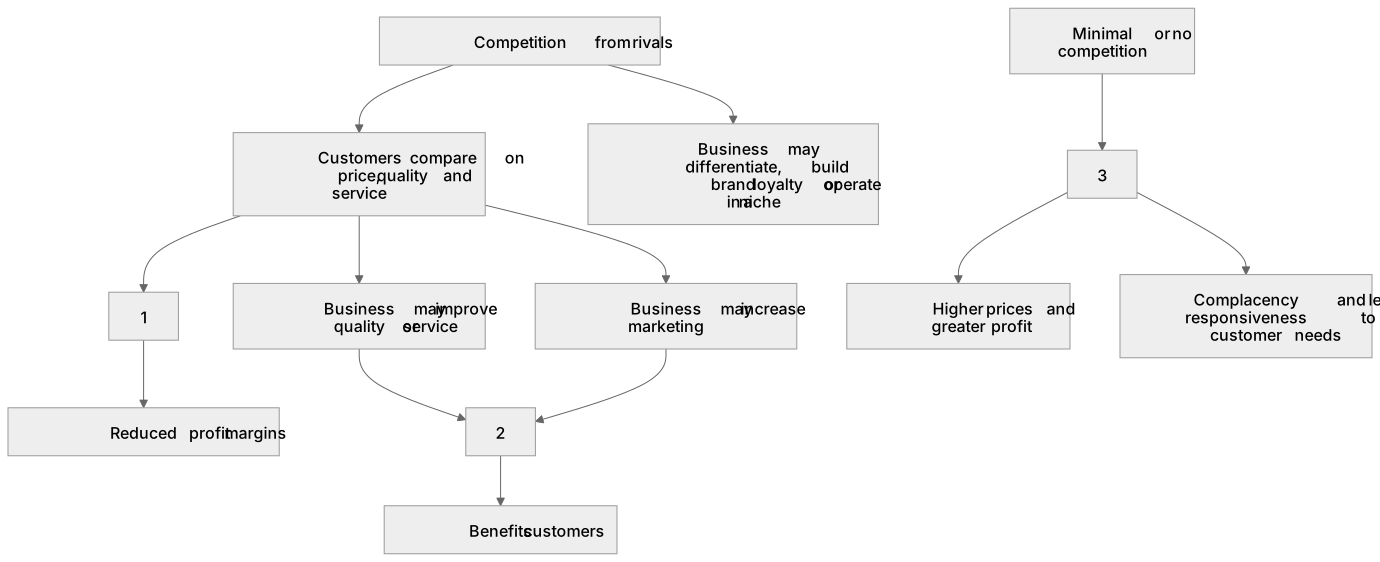
1Box 1
2Box 2
3Box 3
There is more to this lesson
The full lesson goes on to check your understanding and help you earn the marks. Create a free account to carry on, with your progress saved.
A week of Premium from your first lesson · Then the free plan continues · No card, no charge
Test your understanding of Competitive environment: analyse potential impacts of competition on businesses and identify situations when businesses face minimal or no competition
Active recall beats re-reading. Take an instant quiz now to test what you’ve learned and lock it into long-term memory.
A week of Premium from your first lesson · Then the free plan continues · No card, no charge