AQA · GCSE · Business
Course version: 8132 · Version from Sept 2017
Ethical considerations Students should be able to identify and analyse…
Full specification wording
Ethical and environmental considerations: Ethical considerations Students should be able to identify and analyse where there may be a possible trade off between ethics and profit.
Ethical considerations are the moral principles a business uses when deciding how to act.
Checked against the AQA 8132 specification (opens in a new tab) on .
- Point 1 of 13
- 4 key terms
Study notes
From the checked teaching notes for this specification point.
The idea
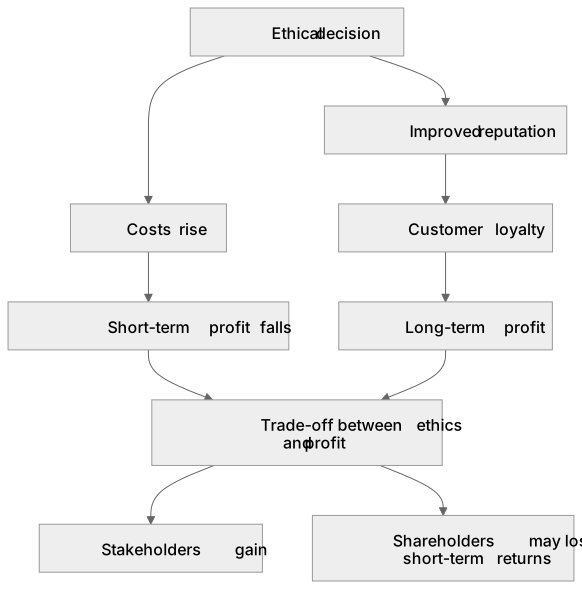
Ethical considerations are the moral principles a business uses when deciding how to act. Acting ethically can raise costs: fair pay, safe conditions, sustainable materials or animal welfare may reduce profit in the short term. A trade-off exists when improving one objective worsens another, so a business may accept lower profit to behave ethically, or accept ethical criticism to protect profit. For example, a clothing retailer switching to organic cotton may pay more per metre, raising unit cost and lowering gross profit margin, but may gain sales from ethically minded customers. Analysis weighs short-term profit loss against long-term reputation, customer loyalty and legal risk.
What earns the marks
- Defines ethical considerations as moral principles guiding business decisions, such as fairness, honesty and avoiding harm.
- Identifies a specific trade-off: an ethical action, such as paying above the minimum wage, increases costs and can reduce short-term profit.
- Analyses the trade-off by explaining consequences for the business, for example lower profit margin but improved reputation and customer loyalty.
- Uses a stakeholder perspective, showing that employees, customers, suppliers or local communities may gain while shareholders may lose short-term returns.
- Applies a business example, such as a café buying Fairtrade coffee at a higher price per kilogram and deciding whether to absorb the cost or raise prices.
- Evaluates the balance between ethics and profit, recognising that the outcome depends on customer response, cost size and time period.
Common mistakes and how to put them right
Treating ethics and profit as always opposed.
Put it right: Explain that ethical behaviour can raise long-term profit through reputation and repeat custom.
Listing ethical actions without analysing the trade-off.
Put it right: Link each action to a cost, benefit and effect on profit.
Ignoring stakeholders; correction: state who gains and who loses, such as employees gaining fair pay while owners receive lower dividends.
Assuming all customers will pay more for ethical products.
Put it right: Analyse demand sensitivity and the risk of losing price-sensitive customers.
Exam tips
- Use the command word: for identify, state the ethical issue and the profit effect; for analyse, develop a chain of cause and effect.
- Anchor answers in a named business or product so the trade-off is concrete rather than abstract.
- Refer to both short-term and long-term effects to show balanced analysis.
- Use business terms such as cost, revenue, profit margin, reputation and stakeholder to raise the quality of response.
Try the lesson
The start of the Ethical and environmental considerations: Ethical considerations Students should be able to identify and analyse where there may be a possible trade off between ethics and profit. lesson, made from checked teaching notes for this specification point.
Have a go first
Which of the following best describes a trade-off between ethics and profit for a clothing manufacturer?
Listen
Ethical considerations are the moral principles a business uses when deciding how to act. Acting ethically can raise costs: fair pay, safe conditions, sustainable materials or animal welfare may reduce profit in the short term. A trade-off exists when improving one objective worsens another, so a business may accept lower profit to behave ethically, or accept ethical criticism to protect profit. For example, a clothing retailer switching to organic cotton may pay more per metre, raising unit cost and lowering gross profit margin, but may gain sales from ethically minded customers. Analysis weighs short-term profit loss against long-term reputation, customer loyalty and legal risk. A strong answer earns marks for these points. Defines ethical considerations as moral principles guiding business decisions, such as fairness, honesty and avoiding harm. Identifies a specific trade-off: an ethical action, such as paying above the minimum wage, increases costs and can reduce short-term profit. Analyses the trade-off by explaining consequences for the business, for example lower profit margin but improved reputation and customer loyalty. Uses a stakeholder perspective, showing that employees, customers, suppliers or local communities may gain while shareholders may lose short-term returns. A common slip: Treating ethics and profit as always opposed. Instead, explain that ethical behaviour can raise long-term profit through reputation and repeat custom. Exam tip: Use the command word: for identify, state the ethical issue and the profit effect; for analyse, develop a chain of cause and effect.
See it
Key words
Say what each word means before you turn the card.
Ethics versus profit
Try answering aloud or in your head before turning the card.
Stakeholder impact
Try answering aloud or in your head before turning the card.
Cost and revenue consequences
Try answering aloud or in your head before turning the card.
Short-term versus long-term decision making
Try answering aloud or in your head before turning the card.
See every definition
- Ethics versus profit
- A possible trade off where acting on moral principles, such as fair pay or animal welfare, may reduce profit in the short term.
- Stakeholder impact
- The consequences of a decision for groups such as employees, customers, suppliers or local communities, who may gain while shareholders may lose short-term returns.
- Cost and revenue consequences
- An ethical action can raise costs, for example paying more per unit, while possibly gaining sales from ethically minded customers.
- Short-term versus long-term decision making
- Weighing short-term profit loss against long-term reputation, customer loyalty and legal risk.
Label the diagram
Some boxes have lost their names. Pick the right name for each number.
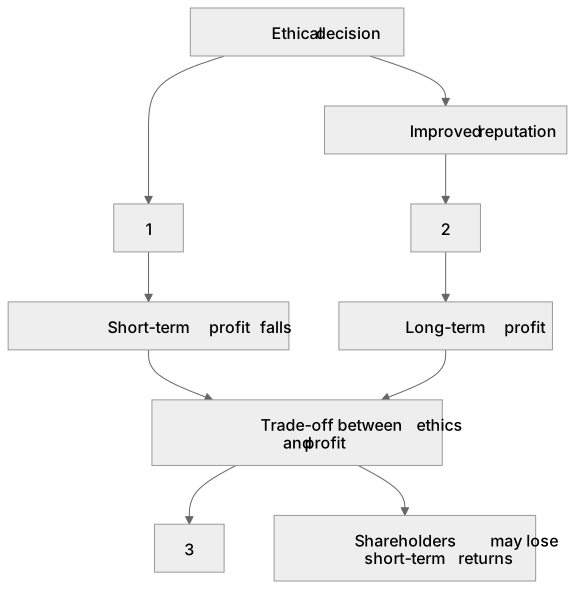
1Box 1
2Box 2
3Box 3
There is more to this lesson
The full lesson goes on to check your understanding and help you earn the marks. Create a free account to carry on, with your progress saved.
A week of Premium from your first lesson · Then the free plan continues · No card, no charge
Test your understanding of Ethical and environmental considerations: Ethical considerations Students should be able to identify and analyse where there may be a possible trade off between ethics and profit.
Active recall beats re-reading. Take an instant quiz now to test what you’ve learned and lock it into long-term memory.
A week of Premium from your first lesson · Then the free plan continues · No card, no charge