AQA · GCSE · Business
Course version: 8132 · Version from Sept 2017
Ethical behaviour requires businesses to act in ways that stakeholders…
Full specification wording
Ethical and environmental considerations: Ethical behaviour requires businesses to act in ways that stakeholders consider to be both fair and honest.
Ethical behaviour means acting fairly and honestly as judged by stakeholders.
Checked against the AQA 8132 specification (opens in a new tab) on .
- Point 2 of 13
- 4 key terms
Study notes
From the checked teaching notes for this specification point.
The idea
Ethical behaviour means acting fairly and honestly as judged by stakeholders. Fairness concerns equal treatment, just rewards and avoiding exploitation, such as paying at least the legal minimum wage and not using child labour. Honesty concerns truthfulness and transparency, such as accurate labelling, clear pricing and not making false environmental claims. Stakeholders include employees, customers, suppliers, investors, local communities and pressure groups. Because different stakeholders may disagree, a business must consider whose views matter and how to respond. For example, a food producer that labels a product as organic must ensure the claim is true; if it is false, customers feel misled and trust falls. Ethical behaviour is therefore assessed by stakeholder perception, not only by the business's own opinion.
What earns the marks
- Defines ethical behaviour as acting fairly and honestly according to stakeholder views.
- Explains fairness with examples such as fair pay, safe working conditions and equal treatment of employees.
- Explains honesty with examples such as truthful advertising, accurate product labelling and transparent pricing.
- Identifies relevant stakeholders, including employees, customers, suppliers, investors, local communities and pressure groups.
- Analyses how stakeholder perception affects business reputation, customer loyalty and sales.
- Evaluates that stakeholders may have conflicting views, so a business must judge which expectations to meet.
Common mistakes and how to put them right
Confusing ethical behaviour with legal compliance.
Put it right: Explain that an action can be legal but still considered unfair or dishonest by stakeholders.
Treating stakeholders as a single group.
Put it right: Identify different stakeholder groups and their possibly conflicting expectations.
Giving only one side of fairness or honesty.
Put it right: Cover both fairness and honesty with separate examples.
Assuming ethical behaviour always costs money.
Put it right: Analyse cases where honesty and fairness build trust and reduce staff turnover or customer complaints.
Exam tips
- Define both fairness and honesty before applying them to a business example.
- Name specific stakeholders and state what they expect, rather than referring vaguely to 'people'.
- Use a real or realistic scenario, such as a supermarket labelling local produce, to show stakeholder judgement.
- Link ethical behaviour to business outcomes such as reputation, trust, sales and employee motivation.
Try the lesson
The start of the Ethical and environmental considerations: Ethical behaviour requires businesses to act in ways that stakeholders consider to be both fair and honest. lesson, made from checked teaching notes for this specification point.
Have a go first
According to the concept of ethical behaviour, how should a business act towards its stakeholders?
Listen
Ethical behaviour means acting fairly and honestly as judged by stakeholders. Fairness concerns equal treatment, just rewards and avoiding exploitation, such as paying at least the legal minimum wage and not using child labour. Honesty concerns truthfulness and transparency, such as accurate labelling, clear pricing and not making false environmental claims. Stakeholders include employees, customers, suppliers, investors, local communities and pressure groups. Because different stakeholders may disagree, a business must consider whose views matter and how to respond. For example, a food producer that labels a product as organic must ensure the claim is true; if it is false, customers feel misled and trust falls. Ethical behaviour is therefore assessed by stakeholder perception, not only by the business's own opinion. A strong answer earns marks for these points. Defines ethical behaviour as acting fairly and honestly according to stakeholder views. Explains fairness with examples such as fair pay, safe working conditions and equal treatment of employees. Explains honesty with examples such as truthful advertising, accurate product labelling and transparent pricing. Identifies relevant stakeholders, including employees, customers, suppliers, investors, local communities and pressure groups. A common slip: Confusing ethical behaviour with legal compliance. Instead, explain that an action can be legal but still considered unfair or dishonest by stakeholders. Exam tip: Define both fairness and honesty before applying them to a business example.
See it
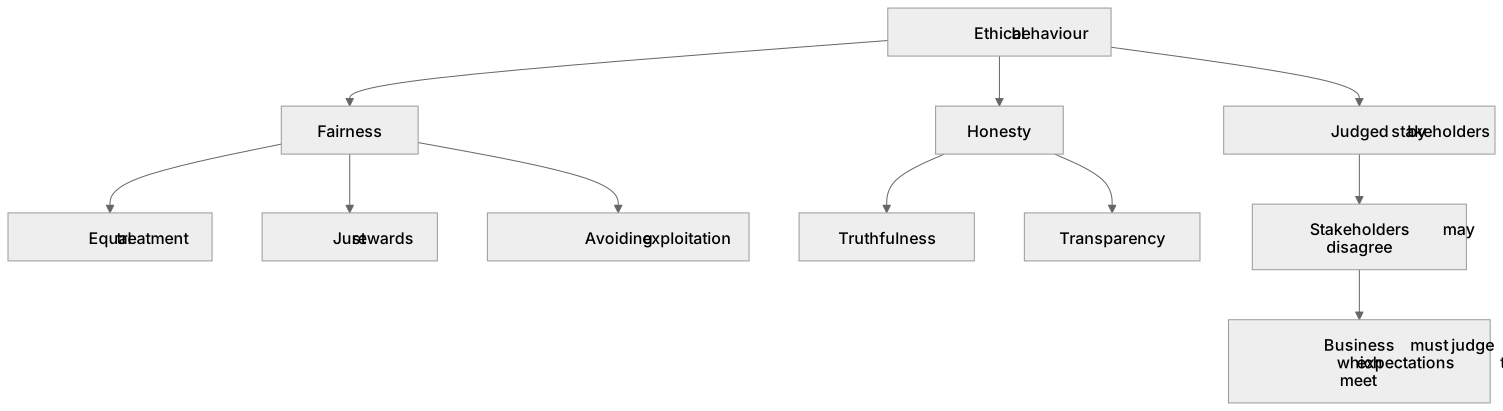
Key words
Say what each word means before you turn the card.
Ethical behaviour
Try answering aloud or in your head before turning the card.
Fairness
Try answering aloud or in your head before turning the card.
Honesty
Try answering aloud or in your head before turning the card.
Stakeholders
Try answering aloud or in your head before turning the card.
See every definition
- Ethical behaviour
- Acting in ways that stakeholders consider to be both fair and honest.
- Fairness
- Concerns equal treatment, just rewards and avoiding exploitation, such as paying at least the legal minimum wage and not using child labour.
- Honesty
- Concerns truthfulness and transparency, such as accurate labelling, clear pricing and not making false environmental claims.
- Stakeholders
- Include employees, customers, suppliers, investors, local communities and pressure groups.
Label the diagram
Some boxes have lost their names. Pick the right name for each number.
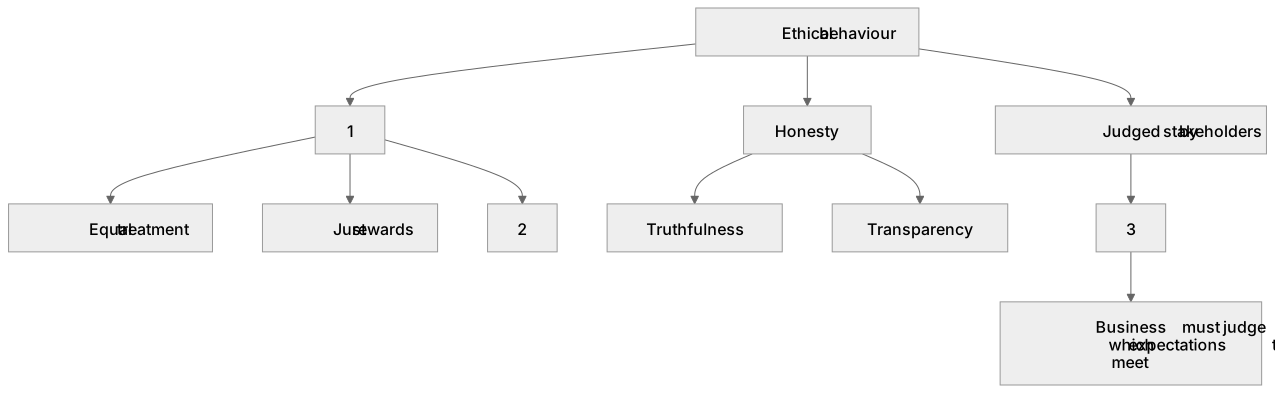
1Box 1
2Box 2
3Box 3
There is more to this lesson
The full lesson goes on to check your understanding and help you earn the marks. Create a free account to carry on, with your progress saved.
A week of Premium from your first lesson · Then the free plan continues · No card, no charge
Test your understanding of Ethical and environmental considerations: Ethical behaviour requires businesses to act in ways that stakeholders consider to be both fair and honest.
Active recall beats re-reading. Take an instant quiz now to test what you’ve learned and lock it into long-term memory.
A week of Premium from your first lesson · Then the free plan continues · No card, no charge