AQA · GCSE · Business
Course version: 8132 · Version from Sept 2017
Students are expected to know relevant examples of ways in which a…
Full specification wording
Ethical and environmental considerations: Students are expected to know relevant examples of ways in which a business can behave ethically and the benefits and drawbacks of ethical behaviour.
Ethical behaviour means acting on moral principles beyond what the law demands.
Checked against the AQA 8132 specification (opens in a new tab) on .
- Point 3 of 13
- 4 key terms
Study notes
From the checked teaching notes for this specification point.
The idea
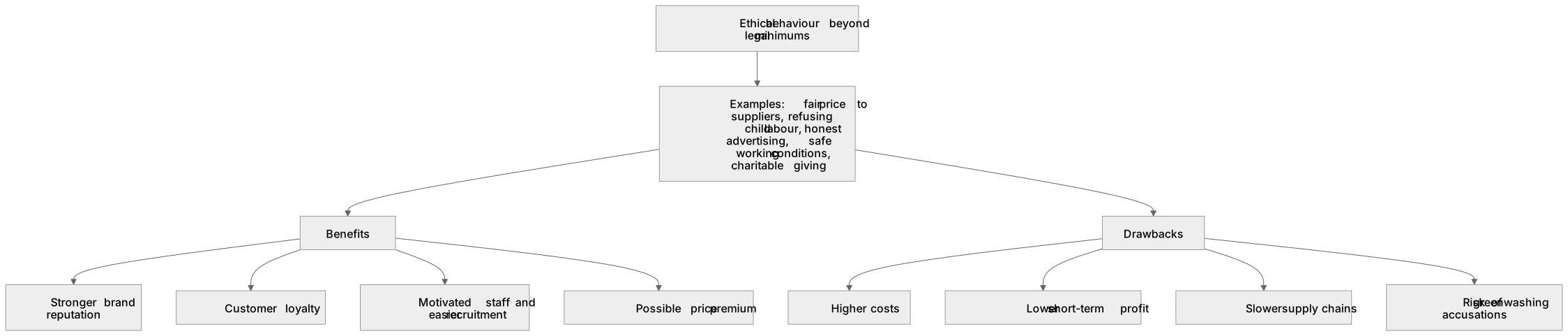
Ethical behaviour means acting on moral principles beyond what the law demands. Examples include paying suppliers a fair price, refusing child labour, honest advertising, safe working conditions and charitable giving. A business may source Fairtrade cocoa, audit overseas factories or publish supply-chain reports. Benefits: stronger brand reputation, customer loyalty, motivated staff, easier recruitment and possible price premium. Drawbacks: higher costs, lower short-term profit, slower supply chains and risk of accusations of greenwashing if claims are not genuine. Assessment requires applying an example to a named business and weighing both sides before judging.
What earns the marks
- Identifies a specific ethical action, such as paying above the minimum wage or using Fairtrade suppliers, rather than a vague statement about being nice.
- Explains how the action affects a stakeholder group, for example customers, employees or overseas suppliers.
- Develops a benefit with a chain of reasoning, such as ethical sourcing improving brand reputation, which raises repeat purchases and revenue.
- Develops a drawback with a chain of reasoning, such as higher ingredient costs reducing profit margins if prices cannot be raised.
- Applies the point to the context given in the question, for example a named supermarket or clothing retailer.
- Reaches a supported judgement that weighs the benefit against the drawback for that specific business.
Common mistakes and how to put them right
Confusing ethical behaviour with illegal behaviour.
Put it right: Ethical choices go beyond legal minimums, so a lawful decision can still be unethical.
Listing benefits without any consequence.
Put it right: Extend each point into an effect on costs, revenue, reputation or staff.
Treating all ethical actions as cost-free.
Put it right: Recognise that ethical sourcing, audits and safer conditions usually raise business costs.
Exam tips
- Anchor each example to a named business or industry so the answer is applied rather than generic.
- Use connectives such as therefore and which means to build cause-and-effect chains instead of isolated points.
- Finish with a short judgement that states which effect is likely to matter most and why, rather than repeating both sides.
Try the lesson
The start of the Ethical and environmental considerations: Students are expected to know relevant examples of ways in which a business can behave ethically and the benefits and drawbacks of ethical behaviour. lesson, made from checked teaching notes for this specification point.
Have a go first
Which of the following is an example of a business behaving ethically towards its workers?
Listen
Ethical behaviour means acting on moral principles beyond what the law demands. Examples include paying suppliers a fair price, refusing child labour, honest advertising, safe working conditions and charitable giving. A business may source Fairtrade cocoa, audit overseas factories or publish supply-chain reports. Benefits: stronger brand reputation, customer loyalty, motivated staff, easier recruitment and possible price premium. Drawbacks: higher costs, lower short-term profit, slower supply chains and risk of accusations of greenwashing if claims are not genuine. Assessment requires applying an example to a named business and weighing both sides before judging. A strong answer earns marks for these points. Identifies a specific ethical action, such as paying above the minimum wage or using Fairtrade suppliers, rather than a vague statement about being nice. Explains how the action affects a stakeholder group, for example customers, employees or overseas suppliers. Develops a benefit with a chain of reasoning, such as ethical sourcing improving brand reputation, which raises repeat purchases and revenue. Develops a drawback with a chain of reasoning, such as higher ingredient costs reducing profit margins if prices cannot be raised. A common slip: Confusing ethical behaviour with illegal behaviour. Instead, ethical choices go beyond legal minimums, so a lawful decision can still be unethical. Exam tip: Anchor each example to a named business or industry so the answer is applied rather than generic.
See it
Key words
Say what each word means before you turn the card.
Ethical behaviour
Try answering aloud or in your head before turning the card.
Stakeholder impact
Try answering aloud or in your head before turning the card.
Costs versus reputation benefits
Try answering aloud or in your head before turning the card.
Applied judgement in context
Try answering aloud or in your head before turning the card.
See every definition
- Ethical behaviour
- Acting on moral principles beyond what the law demands, such as paying suppliers a fair price or refusing child labour.
- Stakeholder impact
- How an ethical action affects a stakeholder group, for example customers, employees or overseas suppliers.
- Costs versus reputation benefits
- Higher costs and lower short-term profit weighed against stronger brand reputation, customer loyalty and a possible price premium.
- Applied judgement in context
- Weighing the benefit against the drawback for a specific named business before reaching a supported judgement.
Label the diagram
Some boxes have lost their names. Pick the right name for each number.
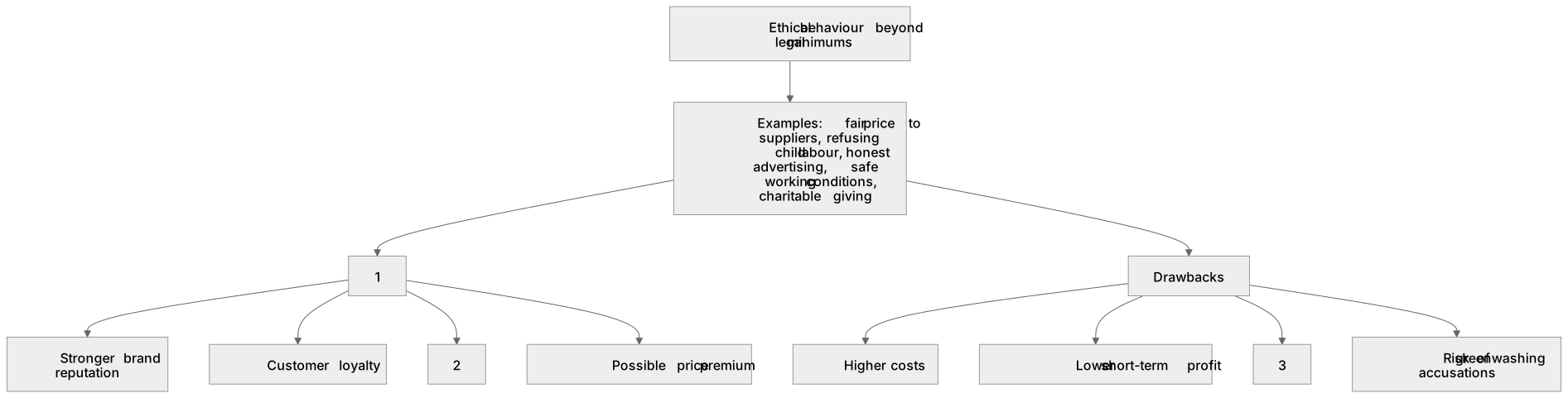
1Box 1
2Box 2
3Box 3
There is more to this lesson
The full lesson goes on to check your understanding and help you earn the marks. Create a free account to carry on, with your progress saved.
A week of Premium from your first lesson · Then the free plan continues · No card, no charge
Test your understanding of Ethical and environmental considerations: Students are expected to know relevant examples of ways in which a business can behave ethically and the benefits and drawbacks of ethical behaviour.
Active recall beats re-reading. Take an instant quiz now to test what you’ve learned and lock it into long-term memory.
A week of Premium from your first lesson · Then the free plan continues · No card, no charge