AQA · GCSE · Business
Course version: 8132 · Version from Sept 2017
Students should be able to demonstrate knowledge and understanding of how…
Full specification wording
Ethical and environmental considerations: Students should be able to demonstrate knowledge and understanding of how business and consumers accept greater environmental responsibility in their decision making and the costs and benefits of businesses behaving this way.
Environmental responsibility means choosing options that reduce harm to the natural world.
Checked against the AQA 8132 specification (opens in a new tab) on .
- Point 5 of 13
- 4 key terms
Study notes
From the checked teaching notes for this specification point.
The idea
Environmental responsibility means choosing options that reduce harm to the natural world. Consumers show it by buying recycled or refillable goods, cutting food waste, using public transport or choosing energy-efficient appliances. Businesses show it by designing recyclable packaging, sourcing sustainable materials, cutting energy use, reducing emissions and managing waste lawfully. Decision making changes because environmental factors join price, quality and convenience in the choice. Behaving responsibly brings benefits: lower energy and waste bills, stronger brand reputation, loyal customers, motivated staff and fewer legal penalties. Costs include buying greener machinery, retraining staff, slower or dearer sourcing and higher prices that may deter some buyers. A café switching to compostable cups pays more per cup but may attract customers who value low waste.
What earns the marks
- Explains how consumers accept greater environmental responsibility, for example choosing products with less packaging, recycling, buying second-hand or selecting energy-efficient goods.
- Explains how businesses accept greater environmental responsibility, for example using sustainable raw materials, reducing packaging, cutting carbon emissions or recycling waste.
- Shows how environmental responsibility changes decision making, such as weighing environmental impact alongside price, quality and convenience.
- Identifies a benefit of responsible behaviour, such as lower energy and waste costs, improved reputation, customer loyalty or reduced risk of fines.
- Identifies a cost of responsible behaviour, such as investment in greener equipment, higher material prices, staff training or possible price rises.
- Uses a business example to show the trade-off between environmental benefits and added costs.
Common mistakes and how to put them right
Treating environmental responsibility as cost-free.
Put it right by explaining that greener inputs, equipment and processes usually require upfront spending.
Assuming all consumers will pay more for green products.
Put it right by noting that demand depends on price sensitivity and the size of the price premium.
Confusing ethical and environmental considerations.
Put it right by linking environmental points to harm to the natural world, such as pollution, waste and resource use.
Exam tips
- Define the term briefly, then apply it to the business in the case before analysing effects.
- Develop each cost or benefit through a chain of reasoning, for example higher costs leading to a higher selling price and possible loss of sales.
- Use case details such as the product, market and customer type to justify whether responsible behaviour is worthwhile.
Try the lesson
The start of the Ethical and environmental considerations: Students should be able to demonstrate knowledge and understanding of how business and consumers accept greater environmental responsibility in their decision making and the costs and benefits of businesses behaving this way. lesson, made from checked teaching notes for this specification point.
Have a go first
Which of the following is an example of a consumer accepting greater environmental responsibility when making a decision?
Listen
Environmental responsibility means choosing options that reduce harm to the natural world. Consumers show it by buying recycled or refillable goods, cutting food waste, using public transport or choosing energy-efficient appliances. Businesses show it by designing recyclable packaging, sourcing sustainable materials, cutting energy use, reducing emissions and managing waste lawfully. Decision making changes because environmental factors join price, quality and convenience in the choice. Behaving responsibly brings benefits: lower energy and waste bills, stronger brand reputation, loyal customers, motivated staff and fewer legal penalties. Costs include buying greener machinery, retraining staff, slower or dearer sourcing and higher prices that may deter some buyers. A café switching to compostable cups pays more per cup but may attract customers who value low waste. A strong answer earns marks for these points. Explains how consumers accept greater environmental responsibility, for example choosing products with less packaging, recycling, buying second-hand or selecting energy-efficient goods. Explains how businesses accept greater environmental responsibility, for example using sustainable raw materials, reducing packaging, cutting carbon emissions or recycling waste. Shows how environmental responsibility changes decision making, such as weighing environmental impact alongside price, quality and convenience. Identifies a benefit of responsible behaviour, such as lower energy and waste costs, improved reputation, customer loyalty or reduced risk of fines. A common slip: Treating environmental responsibility as cost-free. Instead, explaining that greener inputs, equipment and processes usually require upfront spending. Exam tip: Define the term briefly, then apply it to the business in the case before analysing effects.
See it

Key words
Say what each word means before you turn the card.
Environmental responsibility
Try answering aloud or in your head before turning the card.
Consumer decision making
Try answering aloud or in your head before turning the card.
Business costs
Try answering aloud or in your head before turning the card.
Business benefits
Try answering aloud or in your head before turning the card.
See every definition
- Environmental responsibility
- Choosing options that reduce harm to the natural world.
- Consumer decision making
- Changes because environmental factors join price, quality and convenience in the choice.
- Business costs
- Include buying greener machinery, retraining staff, slower or dearer sourcing and higher prices that may deter some buyers.
- Business benefits
- Include lower energy and waste bills, stronger brand reputation, loyal customers, motivated staff and fewer legal penalties.
Label the diagram
Some boxes have lost their names. Pick the right name for each number.
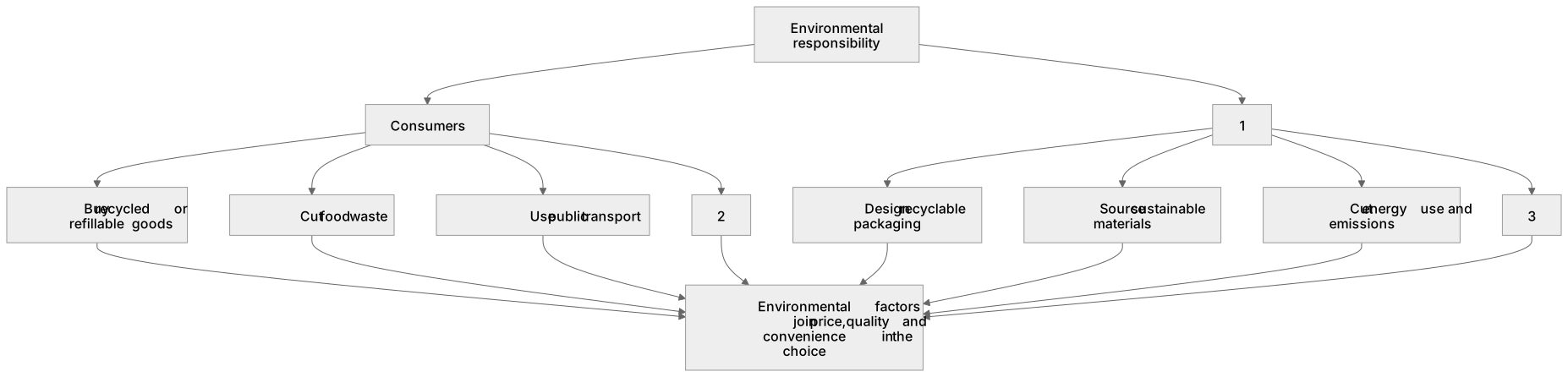
1Box 1
2Box 2
3Box 3
There is more to this lesson
The full lesson goes on to check your understanding and help you earn the marks. Create a free account to carry on, with your progress saved.
A week of Premium from your first lesson · Then the free plan continues · No card, no charge
Test your understanding of Ethical and environmental considerations: Students should be able to demonstrate knowledge and understanding of how business and consumers accept greater environmental responsibility in their decision making and the costs and benefits of businesses behaving this way.
Active recall beats re-reading. Take an instant quiz now to test what you’ve learned and lock it into long-term memory.
A week of Premium from your first lesson · Then the free plan continues · No card, no charge