AQA · GCSE · Business
Course version: 8132 · Version from Sept 2017
Ethical and environmental considerations: impact on traffic congestion
Traffic congestion occurs when too many vehicles use a road network at the same time, so journeys slow down and queues build.
Checked against the AQA 8132 specification (opens in a new tab) on .
- Point 6 of 13
- 3 key terms
Study notes
From the checked teaching notes for this specification point.
The idea
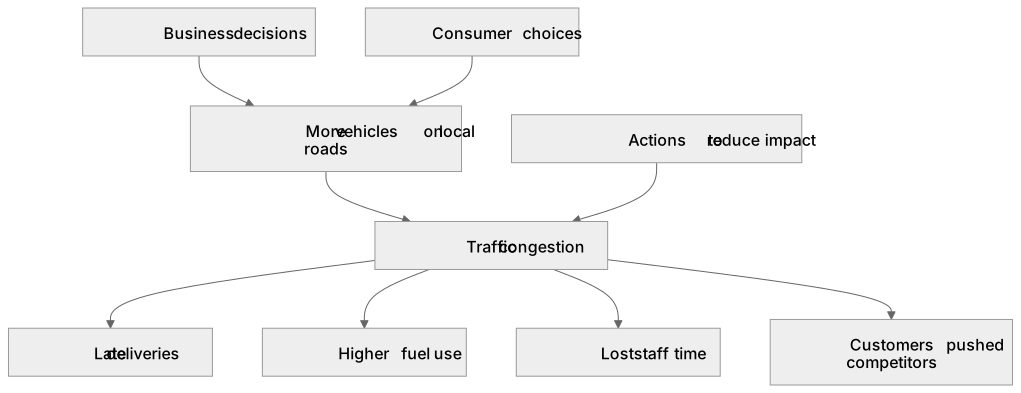
Traffic congestion occurs when too many vehicles use a road network at the same time, so journeys slow down and queues build. Business decisions affect congestion: locating a large store or warehouse out of town, running frequent delivery vans or offering click-and-collect can add vehicles to local roads. Congestion raises business costs through late deliveries, higher fuel use and lost staff time, and it can push customers towards competitors. Consumers also influence congestion by choosing car travel, public transport, cycling or online delivery. A business can reduce its impact by consolidating deliveries into fewer fuller loads, routing vehicles efficiently, encouraging home working or supporting public transport for staff. These actions may cut fuel and time costs and improve local goodwill, but they can require investment and may slow some deliveries.
What earns the marks
- Defines traffic congestion as too many vehicles using a road network at the same time, causing delays and queues.
- Explains how business decisions such as out-of-town locations, frequent deliveries or click-and-collect can increase traffic congestion.
- Explains how consumer choices such as car use, public transport, cycling or online ordering affect congestion levels.
- Analyses the business impact of congestion, such as late deliveries, higher fuel costs, lost staff time or reduced customer numbers.
- Evaluates ways a business can reduce congestion, such as consolidating deliveries, efficient routing, or flexible working.
- Weighs the benefits of reducing congestion against the costs, such as investment in new logistics software or changes to delivery schedules.
Common mistakes and how to put them right
Describing congestion only as a general problem for society.
Put it right by linking it to specific business costs such as delayed deliveries and higher fuel use.
Claiming that online shopping always removes traffic.
Put it right by noting that home delivery vans can add to congestion even when shoppers stay at home.
Suggesting that switching to electric vehicles reduces congestion.
Put it right by explaining that while EVs reduce emissions, they take up the same road space and do not ease congestion.
Exam tips
- Link each congestion point to a named business decision or consumer choice from the case.
- Develop the consequence step by step, for example congestion causing late deliveries, which damages customer satisfaction and repeat sales.
Try the lesson
The start of the Ethical and environmental considerations: impact on traffic congestion lesson, made from checked teaching notes for this specification point.
Have a go first
A large supermarket opens a new store on the edge of a busy town. Which of the following is the most likely impact of this business activity on local traffic congestion?
Listen
Traffic congestion occurs when too many vehicles use a road network at the same time, so journeys slow down and queues build. Business decisions affect congestion: locating a large store or warehouse out of town, running frequent delivery vans or offering click-and-collect can add vehicles to local roads. Congestion raises business costs through late deliveries, higher fuel use and lost staff time, and it can push customers towards competitors. Consumers also influence congestion by choosing car travel, public transport, cycling or online delivery. A business can reduce its impact by consolidating deliveries into fewer fuller loads, routing vehicles efficiently, encouraging home working or supporting public transport for staff. These actions may cut fuel and time costs and improve local goodwill, but they can require investment and may slow some deliveries. A strong answer earns marks for these points. Defines traffic congestion as too many vehicles using a road network at the same time, causing delays and queues. Explains how business decisions such as out-of-town locations, frequent deliveries or click-and-collect can increase traffic congestion. Explains how consumer choices such as car use, public transport, cycling or online ordering affect congestion levels. Analyses the business impact of congestion, such as late deliveries, higher fuel costs, lost staff time or reduced customer numbers. A common slip: Describing congestion only as a general problem for society. Instead, linking it to specific business costs such as delayed deliveries and higher fuel use. Exam tip: Link each congestion point to a named business decision or consumer choice from the case.
See it
Key words
Say what each word means before you turn the card.
Traffic congestion
Try answering aloud or in your head before turning the card.
Business location
Try answering aloud or in your head before turning the card.
Delivery and logistics
Try answering aloud or in your head before turning the card.
See every definition
- Traffic congestion
- Occurs when too many vehicles use a road network at the same time, so journeys slow down and queues build.
- Business location
- Locating a large store or warehouse out of town can add vehicles to local roads.
- Delivery and logistics
- Consolidating deliveries into fewer fuller loads and routing vehicles efficiently can reduce a business's impact on congestion.
Label the diagram
Some boxes have lost their names. Pick the right name for each number.
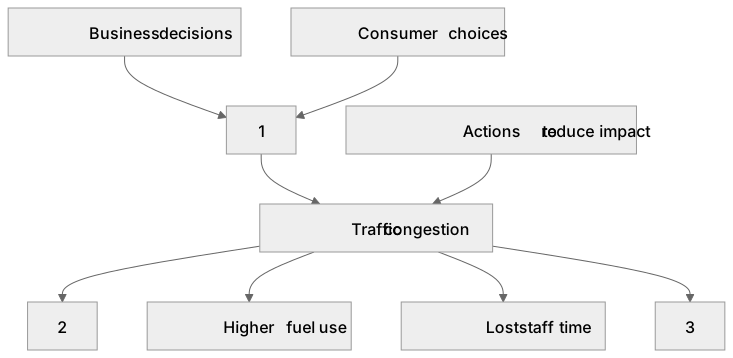
1Box 1
2Box 2
3Box 3
There is more to this lesson
The full lesson goes on to check your understanding and help you earn the marks. Create a free account to carry on, with your progress saved.
A week of Premium from your first lesson · Then the free plan continues · No card, no charge
Test your understanding of Ethical and environmental considerations: impact on traffic congestion
Active recall beats re-reading. Take an instant quiz now to test what you’ve learned and lock it into long-term memory.
A week of Premium from your first lesson · Then the free plan continues · No card, no charge