AQA · GCSE · Business
Course version: 8132 · Version from Sept 2017
Ethical and environmental considerations: using scarce resources.
Scarce resources are inputs with limited availability relative to unlimited wants, such as raw materials, energy, water, land and skilled labour.
Checked against the AQA 8132 specification (opens in a new tab) on .
- Point 13 of 13
- 4 key terms
Study notes
From the checked teaching notes for this specification point.
The idea
Scarce resources are inputs with limited availability relative to unlimited wants, such as raw materials, energy, water, land and skilled labour. In an ethical and environmental context, a business that uses scarce resources must decide how to allocate them responsibly. For example, a furniture maker using oak from slow-growing forests could reduce waste by optimising cutting patterns, reuse offcuts for smaller products, and source certified timber. This lowers environmental damage and long-term cost exposure while supporting reputation. The skill is to identify which resources are scarce, explain why their use matters ethically and environmentally, and evaluate trade-offs between profit, stakeholder expectations and sustainability. Assessment rewards applied reasoning about specific resources and consequences, not generic statements that resources are limited.
What earns the marks
- Defines scarce resources as inputs whose supply is limited relative to demand, giving examples such as timber, water, energy or skilled labour.
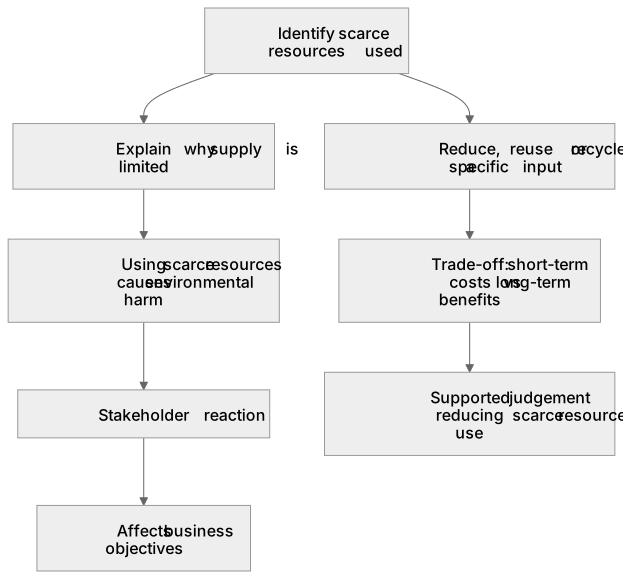
- Explains how using scarce resources can cause environmental harm, for example deforestation, water depletion or greenhouse gas emissions.
- Applies the concept to a business context, showing how a named business could reduce, reuse or recycle a specific scarce input.
- Analyses the trade-off between short-term costs of responsible resource use and long-term benefits such as lower waste, resilience and reputation.
- Evaluates how ethical and environmental considerations may conflict with profit maximisation when scarce resources are cheap in the short term.
- Reaches a supported judgement on whether a business should prioritise reducing scarce resource use, referring to stakeholders and context.
Common mistakes and how to put them right
Treating all resources as equally scarce.
Put it right: Identify the specific resource and explain why its supply is limited, such as freshwater in a drought-prone region.
Confusing scarce resources with free goods.
Put it right: State that scarce resources have an opportunity cost because they could be used for an alternative purpose.
Giving only environmental benefits without business consequences.
Put it right: Link reduced resource use to costs, legal compliance, reputation or customer demand.
Exam tips
- Name the scarce resource explicitly in each application point so the examiner can see contextual understanding.
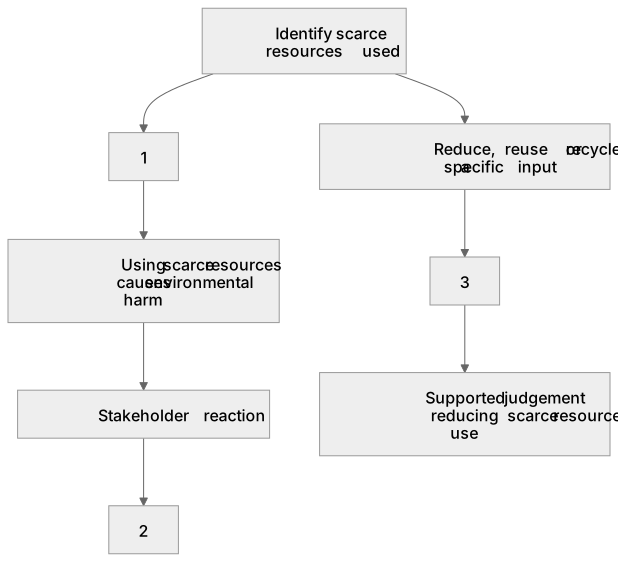
- Use a cause-and-effect chain: scarce resource use leads to environmental pressure, which leads to stakeholder reaction, which affects business objectives.
- For evaluation, compare at least two options and state a justified recommendation rather than listing advantages and disadvantages.
Try the lesson
The start of the Ethical and environmental considerations: using scarce resources. lesson, made from checked teaching notes for this specification point.
Have a go first
What does it mean when a business is described as using scarce resources?
Listen
Scarce resources are inputs with limited availability relative to unlimited wants, such as raw materials, energy, water, land and skilled labour. In an ethical and environmental context, a business that uses scarce resources must decide how to allocate them responsibly. For example, a furniture maker using oak from slow-growing forests could reduce waste by optimising cutting patterns, reuse offcuts for smaller products, and source certified timber. This lowers environmental damage and long-term cost exposure while supporting reputation. The skill is to identify which resources are scarce, explain why their use matters ethically and environmentally, and evaluate trade-offs between profit, stakeholder expectations and sustainability. Assessment rewards applied reasoning about specific resources and consequences, not generic statements that resources are limited. A strong answer earns marks for these points. Defines scarce resources as inputs whose supply is limited relative to demand, giving examples such as timber, water, energy or skilled labour. Explains how using scarce resources can cause environmental harm, for example deforestation, water depletion or greenhouse gas emissions. Applies the concept to a business context, showing how a named business could reduce, reuse or recycle a specific scarce input. Analyses the trade-off between short-term costs of responsible resource use and long-term benefits such as lower waste, resilience and reputation. A common slip: Treating all resources as equally scarce. Instead, identify the specific resource and explain why its supply is limited, such as freshwater in a drought-prone region. Exam tip: Name the scarce resource explicitly in each application point so the examiner can see contextual understanding.
See it
Key words
Say what each word means before you turn the card.
Scarce resources
Try answering aloud or in your head before turning the card.
Sustainability and resource stewardship
Try answering aloud or in your head before turning the card.
Ethical decision-making and stakeholder impact
Try answering aloud or in your head before turning the card.
Trade-offs between profit and environmental responsibility
Try answering aloud or in your head before turning the card.
See every definition
- Scarce resources
- Inputs whose supply is limited relative to demand, such as timber, water, energy or skilled labour.
- Sustainability and resource stewardship
- Allocating scarce resources responsibly so that environmental damage and long-term cost exposure are lowered while reputation is supported.
- Ethical decision-making and stakeholder impact
- Deciding how to allocate scarce resources responsibly, taking account of stakeholder expectations alongside profit and sustainability.
- Trade-offs between profit and environmental responsibility
- Weighing the short-term costs of responsible resource use against long-term benefits such as lower waste, resilience and reputation.
Label the diagram
Some boxes have lost their names. Pick the right name for each number.
1Box 1
2Box 2
3Box 3
There is more to this lesson
The full lesson goes on to check your understanding and help you earn the marks. Create a free account to carry on, with your progress saved.
A week of Premium from your first lesson · Then the free plan continues · No card, no charge
Test your understanding of Ethical and environmental considerations: using scarce resources.
Active recall beats re-reading. Take an instant quiz now to test what you’ve learned and lock it into long-term memory.
A week of Premium from your first lesson · Then the free plan continues · No card, no charge