AQA · GCSE · Business
Course version: 8132 · Version from Sept 2017
Expanding a business: calculate and interpret average unit costs.
Average unit cost is total cost divided by output: AUC = total cost ÷ quantity produced.
Checked against the AQA 8132 specification (opens in a new tab) on .
- Point 10 of 10
- 3 key terms
Study notes
From the checked teaching notes for this specification point.
The idea
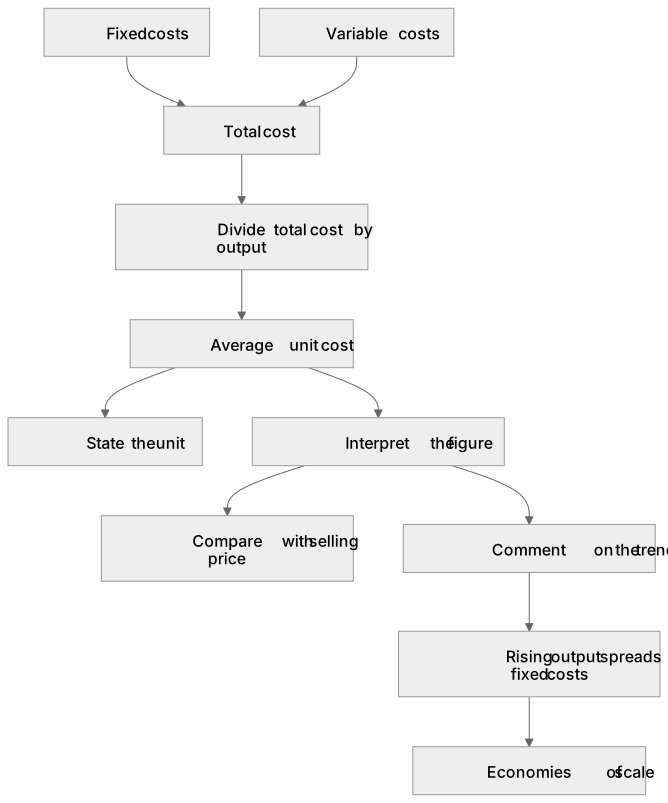
Average unit cost is total cost divided by output: AUC = total cost ÷ quantity produced. If a bakery's total costs are £4,800 for 1,200 loaves, AUC = £4,800 ÷ 1,200 = £4.00 per loaf. Total cost combines fixed costs, which do not vary with output, and variable costs, which do. Interpretation means explaining what the figure shows: whether unit costs are falling as output rises, how they compare with the selling price, and what that implies for profit and competitiveness. Expansion often lowers average unit costs because fixed costs are spread over more units, giving economies of scale. Always state the unit, such as £ per item, and comment on the trend rather than only the number.
What earns the marks
- Correctly identify total cost as fixed costs plus variable costs before dividing by output.
- Divide total cost by the number of units produced, showing the calculation clearly.
- State the result with the correct unit, for example £ per unit or pence per unit.
- Interpret the figure by comparing it with selling price to judge whether each sale contributes to profit.
- Explain how rising output can spread fixed costs and reduce average unit cost, linking to economies of scale.
- Use the result to support a judgement about expansion, pricing or competitiveness.
Common mistakes and how to put them right
Dividing output by total cost instead of total cost by output.
Put it right by writing AUC = total cost ÷ output and checking the answer is a sensible cost per unit.
Forgetting to include fixed costs in total cost.
Put it right by adding fixed and variable costs before dividing.
Giving a bare number with no unit or interpretation.
Put it right by adding the unit and one sentence explaining what the figure means for the business.
Exam tips
- Show the substitution line, for example £4,800 ÷ 1,200, so method is visible even if the final figure slips.
- Round money to two decimal places and always attach the unit, such as £4.00 per loaf.
- Add one interpretive sentence linking the result to price, profit or the effect of expansion to reach the higher bands.
Try the lesson
The start of the Expanding a business: calculate and interpret average unit costs. lesson, made from checked teaching notes for this specification point.
Have a go first
A bakery has total costs of £4,000 for the month and produces 2,000 loaves. What is the average unit cost of one loaf?
Listen
Average unit cost is total cost divided by output: AUC = total cost ÷ quantity produced. If a bakery's total costs are £4,800 for 1,200 loaves, AUC = £4,800 ÷ 1,200 = £4.00 per loaf. Total cost combines fixed costs, which do not vary with output, and variable costs, which do. Interpretation means explaining what the figure shows: whether unit costs are falling as output rises, how they compare with the selling price, and what that implies for profit and competitiveness. Expansion often lowers average unit costs because fixed costs are spread over more units, giving economies of scale. Always state the unit, such as £ per item, and comment on the trend rather than only the number. A strong answer earns marks for these points. Correctly identify total cost as fixed costs plus variable costs before dividing by output. Divide total cost by the number of units produced, showing the calculation clearly. State the result with the correct unit, for example £ per unit or pence per unit. Interpret the figure by comparing it with selling price to judge whether each sale contributes to profit. A common slip: Dividing output by total cost instead of total cost by output. Instead, writing AUC = total cost ÷ output and checking the answer is a sensible cost per unit. Exam tip: Show the substitution line, for example £4,800 ÷ 1,200, so method is visible even if the final figure slips.
See it
Key words
Say what each word means before you turn the card.
Average unit cost
Try answering aloud or in your head before turning the card.
Fixed costs
Try answering aloud or in your head before turning the card.
Variable costs
Try answering aloud or in your head before turning the card.
See every definition
- Average unit cost
- Total cost divided by output, written as AUC = total cost ÷ quantity produced.
- Fixed costs
- Costs which do not vary with output and which combine with variable costs to make total cost.
- Variable costs
- Costs which vary with output and which combine with fixed costs to make total cost.
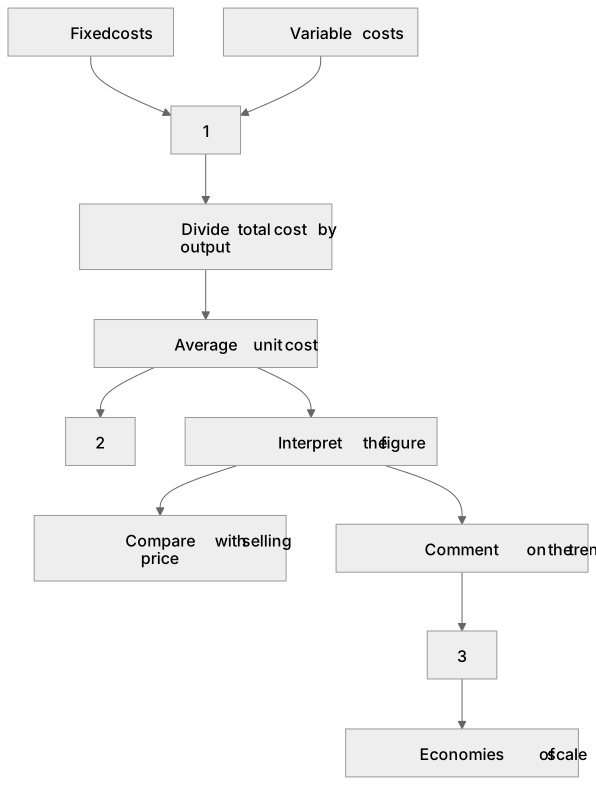
Label the diagram
Some boxes have lost their names. Pick the right name for each number.
1Box 1
2Box 2
3Box 3
There is more to this lesson
The full lesson goes on to check your understanding and help you earn the marks. Create a free account to carry on, with your progress saved.
A week of Premium from your first lesson · Then the free plan continues · No card, no charge
Test your understanding of Expanding a business: calculate and interpret average unit costs.
Active recall beats re-reading. Take an instant quiz now to test what you’ve learned and lock it into long-term memory.
A week of Premium from your first lesson · Then the free plan continues · No card, no charge