AQA · GCSE · Business
Course version: 8132 · Version from Sept 2017
Understand that with growth businesses increase the risk of diseconomies…
Full specification wording
Expanding a business: understand that with growth businesses increase the risk of diseconomies of scale occurring due to poor communication, coordination issues and reduced staff motivation
Diseconomies of scale are the cost disadvantages that can appear when a business grows too large, causing average cost per unit to rise.
Checked against the AQA 8132 specification (opens in a new tab) on .
- Point 9 of 10
- 4 key terms
Study notes
From the checked teaching notes for this specification point.
The idea
Diseconomies of scale are the cost disadvantages that can appear when a business grows too large, causing average cost per unit to rise. Growth increases the risk of three linked problems. Poor communication: messages pass through more layers of management, so instructions become distorted or delayed. Coordination issues: more departments, sites and products make it harder to schedule work, control quality and avoid duplication. Reduced staff motivation: workers may feel like a small part of a large machine, with less recognition and weaker team spirit, raising absenteeism and turnover.
For example: A chain that expands from 5 to 500 shops may find head office decisions slow, stock mismatched to local demand and staff disengaged, pushing unit costs up.
What earns the marks
- Defines diseconomies of scale as a rise in average cost per unit caused by becoming too large.
- Explains poor communication through longer chains of command, distortion and delay.
- Explains coordination issues such as managing more departments, sites, products and quality control.
- Explains reduced staff motivation through loss of recognition, weaker team spirit and higher turnover.
- Links each cause to rising costs, for example errors, waste, supervision or recruitment costs.
- Uses a growth example showing how a larger scale creates these pressures.
Common mistakes and how to put them right
Confusing diseconomies of scale with falling demand or lower sales.
Put it right: Diseconomies concern rising average costs from internal inefficiency.
Assuming growth always lowers unit cost.
Put it right: Beyond a certain size, coordination and motivation problems can reverse the saving.
Listing poor communication without explaining the cost effect.
Put it right: State how delay or error raises unit cost.
Exam tips
- Name the three causes and give a short consequence for each to secure full coverage.
- Use the case study to show a specific communication or coordination problem rather than a generic statement.
- Contrast diseconomies with economies of scale to show the trade-off of growth.
Try the lesson
The start of the Expanding a business: understand that with growth businesses increase the risk of diseconomies of scale occurring due to poor communication, coordination issues and reduced staff motivation lesson, made from checked teaching notes for this specification point.
Have a go first
Which of the following is a cause of diseconomies of scale when a business grows larger?
Listen
Diseconomies of scale are the cost disadvantages that can appear when a business grows too large, causing average cost per unit to rise. Growth increases the risk of three linked problems. Poor communication: messages pass through more layers of management, so instructions become distorted or delayed. Coordination issues: more departments, sites and products make it harder to schedule work, control quality and avoid duplication. Reduced staff motivation: workers may feel like a small part of a large machine, with less recognition and weaker team spirit, raising absenteeism and turnover. For example, a chain that expands from 5 to 500 shops may find head office decisions slow, stock mismatched to local demand and staff disengaged, pushing unit costs up. A strong answer earns marks for these points. Defines diseconomies of scale as a rise in average cost per unit caused by becoming too large. Explains poor communication through longer chains of command, distortion and delay. Explains coordination issues such as managing more departments, sites, products and quality control. Explains reduced staff motivation through loss of recognition, weaker team spirit and higher turnover. A common slip: Confusing diseconomies of scale with falling demand or lower sales. Instead, diseconomies concern rising average costs from internal inefficiency. Exam tip: Name the three causes and give a short consequence for each to secure full coverage.
See it
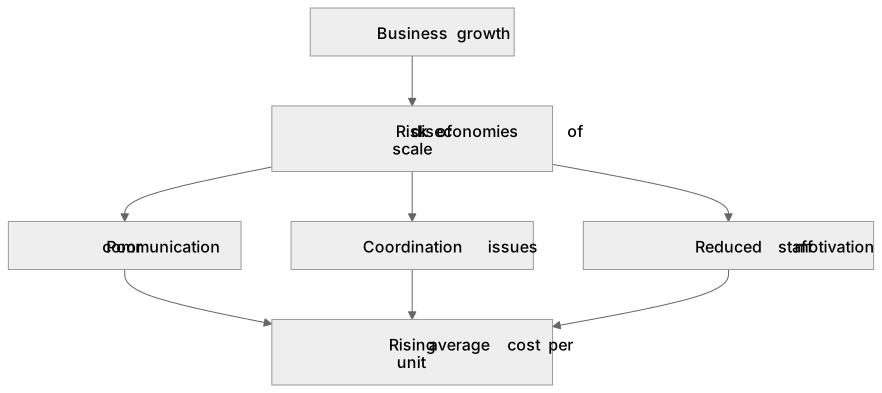
Key words
Say what each word means before you turn the card.
Diseconomies of scale
Try answering aloud or in your head before turning the card.
Poor communication
Try answering aloud or in your head before turning the card.
Coordination issues
Try answering aloud or in your head before turning the card.
Reduced staff motivation
Try answering aloud or in your head before turning the card.
See every definition
- Diseconomies of scale
- Cost disadvantages that can appear when a business grows too large, causing average cost per unit to rise.
- Poor communication
- Messages pass through more layers of management, so instructions become distorted or delayed.
- Coordination issues
- More departments, sites and products make it harder to schedule work, control quality and avoid duplication.
- Reduced staff motivation
- Workers may feel like a small part of a large machine, with less recognition and weaker team spirit, raising absenteeism and turnover.
Label the diagram
Some boxes have lost their names. Pick the right name for each number.
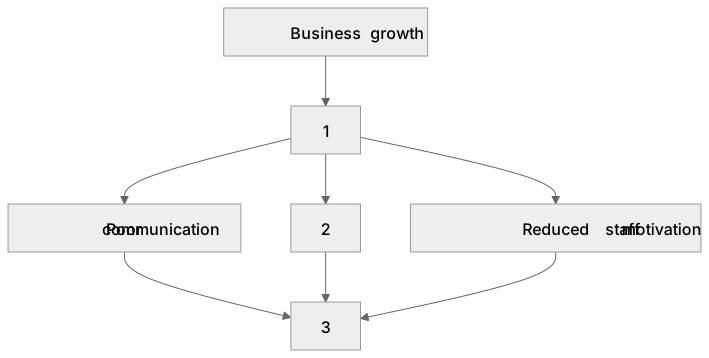
1Box 1
2Box 2
3Box 3
There is more to this lesson
The full lesson goes on to check your understanding and help you earn the marks. Create a free account to carry on, with your progress saved.
A week of Premium from your first lesson · Then the free plan continues · No card, no charge
Test your understanding of Expanding a business: understand that with growth businesses increase the risk of diseconomies of scale occurring due to poor communication, coordination issues and reduced staff motivation
Active recall beats re-reading. Take an instant quiz now to test what you’ve learned and lock it into long-term memory.
A week of Premium from your first lesson · Then the free plan continues · No card, no charge