AQA · GCSE · Business
Course version: 8132 · Version from Sept 2017
Expanding a business: Economies of scale
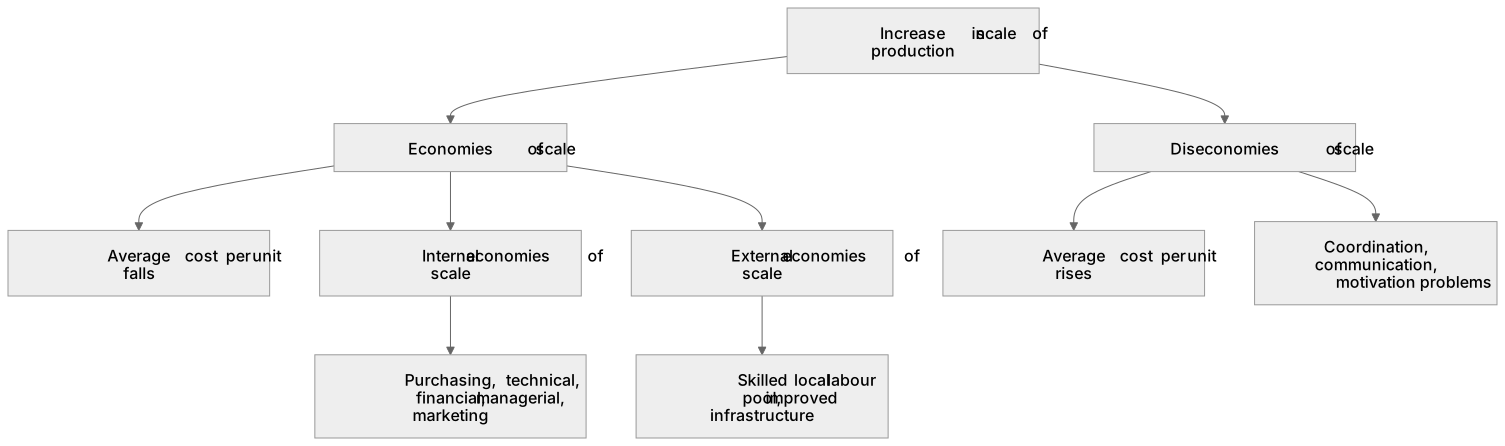
Economies of scale are the cost advantages that a business gains as it increases its scale of production.
Checked against the AQA 8132 specification (opens in a new tab) on .
- Point 3 of 10
- 2 key terms
Study notes
From the checked teaching notes for this specification point.
The idea
Economies of scale are the cost advantages that a business gains as it increases its scale of production. They cause average cost per unit to fall. Internal economies of scale arise within the business, for example purchasing, technical, financial, managerial, and marketing economies. External economies of scale arise from the industry or location, such as a skilled local labour pool or improved infrastructure. For example, a larger factory can buy raw materials in bulk at lower prices, reducing average cost. Diseconomies of scale occur when a business becomes too large, causing average costs to rise due to coordination, communication, or motivation problems. Understanding economies of scale helps explain why expansion can improve competitiveness.
What earns the marks
- Defines economies of scale as the reduction in average cost per unit as output increases.
- Distinguishes between internal and external economies of scale, giving examples of each.
- Explains how a specific type of economy of scale reduces average costs, such as bulk buying or specialised managers.
- Explains diseconomies of scale as factors that increase average costs when a business grows too large.
- Uses a numerical or graphical example to show average cost falling as output rises.
Common mistakes and how to put them right
Confusing economies of scale with increased output alone.
Put it right: Economies of scale specifically refer to falling average costs as scale increases.
Mixing up internal and external economies.
Put it right: Internal economies arise from the business's own growth, while external economies arise from industry or location factors.
Assuming average costs always fall with growth.
Put it right: Diseconomies of scale can cause average costs to rise beyond a certain size.
Exam tips
- Use precise terms such as 'average cost per unit' and 'output' to show understanding.
- When giving examples, link them to the type of economy of scale, such as technical or purchasing.
- For higher marks, explain the link between economies of scale and competitiveness or profitability.
Try the lesson
The start of the Expanding a business: Economies of scale lesson, made from checked teaching notes for this specification point.
Have a go first
What is meant by an economy of scale?
Listen
Economies of scale are the cost advantages that a business gains as it increases its scale of production. They cause average cost per unit to fall. Internal economies of scale arise within the business, for example purchasing, technical, financial, managerial, and marketing economies. External economies of scale arise from the industry or location, such as a skilled local labour pool or improved infrastructure. For example, a larger factory can buy raw materials in bulk at lower prices, reducing average cost. Diseconomies of scale occur when a business becomes too large, causing average costs to rise due to coordination, communication, or motivation problems. Understanding economies of scale helps explain why expansion can improve competitiveness. A strong answer earns marks for these points. Defines economies of scale as the reduction in average cost per unit as output increases. Distinguishes between internal and external economies of scale, giving examples of each. Explains how a specific type of economy of scale reduces average costs, such as bulk buying or specialised managers. Explains diseconomies of scale as factors that increase average costs when a business grows too large. A common slip: Confusing economies of scale with increased output alone. Instead, economies of scale specifically refer to falling average costs as scale increases. Exam tip: Use precise terms such as 'average cost per unit' and 'output' to show understanding.
See it
Key words
Say what each word means before you turn the card.
Economies of scale
Try answering aloud or in your head before turning the card.
Internal and external factors
Try answering aloud or in your head before turning the card.
See every definition
- Economies of scale
- The cost advantages that a business gains as it increases its scale of production, causing average cost per unit to fall.
- Internal and external factors
- Internal economies of scale arise within the business, while external economies of scale arise from the industry or location.
Label the diagram
Some boxes have lost their names. Pick the right name for each number.
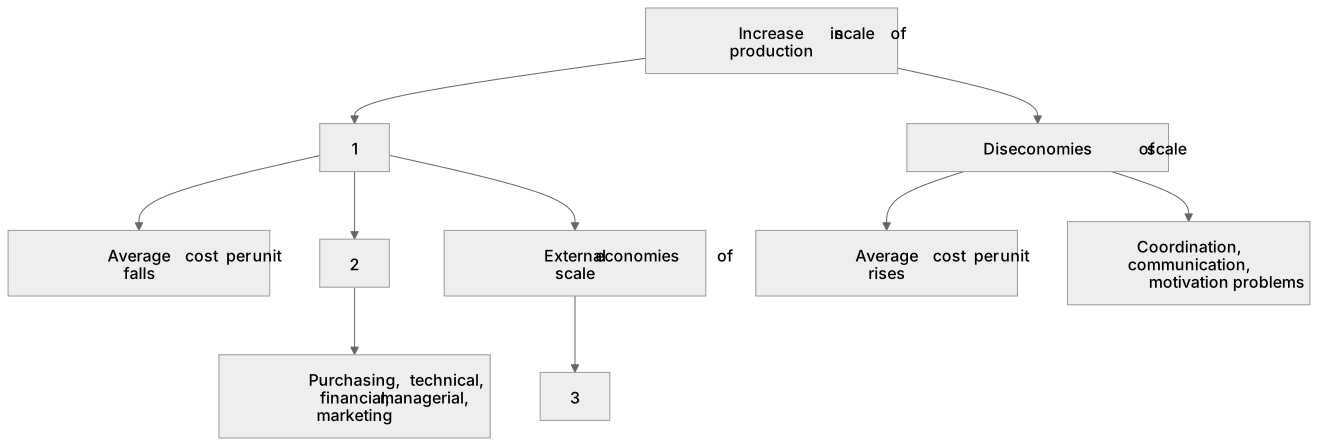
1Box 1
2Box 2
3Box 3
There is more to this lesson
The full lesson goes on to check your understanding and help you earn the marks. Create a free account to carry on, with your progress saved.
A week of Premium from your first lesson · Then the free plan continues · No card, no charge
Test your understanding of Expanding a business: Economies of scale
Active recall beats re-reading. Take an instant quiz now to test what you’ve learned and lock it into long-term memory.
A week of Premium from your first lesson · Then the free plan continues · No card, no charge