AQA · GCSE · Business
Course version: 8132 · Version from Sept 2017
Expanding a business: Diseconomies of scale
Diseconomies of scale are the rises in average cost per unit that can occur once a business grows beyond its efficient scale.
Checked against the AQA 8132 specification (opens in a new tab) on .
- Point 4 of 10
- 2 key terms
Study notes
From the checked teaching notes for this specification point.
The idea
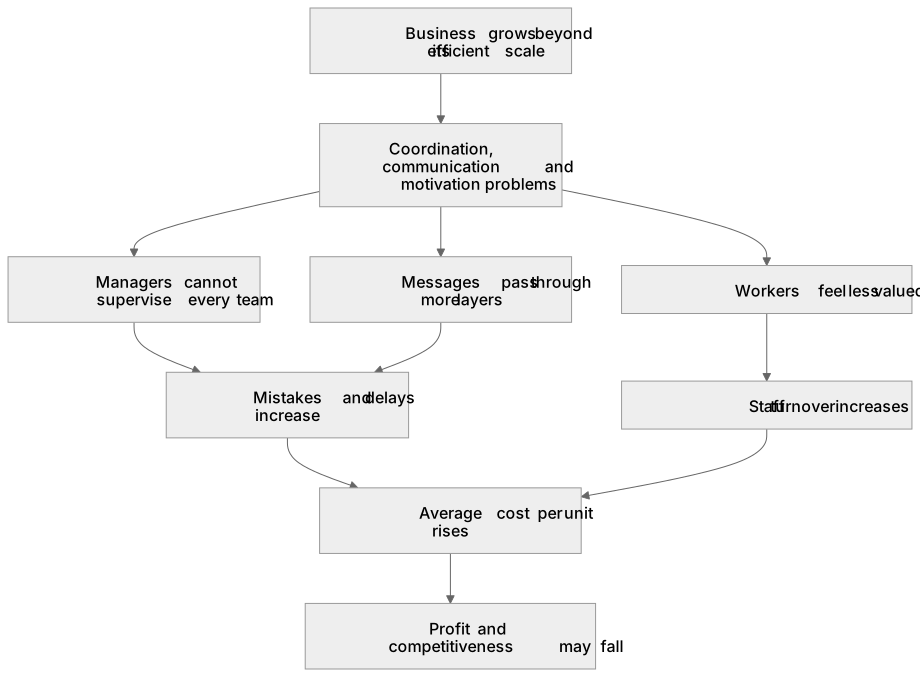
Diseconomies of scale are the rises in average cost per unit that can occur once a business grows beyond its efficient scale. Expansion may bring economies of scale, but beyond a certain output, coordination, communication and motivation problems push unit costs up. For example, a factory making 10,000 units a week may have low average costs, but at 40,000 units a week managers cannot supervise every team, messages pass through more layers, and workers feel less valued, so mistakes, delays and staff turnover increase. These factors raise average costs, shown by the average cost curve turning upwards. Diseconomies are not inevitable; good management, training and clear communication can delay them. They matter because growth that raises unit costs can reduce profit and competitiveness, so a business must judge when further expansion stops being worthwhile.
What earns the marks
- Defines diseconomies of scale as an increase in average cost per unit caused by growth beyond the efficient scale of output.
- Explains at least one cause, such as poor communication through many management layers, weak coordination between departments, or falling staff motivation in a large workforce.
- Links the cause to a rise in unit cost, for example wasted materials, delays, duplication of effort or higher wages needed to retain staff.
- Uses a numerical illustration, such as average cost rising from £4 per unit at 10,000 units to £5 per unit at 40,000 units, to show the direction of the effect.
- Distinguishes diseconomies from economies of scale, showing that economies lower unit cost as output rises while diseconomies raise it.
- Evaluates how management action, such as delegation, training or better information systems, may reduce or postpone diseconomies.
Common mistakes and how to put them right
Confusing diseconomies of scale with falling demand or falling revenue.
Put it right: Diseconomies concern rising average costs as output grows, not sales.
Assuming growth always lowers unit cost.
Put it right: Economies apply only up to a point, after which average cost can rise.
Describing diseconomies merely as total costs increasing.
Put it right: Total costs naturally rise with output, but diseconomies occur specifically when total costs rise faster than output, causing average cost per unit to increase.
Exam tips
- Define the term precisely, then apply it to the case study business rather than writing generally about large firms.
- Use a cause-and-effect chain: growth leads to a specific problem, which leads to higher unit cost, which affects profit or competitiveness.
Try the lesson
The start of the Expanding a business: Diseconomies of scale lesson, made from checked teaching notes for this specification point.
Have a go first
Which of the following best describes a diseconomy of scale for a growing business?
Listen
Diseconomies of scale are the rises in average cost per unit that can occur once a business grows beyond its efficient scale. Expansion may bring economies of scale, but beyond a certain output, coordination, communication and motivation problems push unit costs up. For example, a factory making 10,000 units a week may have low average costs, but at 40,000 units a week managers cannot supervise every team, messages pass through more layers, and workers feel less valued, so mistakes, delays and staff turnover increase. These factors raise average costs, shown by the average cost curve turning upwards. Diseconomies are not inevitable; good management, training and clear communication can delay them. They matter because growth that raises unit costs can reduce profit and competitiveness, so a business must judge when further expansion stops being worthwhile. A strong answer earns marks for these points. Defines diseconomies of scale as an increase in average cost per unit caused by growth beyond the efficient scale of output. Explains at least one cause, such as poor communication through many management layers, weak coordination between departments, or falling staff motivation in a large workforce. Links the cause to a rise in unit cost, for example wasted materials, delays, duplication of effort or higher wages needed to retain staff. Uses a numerical illustration, such as average cost rising from £4 per unit at 10,000 units to £5 per unit at 40,000 units, to show the direction of the effect. A common slip: Confusing diseconomies of scale with falling demand or falling revenue. Instead, diseconomies concern rising average costs as output grows, not sales. Exam tip: Define the term precisely, then apply it to the case study business rather than writing generally about large firms.
See it
Key words
Say what each word means before you turn the card.
Diseconomies of scale
Try answering aloud or in your head before turning the card.
Efficient scale
Try answering aloud or in your head before turning the card.
See every definition
- Diseconomies of scale
- The rises in average cost per unit that can occur once a business grows beyond its efficient scale.
- Efficient scale
- The level of output beyond which rises in average cost per unit can occur as a business grows.
Label the diagram
Some boxes have lost their names. Pick the right name for each number.
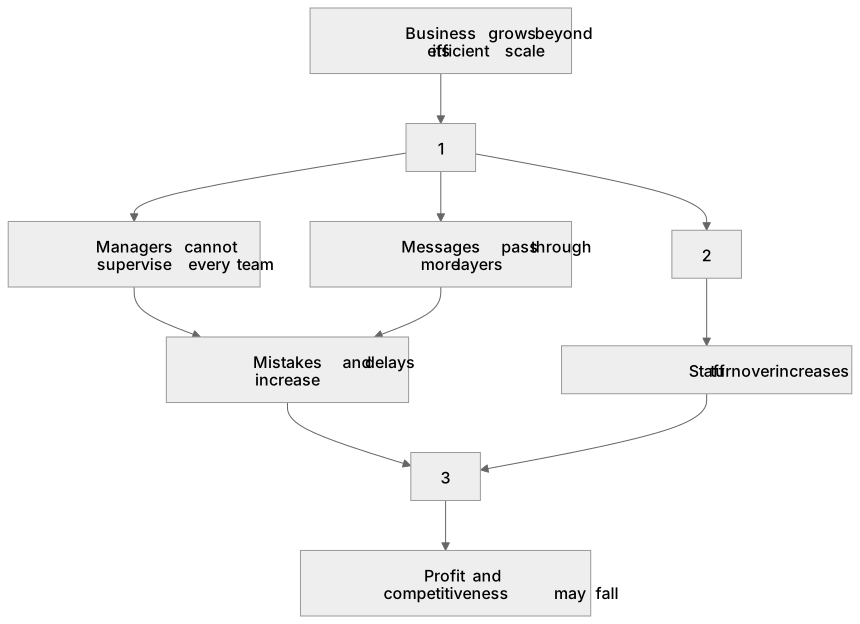
1Box 1
2Box 2
3Box 3
There is more to this lesson
The full lesson goes on to check your understanding and help you earn the marks. Create a free account to carry on, with your progress saved.
A week of Premium from your first lesson · Then the free plan continues · No card, no charge
Test your understanding of Expanding a business: Diseconomies of scale
Active recall beats re-reading. Take an instant quiz now to test what you’ve learned and lock it into long-term memory.
A week of Premium from your first lesson · Then the free plan continues · No card, no charge