AQA · GCSE · Business
Course version: 8132 · Version from Sept 2017
Evaluate the value of using break-even analysis to a business.
Full specification wording
Financial terms and calculations: evaluate the value of using break-even analysis to a business.
Break-even analysis calculates the output at which total revenue equals total costs, giving zero profit.
Checked against the AQA 8132 specification (opens in a new tab) on .
- Point 10 of 10
- 2 key terms
Study notes
From the checked teaching notes for this specification point.
The idea
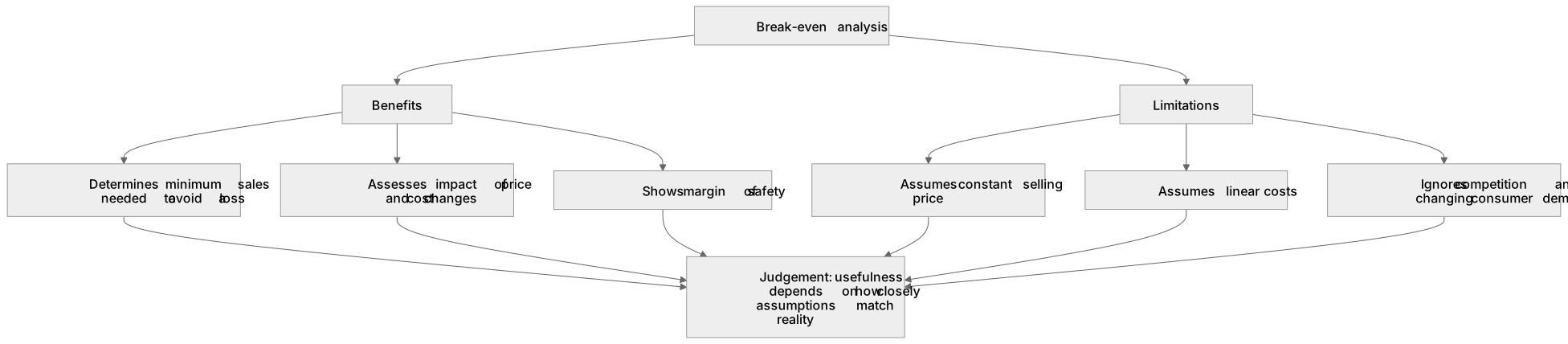
Break-even analysis calculates the output at which total revenue equals total costs, giving zero profit. Its value lies in helping a business determine the minimum sales needed to avoid a loss, assess the impact of price and cost changes, and support decisions on pricing, cost control and investment. It also shows the margin of safety, indicating how much sales can fall before a loss occurs. However, it assumes all output is sold at a constant price, costs are linear, and ignores factors like competition, changing consumer demand, and economies of scale. Therefore, its usefulness depends on how closely these assumptions match reality. Evaluation requires weighing these benefits against limitations to judge how valuable the technique is in a given context.
What earns the marks
- Explains how break-even analysis helps a business determine the minimum sales volume needed to avoid loss.
- Discusses how it can be used to assess the effect of changing price or costs on profit.
- Considers the limitation that it assumes constant selling price and linear costs.
- Evaluates that it ignores external factors such as competition and changes in consumer demand.
- Reaches a judgement on the value of break-even analysis, considering the business context.
Common mistakes and how to put them right
Listing advantages and disadvantages without making a judgement.
Put it right: Ensure a clear conclusion is given that weighs up the points.
Assuming break-even analysis is always accurate.
Put it right: Acknowledge its assumptions and limitations.
Ignoring the context of the business.
Put it right: Apply the evaluation to the specific business situation provided.
Exam tips
- Use connectives such as 'however' and 'therefore' to build a balanced argument.
- Refer to the business in the case study to support your evaluation.
- Conclude with a justified judgement on the overall value.
Try the lesson
The start of the Financial terms and calculations: evaluate the value of using break-even analysis to a business. lesson, made from checked teaching notes for this specification point.
Have a go first
Which statement describes a valid benefit of using break-even analysis to a business?
Listen
Break-even analysis calculates the output at which total revenue equals total costs, giving zero profit. Its value lies in helping a business determine the minimum sales needed to avoid a loss, assess the impact of price and cost changes, and support decisions on pricing, cost control and investment. It also shows the margin of safety, indicating how much sales can fall before a loss occurs. However, it assumes all output is sold at a constant price, costs are linear, and ignores factors like competition, changing consumer demand, and economies of scale. Therefore, its usefulness depends on how closely these assumptions match reality. Evaluation requires weighing these benefits against limitations to judge how valuable the technique is in a given context. A strong answer earns marks for these points. Explains how break-even analysis helps a business determine the minimum sales volume needed to avoid loss. Discusses how it can be used to assess the effect of changing price or costs on profit. Considers the limitation that it assumes constant selling price and linear costs. Evaluates that it ignores external factors such as competition and changes in consumer demand. A common slip: Listing advantages and disadvantages without making a judgement. Instead, ensure a clear conclusion is given that weighs up the points. Exam tip: Use connectives such as 'however' and 'therefore' to build a balanced argument.
See it
Key words
Say what each word means before you turn the card.
Break-even analysis
Try answering aloud or in your head before turning the card.
Margin of safety
Try answering aloud or in your head before turning the card.
See every definition
- Break-even analysis
- Calculates the output at which total revenue equals total costs, giving zero profit.
- Margin of safety
- Shows how much sales can fall before a loss occurs.
Label the diagram
Some boxes have lost their names. Pick the right name for each number.
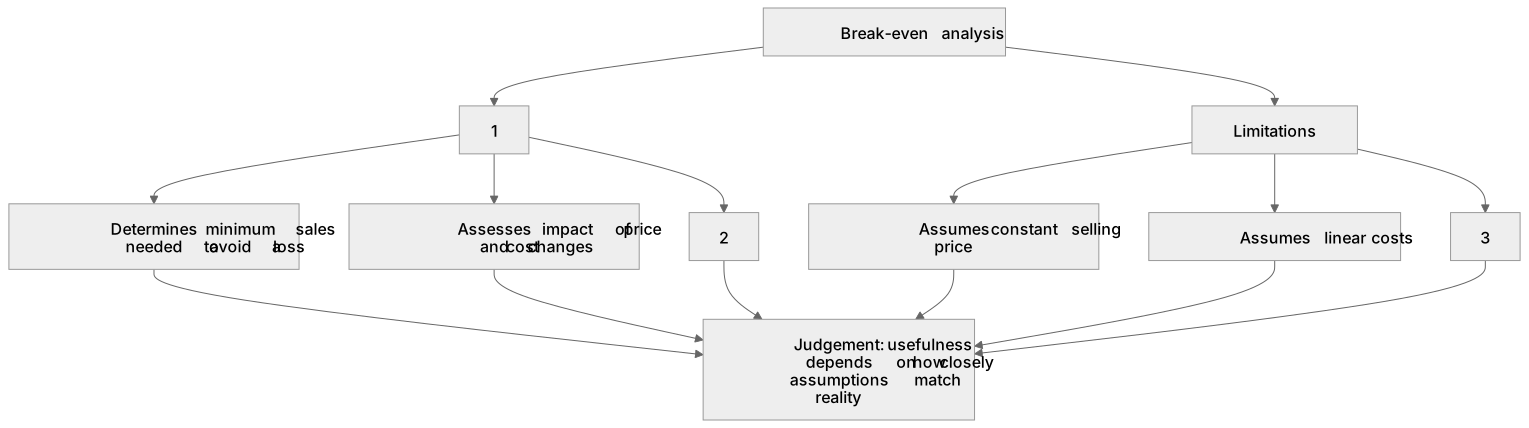
1Box 1
2Box 2
3Box 3
There is more to this lesson
The full lesson goes on to check your understanding and help you earn the marks. Create a free account to carry on, with your progress saved.
A week of Premium from your first lesson · Then the free plan continues · No card, no charge
Test your understanding of Financial terms and calculations: evaluate the value of using break-even analysis to a business.
Active recall beats re-reading. Take an instant quiz now to test what you’ve learned and lock it into long-term memory.
A week of Premium from your first lesson · Then the free plan continues · No card, no charge