AQA · GCSE · Business
Course version: 8132 · Version from Sept 2017
Understand the difference between variable costs, fixed costs and total…
Full specification wording
Financial terms and calculations: understand the difference between variable costs, fixed costs and total costs
Costs are the payments a business makes to produce and sell its output.
Checked against the AQA 8132 specification (opens in a new tab) on .
- Point 5 of 10
- 3 key terms
Study notes
From the checked teaching notes for this specification point.
The idea
Costs are the payments a business makes to produce and sell its output. Variable costs change directly with output: each extra unit made adds more cost, for example raw materials at £4 per unit, so 200 units cost £800 and 300 units cost £1,200. Fixed costs do not change with output over a period, such as rent of £2,000 per month, and are paid even at zero output. Total costs combine both: total costs = fixed costs + variable costs. At 200 units, total costs = £2,000 + £800 = £2,800; at 300 units, total costs = £2,000 + £1,200 = £3,200. The difference matters because variable costs rise as output rises, fixed costs stay constant in total, and total costs capture the full outlay. Understanding this helps a student judge break-even, pricing and profitability.
What earns the marks
- Defines variable costs as costs that vary directly with the level of output, giving a per-unit example such as materials or packaging.
- Defines fixed costs as costs that do not change with output in the short run, giving an example such as rent, insurance or salaries.
- States the relationship total costs = fixed costs + variable costs and applies it correctly to a numerical example.
- Explains that fixed costs are incurred even when output is zero, whereas variable costs are zero when nothing is produced.
- Uses a worked example to show how total costs change when output changes, for example comparing two output levels.
- Distinguishes total costs from average or unit costs, recognising that total costs are the whole outlay for a period.
Common mistakes and how to put them right
Treating all costs as variable.
Put it right: Fixed costs such as rent remain payable regardless of output.
Adding fixed costs to variable costs but forgetting to multiply variable cost per unit by the number of units.
Put it right: Calculate variable costs as unit cost × quantity first.
Assuming fixed costs per unit stay constant.
Put it right: Fixed costs per unit fall as output rises because the same total is spread over more units.
Exam tips
- Always label the cost type before calculating, so the examiner can see whether you are using a fixed or variable figure.
- Show the formula total costs = fixed costs + variable costs and substitute values line by line to secure method credit.
- Use a short context, such as a bakery, to make definitions concrete and to link costs to decisions about output.
Try the lesson
The start of the Financial terms and calculations: understand the difference between variable costs, fixed costs and total costs lesson, made from checked teaching notes for this specification point.
Have a go first
A bakery pays £800 per month in rent, which does not change with the number of loaves baked. What name is given to a cost of this type?
Listen
Costs are the payments a business makes to produce and sell its output. Variable costs change directly with output: each extra unit made adds more cost, for example raw materials at £4 per unit, so 200 units cost £800 and 300 units cost £1,200. Fixed costs do not change with output over a period, such as rent of £2,000 per month, and are paid even at zero output. Total costs combine both: total costs = fixed costs + variable costs. At 200 units, total costs = £2,000 + £800 = £2,800; at 300 units, total costs = £2,000 + £1,200 = £3,200. The difference matters because variable costs rise as output rises, fixed costs stay constant in total, and total costs capture the full outlay. Understanding this helps a student judge break-even, pricing and profitability. A strong answer earns marks for these points. Defines variable costs as costs that vary directly with the level of output, giving a per-unit example such as materials or packaging. Defines fixed costs as costs that do not change with output in the short run, giving an example such as rent, insurance or salaries. States the relationship total costs = fixed costs + variable costs and applies it correctly to a numerical example. Explains that fixed costs are incurred even when output is zero, whereas variable costs are zero when nothing is produced. A common slip: Treating all costs as variable. Instead, fixed costs such as rent remain payable regardless of output. Exam tip: Always label the cost type before calculating, so the examiner can see whether you are using a fixed or variable figure.
See it
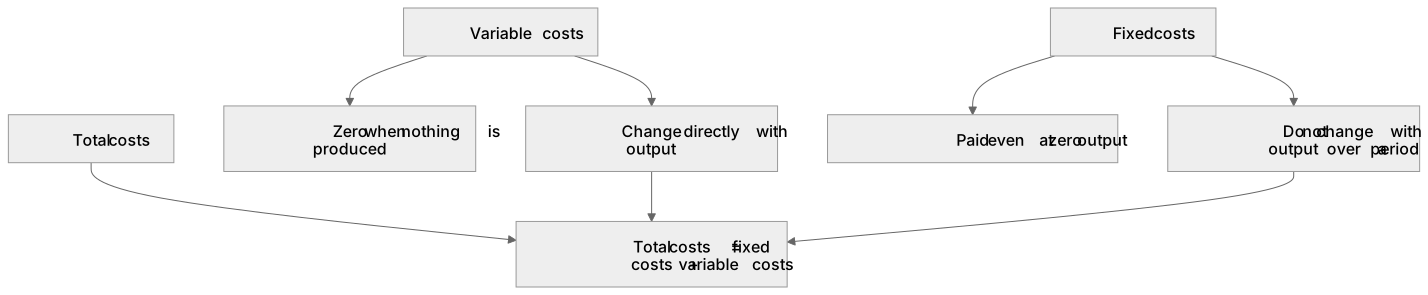
Key words
Say what each word means before you turn the card.
Variable costs
Try answering aloud or in your head before turning the card.
Fixed costs
Try answering aloud or in your head before turning the card.
Total costs
Try answering aloud or in your head before turning the card.
See every definition
- Variable costs
- Costs that change directly with output, where each extra unit made adds more cost.
- Fixed costs
- Costs that do not change with output over a period and are paid even at zero output.
- Total costs
- The full outlay for a period, calculated as fixed costs plus variable costs.
Label the diagram
Some boxes have lost their names. Pick the right name for each number.
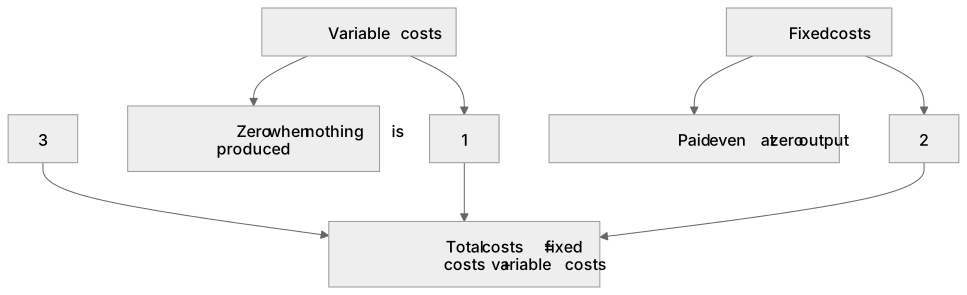
1Box 1
2Box 2
3Box 3
There is more to this lesson
The full lesson goes on to check your understanding and help you earn the marks. Create a free account to carry on, with your progress saved.
A week of Premium from your first lesson · Then the free plan continues · No card, no charge
Test your understanding of Financial terms and calculations: understand the difference between variable costs, fixed costs and total costs
Active recall beats re-reading. Take an instant quiz now to test what you’ve learned and lock it into long-term memory.
A week of Premium from your first lesson · Then the free plan continues · No card, no charge