AQA · GCSE · Business
Course version: 8132 · Version from Sept 2017
Globalisation: better designs
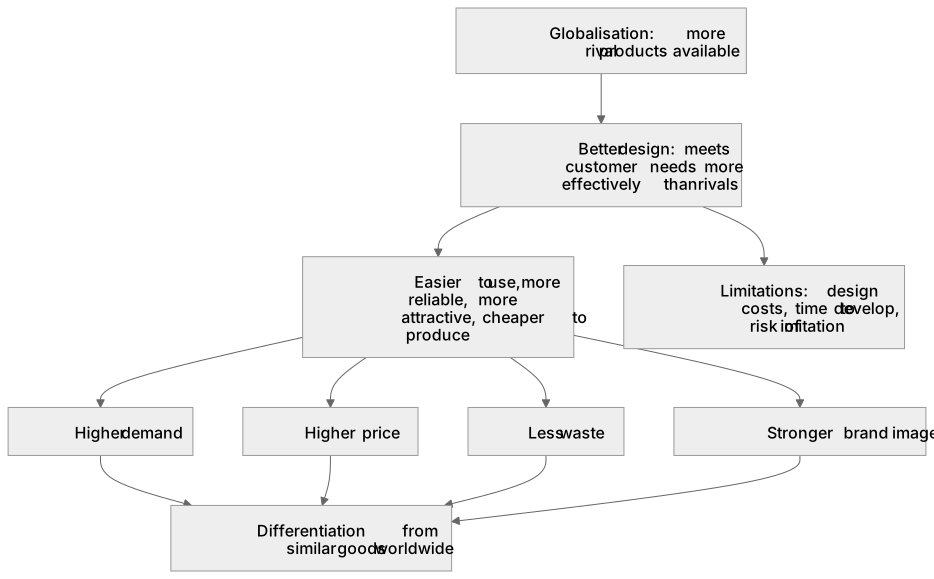
Globalisation exposes UK businesses to products from many countries, so design quality becomes a competitive weapon.
Checked against the AQA 8132 specification (opens in a new tab) on .
- Point 3 of 5
- 4 key terms
Study notes
From the checked teaching notes for this specification point.
The idea
Globalisation exposes UK businesses to products from many countries, so design quality becomes a competitive weapon. A better design means a product or service that meets customer needs more effectively than rivals: easier to use, more reliable, more attractive or cheaper to produce. For example, a UK phone case maker might redesign a case with a slimmer profile and recycled material, making it more appealing than an imported alternative. Better design can raise demand, allow a higher price, cut waste and strengthen brand image. It also helps a business differentiate itself when many similar goods are available worldwide. However, design improvements cost money and time, and rivals may copy them quickly.
What earns the marks
- Defines better design as improving how well a product or service meets customer needs compared with competitors.
- Explains that globalisation increases the number of rival products available, so design becomes a way to stand out.
- Gives a concrete example, such as a slimmer, more durable or more sustainable product design.
- Links better design to a business benefit, such as higher demand, premium pricing, lower waste or stronger brand image.
- Recognises a limitation, such as design costs, time to develop or the risk of imitation by competitors.
Common mistakes and how to put them right
Treating better design as only about appearance.
Put it right: Design also covers function, reliability, ease of use and production efficiency.
Assuming better design always raises profit.
Put it right: Higher costs or lower sales may reduce profit, so the net effect must be considered.
Ignoring the global context.
Put it right: Link the design improvement to competition from imported or international rivals.
Exam tips
- Use a named product or business to make the design improvement concrete.
- Develop each point with a chain of reasoning: design change, customer response, business effect.
- If asked to evaluate, weigh the benefit of better design against its cost and the risk of copying.
Try the lesson
The start of the Globalisation: better designs lesson, made from checked teaching notes for this specification point.
Have a go first
A UK furniture retailer starts importing products from an international supplier because they feature better, more modern designs than locally sourced items. What is the most likely benefit to the UK retailer?
Listen
Globalisation exposes UK businesses to products from many countries, so design quality becomes a competitive weapon. A better design means a product or service that meets customer needs more effectively than rivals: easier to use, more reliable, more attractive or cheaper to produce. For example, a UK phone case maker might redesign a case with a slimmer profile and recycled material, making it more appealing than an imported alternative. Better design can raise demand, allow a higher price, cut waste and strengthen brand image. It also helps a business differentiate itself when many similar goods are available worldwide. However, design improvements cost money and time, and rivals may copy them quickly. A strong answer earns marks for these points. Defines better design as improving how well a product or service meets customer needs compared with competitors. Explains that globalisation increases the number of rival products available, so design becomes a way to stand out. Gives a concrete example, such as a slimmer, more durable or more sustainable product design. Links better design to a business benefit, such as higher demand, premium pricing, lower waste or stronger brand image. A common slip: Treating better design as only about appearance. Instead, design also covers function, reliability, ease of use and production efficiency. Exam tip: Use a named product or business to make the design improvement concrete.
See it
Key words
Say what each word means before you turn the card.
Competitiveness
Try answering aloud or in your head before turning the card.
Customer needs
Try answering aloud or in your head before turning the card.
Differentiation
Try answering aloud or in your head before turning the card.
Cost and benefit
Try answering aloud or in your head before turning the card.
See every definition
- Competitiveness
- How well a business stands out against the many rival products available worldwide when globalisation exposes it to products from many countries.
- Customer needs
- What a product or service must meet more effectively than rivals, such as being easier to use, more reliable or more attractive.
- Differentiation
- Helping a business stand out when many similar goods are available worldwide.
- Cost and benefit
- Weighing the money and time that design improvements cost against benefits such as higher demand, a higher price, less waste or a stronger brand image.
Label the diagram
Some boxes have lost their names. Pick the right name for each number.
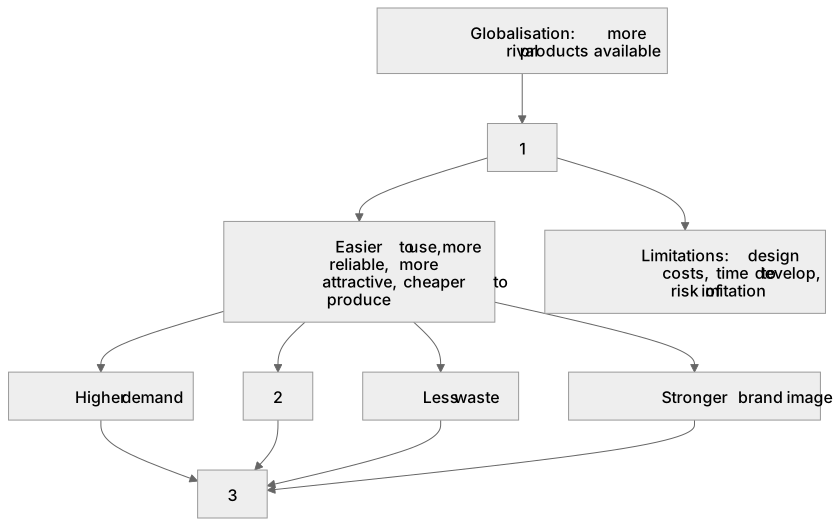
1Box 1
2Box 2
3Box 3
There is more to this lesson
The full lesson goes on to check your understanding and help you earn the marks. Create a free account to carry on, with your progress saved.
A week of Premium from your first lesson · Then the free plan continues · No card, no charge
Test your understanding of Globalisation: better designs
Active recall beats re-reading. Take an instant quiz now to test what you’ve learned and lock it into long-term memory.
A week of Premium from your first lesson · Then the free plan continues · No card, no charge