AQA · GCSE · Business
Course version: 8132 · Version from Sept 2017
Globalisation: higher quality products at lower prices.
Full specification wording
Globalisation: higher quality products at lower prices.
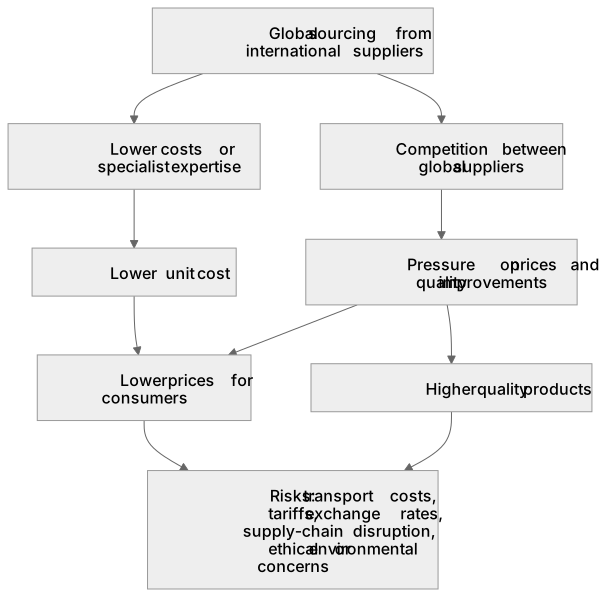
Globalisation can give consumers higher quality products at lower prices because businesses can source materials, components and labour from countries where costs are lower or expertise is stronger.
Checked against the AQA 8132 specification (opens in a new tab) on .
- Point 4 of 5
- 3 key terms
Study notes
From the checked teaching notes for this specification point.
The idea
Globalisation can give consumers higher quality products at lower prices because businesses can source materials, components and labour from countries where costs are lower or expertise is stronger. For example, a UK retailer may buy clothing from a factory abroad that specialises in that product, reducing unit cost while maintaining or improving quality. Competition between global suppliers also pressures prices downward and encourages quality improvements. However, lower prices may come with risks: transport costs, tariffs, exchange-rate changes, supply-chain disruption and ethical or environmental concerns. Quality may also suffer if a supplier cuts corners.
What earns the marks
- Explains that globalisation allows businesses to source from international suppliers with lower costs or specialist expertise.
- Links lower production costs to lower prices for consumers.
- Explains how competition among global suppliers can improve quality as well as reduce price.
- Uses a concrete example, such as a retailer importing clothing or electronics from a specialist overseas supplier.
- Identifies risks or limitations, such as transport costs, tariffs, exchange rates, supply disruption or quality control problems.
Common mistakes and how to put them right
Assuming lower price always means higher quality.
Put it right: Quality depends on supplier control and standards, not price alone.
Ignoring hidden costs; correction: include transport, tariffs, exchange-rate movements and supply-chain risk in the analysis.
Treating globalisation as only about price.
Put it right: It can also improve quality through access to specialist skills and technology.
Exam tips
- Use a specific product and country to show how global sourcing affects cost and quality.
- Develop the chain: global sourcing, lower unit cost, lower price, higher demand, possible quality improvement.
- For evaluation, compare the consumer benefit with the risks to the business and its reputation.
Try the lesson
The start of the Globalisation: higher quality products at lower prices. lesson, made from checked teaching notes for this specification point.
Have a go first
Globalisation can allow a UK business to buy products from overseas suppliers that are of higher quality and cost less. What is the most likely result for the UK business?
Listen
Globalisation can give consumers higher quality products at lower prices because businesses can source materials, components and labour from countries where costs are lower or expertise is stronger. For example, a UK retailer may buy clothing from a factory abroad that specialises in that product, reducing unit cost while maintaining or improving quality. Competition between global suppliers also pressures prices downward and encourages quality improvements. However, lower prices may come with risks: transport costs, tariffs, exchange-rate changes, supply-chain disruption and ethical or environmental concerns. Quality may also suffer if a supplier cuts corners. A strong answer earns marks for these points. Explains that globalisation allows businesses to source from international suppliers with lower costs or specialist expertise. Links lower production costs to lower prices for consumers. Explains how competition among global suppliers can improve quality as well as reduce price. Uses a concrete example, such as a retailer importing clothing or electronics from a specialist overseas supplier. A common slip: Assuming lower price always means higher quality. Instead, quality depends on supplier control and standards, not price alone. Exam tip: Use a specific product and country to show how global sourcing affects cost and quality.
See it
Key words
Say what each word means before you turn the card.
Global sourcing
Try answering aloud or in your head before turning the card.
Competition
Try answering aloud or in your head before turning the card.
Supply-chain risk
Try answering aloud or in your head before turning the card.
See every definition
- Global sourcing
- Buying materials, components and labour from countries where costs are lower or expertise is stronger.
- Competition
- Pressure between global suppliers that pushes prices downward and encourages quality improvements.
- Supply-chain risk
- Risks such as transport costs, tariffs, exchange-rate changes, supply-chain disruption and ethical or environmental concerns.
Label the diagram
Some boxes have lost their names. Pick the right name for each number.
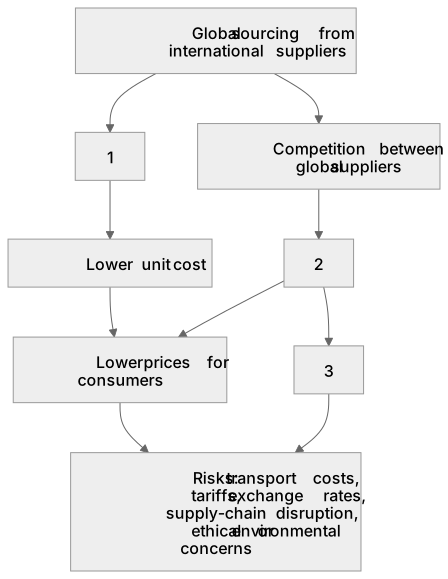
1Box 1
2Box 2
3Box 3
There is more to this lesson
The full lesson goes on to check your understanding and help you earn the marks. Create a free account to carry on, with your progress saved.
A week of Premium from your first lesson · Then the free plan continues · No card, no charge
Test your understanding of Globalisation: higher quality products at lower prices.
Active recall beats re-reading. Take an instant quiz now to test what you’ve learned and lock it into long-term memory.
A week of Premium from your first lesson · Then the free plan continues · No card, no charge