AQA · GCSE · Business
Course version: 8132 · Version from Sept 2017
Good customer services: customer loyalty
Customer loyalty is the tendency of buyers to return to the same business and to resist switching to a rival.
Checked against the AQA 8132 specification (opens in a new tab) on .
- Point 9 of 19
- 4 key terms
Study notes
From the checked teaching notes for this specification point.
The idea
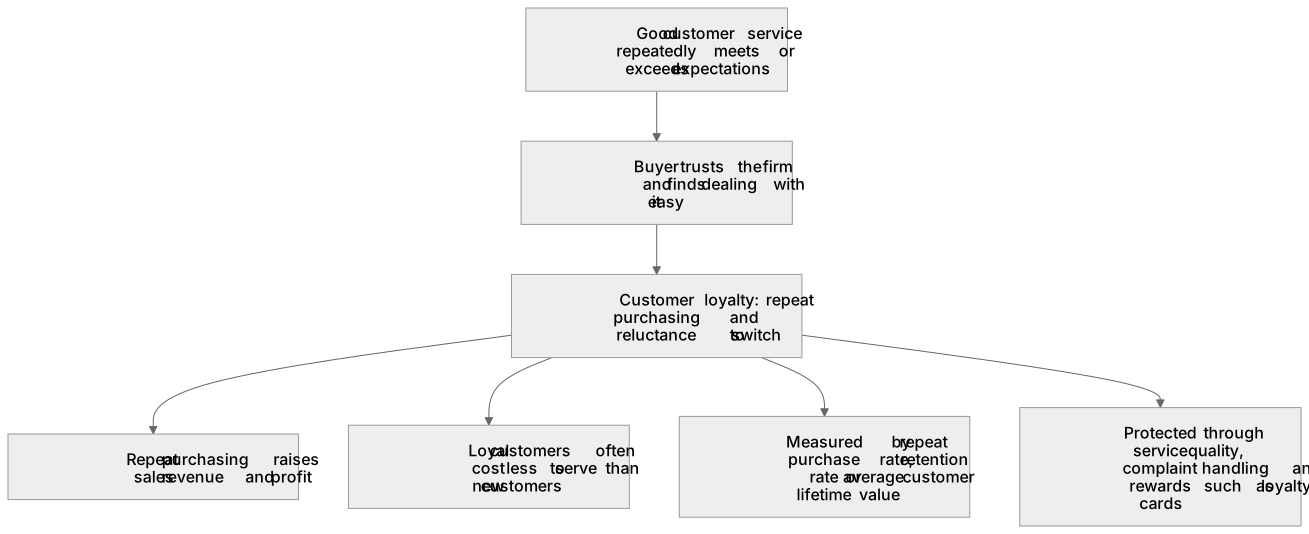
Customer loyalty is the tendency of buyers to return to the same business and to resist switching to a rival. It grows when good customer service repeatedly meets or exceeds expectations, so the buyer trusts the firm and finds dealing with it easy. Loyal customers are valuable because repeat purchasing raises sales revenue and profit, and because they often cost less to serve than new customers, who must first be attracted by costly marketing. Loyalty can be measured by repeat purchase rate, retention rate or average customer lifetime value. A café whose staff remember regulars' orders builds loyalty; a rival cutting prices may then fail to win those regulars away. Loyalty is not guaranteed, so firms protect it through service quality, complaint handling and rewards such as loyalty cards.
What earns the marks
- Defines customer loyalty as repeat purchasing and reluctance to switch to a competitor.
- Links loyalty to good customer service: consistent quality, helpful staff and effective complaint handling build trust.
- Explains the financial benefit: repeat sales raise revenue and can raise profit, and serving existing customers is often cheaper than recruiting new ones.
- Identifies ways loyalty is measured, such as repeat purchase rate, retention rate or average customer lifetime value.
- Uses a relevant example, such as a café whose regulars return because staff know their orders, to show loyalty in context.
- Recognises that loyalty can be lost through poor service or better rival offers, so it must be actively maintained.
Common mistakes and how to put them right
Treating loyalty as identical to customer satisfaction.
Put it right: Satisfaction is a feeling after one purchase, whereas loyalty is shown by repeat buying and resistance to switching.
Assuming loyal customers always pay higher prices.
Put it right: Some are price-sensitive and will switch if a rival undercuts the firm, so loyalty must be earned repeatedly.
Confusing loyalty with a loyalty card scheme alone.
Put it right: A card is one tool that may encourage repeat purchase, but genuine loyalty comes from consistently good service and value.
Exam tips
- Define the term briefly, then apply it to the case business rather than writing generally about customers.
- Use cause and effect: good service leads to trust, which leads to repeat purchase, which leads to higher revenue.
- When asked to analyse, develop the chain of reasoning and refer to the context, such as the type of business and its customers.
Try the lesson
The start of the Good customer services: customer loyalty lesson, made from checked teaching notes for this specification point.
Have a go first
What is meant by customer loyalty in the context of good customer services?
Listen
Customer loyalty is the tendency of buyers to return to the same business and to resist switching to a rival. It grows when good customer service repeatedly meets or exceeds expectations, so the buyer trusts the firm and finds dealing with it easy. Loyal customers are valuable because repeat purchasing raises sales revenue and profit, and because they often cost less to serve than new customers, who must first be attracted by costly marketing. Loyalty can be measured by repeat purchase rate, retention rate or average customer lifetime value. A café whose staff remember regulars' orders builds loyalty; a rival cutting prices may then fail to win those regulars away. Loyalty is not guaranteed, so firms protect it through service quality, complaint handling and rewards such as loyalty cards. A strong answer earns marks for these points. Defines customer loyalty as repeat purchasing and reluctance to switch to a competitor. Links loyalty to good customer service: consistent quality, helpful staff and effective complaint handling build trust. Explains the financial benefit: repeat sales raise revenue and can raise profit, and serving existing customers is often cheaper than recruiting new ones. Identifies ways loyalty is measured, such as repeat purchase rate, retention rate or average customer lifetime value. Exam tip: Define the term briefly, then apply it to the case business rather than writing generally about customers.
See it
Key words
Say what each word means before you turn the card.
Customer loyalty
Try answering aloud or in your head before turning the card.
Repeat purchasing and retention
Try answering aloud or in your head before turning the card.
Trust built through service quality
Try answering aloud or in your head before turning the card.
Revenue and profit from existing customers
Try answering aloud or in your head before turning the card.
See every definition
- Customer loyalty
- The tendency of buyers to return to the same business and to resist switching to a rival.
- Repeat purchasing and retention
- Loyalty shown by repeat buying and resistance to switching, and it can be measured by repeat purchase rate or retention rate.
- Trust built through service quality
- Good customer service repeatedly meets or exceeds expectations, so the buyer trusts the firm and finds dealing with it easy.
- Revenue and profit from existing customers
- Repeat purchasing raises sales revenue and profit, and existing customers often cost less to serve than new customers.
Label the diagram
Some boxes have lost their names. Pick the right name for each number.
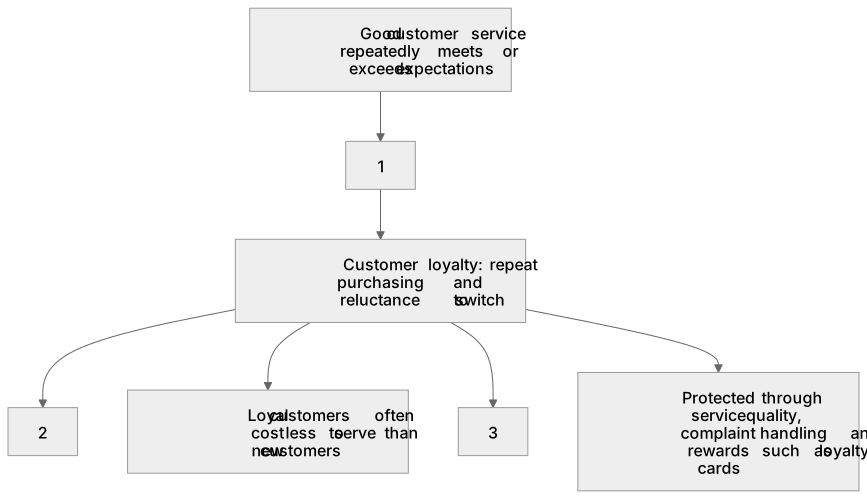
1Box 1
2Box 2
3Box 3
There is more to this lesson
The full lesson goes on to check your understanding and help you earn the marks. Create a free account to carry on, with your progress saved.
A week of Premium from your first lesson · Then the free plan continues · No card, no charge
Test your understanding of Good customer services: customer loyalty
Active recall beats re-reading. Take an instant quiz now to test what you’ve learned and lock it into long-term memory.
A week of Premium from your first lesson · Then the free plan continues · No card, no charge