AQA · GCSE · Business
Course version: 8132 · Version from Sept 2017
Good customer services: increase in customer satisfaction
Customer satisfaction is the gap between what a customer expects and what they actually experience.
Checked against the AQA 8132 specification (opens in a new tab) on .
- Point 8 of 19
- 4 key terms
Study notes
From the checked teaching notes for this specification point.
The idea
Customer satisfaction is the gap between what a customer expects and what they actually experience. Good customer service narrows or closes that gap, so satisfaction rises. A satisfied customer feels the purchase met their needs, trusts the business and is more likely to return. Satisfaction can be raised by accurate product information, friendly and knowledgeable staff, short waiting times, easy returns and quick, fair complaint handling. For example, a customer whose faulty headphones are replaced without argument leaves more satisfied than before the problem arose, because the business proved it values them. Higher satisfaction then feeds other benefits: repeat purchases, positive reviews, willingness to pay a little more and fewer disputes. Businesses can track it through surveys, review scores, complaint rates and repeat-purchase data, then act on weak areas.
What earns the marks
- Defines customer satisfaction as the extent to which a customer's experience meets or exceeds their expectations.
- Explains that good customer service closes the gap between expectation and experience, raising satisfaction.
- Identifies practical ways satisfaction is increased, such as helpful staff, accurate information, short waits, easy returns and fair complaint handling.
- Explains that satisfied customers are more likely to return, recommend the business and accept its prices.
- Explains that businesses can measure satisfaction through surveys, review scores, complaint rates and repeat-purchase data, and use the findings to improve service.
Common mistakes and how to put them right
Confusing customer satisfaction with customer service.
Put it right: Treat service as the actions the business takes and satisfaction as the customer's resulting feeling or judgement.
Assuming a single good experience guarantees loyalty.
Put it right: Recognise that satisfaction must be maintained consistently to keep customers returning.
Ignoring how satisfaction is measured.
Put it right: Refer to evidence such as surveys, review scores, complaint rates or repeat-purchase data.
Exam tips
- Define satisfaction briefly, then explain the expectation-versus-experience gap to show precise understanding.
- Give one concrete example of a service action and state how it changes the customer's judgement.
- Link satisfaction to a measurable outcome, such as repeat-purchase rate or review score, to strengthen analysis.
Try the lesson
The start of the Good customer services: increase in customer satisfaction lesson, made from checked teaching notes for this specification point.
Have a go first
What does an increase in customer satisfaction mean for a business?
Listen
Customer satisfaction is the gap between what a customer expects and what they actually experience. Good customer service narrows or closes that gap, so satisfaction rises. A satisfied customer feels the purchase met their needs, trusts the business and is more likely to return. Satisfaction can be raised by accurate product information, friendly and knowledgeable staff, short waiting times, easy returns and quick, fair complaint handling. For example, a customer whose faulty headphones are replaced without argument leaves more satisfied than before the problem arose, because the business proved it values them. Higher satisfaction then feeds other benefits: repeat purchases, positive reviews, willingness to pay a little more and fewer disputes. Businesses can track it through surveys, review scores, complaint rates and repeat-purchase data, then act on weak areas. A strong answer earns marks for these points. Defines customer satisfaction as the extent to which a customer's experience meets or exceeds their expectations. Explains that good customer service closes the gap between expectation and experience, raising satisfaction. Identifies practical ways satisfaction is increased, such as helpful staff, accurate information, short waits, easy returns and fair complaint handling. Explains that satisfied customers are more likely to return, recommend the business and accept its prices. A common slip: Confusing customer satisfaction with customer service. Instead, treat service as the actions the business takes and satisfaction as the customer's resulting feeling or judgement. Exam tip: Define satisfaction briefly, then explain the expectation-versus-experience gap to show precise understanding.
See it
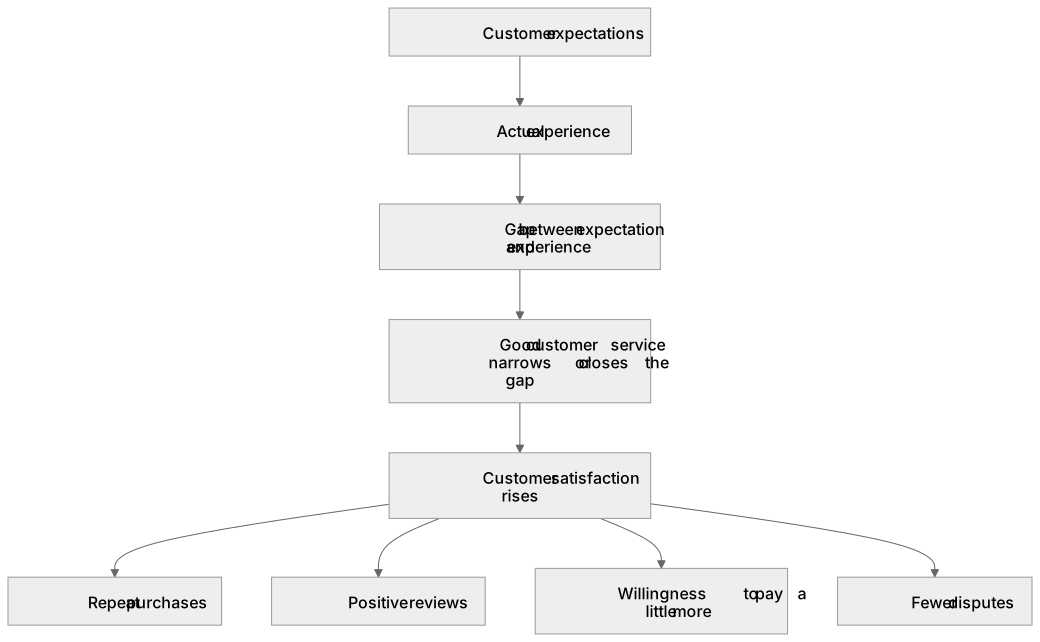
Key words
Say what each word means before you turn the card.
Customer satisfaction
Try answering aloud or in your head before turning the card.
Expectation versus experience
Try answering aloud or in your head before turning the card.
Customer loyalty and repeat purchase
Try answering aloud or in your head before turning the card.
Measuring satisfaction with surveys and reviews
Try answering aloud or in your head before turning the card.
See every definition
- Customer satisfaction
- The gap between what a customer expects and what they actually experience, so that a satisfied customer feels the purchase met their needs.
- Expectation versus experience
- The gap that good customer service narrows or closes, so that satisfaction rises.
- Customer loyalty and repeat purchase
- A satisfied customer trusts the business and is more likely to return, giving repeat purchases and positive reviews.
- Measuring satisfaction with surveys and reviews
- Tracking satisfaction through surveys, review scores, complaint rates and repeat-purchase data, then acting on weak areas.
Label the diagram
Some boxes have lost their names. Pick the right name for each number.
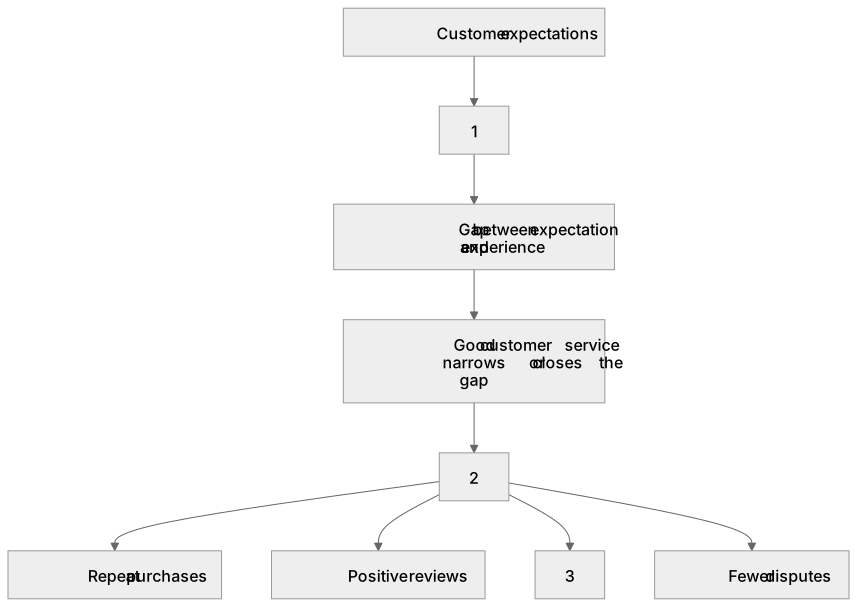
1Box 1
2Box 2
3Box 3
There is more to this lesson
The full lesson goes on to check your understanding and help you earn the marks. Create a free account to carry on, with your progress saved.
A week of Premium from your first lesson · Then the free plan continues · No card, no charge
Test your understanding of Good customer services: increase in customer satisfaction
Active recall beats re-reading. Take an instant quiz now to test what you’ve learned and lock it into long-term memory.
A week of Premium from your first lesson · Then the free plan continues · No card, no charge