AQA · GCSE · Business
Course version: 8132 · Version from Sept 2017
Good customer services: profitability.
Profitability measures how much profit a business earns relative to its size, usually by comparing profit with revenue or with the capital invested.
Checked against the AQA 8132 specification (opens in a new tab) on .
- Point 11 of 19
- 4 key terms
Study notes
From the checked teaching notes for this specification point.
The idea
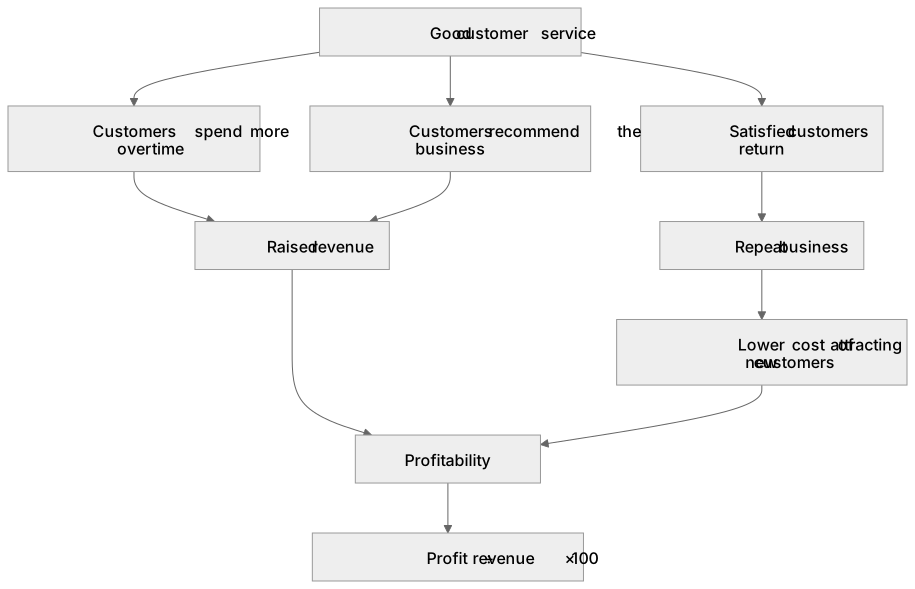
Profitability measures how much profit a business earns relative to its size, usually by comparing profit with revenue or with the capital invested. Good customer service supports profitability because satisfied customers return, spend more over time and recommend the business, which can raise revenue while repeat business may lower the cost of attracting new customers. A simple method is to calculate the profit margin: profit ÷ revenue × 100. For example, revenue of £200,000 and profit of £20,000 gives £20,000 ÷ £200,000 × 100 = 10%. A higher margin suggests the business keeps more of each pound of sales, though a high margin with falling revenue may still signal trouble. Profitability is therefore a useful way to judge whether customer service improvements are translating into stronger financial performance.
What earns the marks
- Defines profitability as profit measured in relation to another figure, such as revenue or capital invested, rather than profit alone.
- Explains that good customer service can raise revenue through repeat purchases, customer loyalty and recommendations.
- Explains that good customer service can lower costs, for example by reducing the need to spend on attracting replacement customers.
- Uses a calculation such as profit ÷ revenue × 100 to show how profitability can be measured.
- Applies profitability to a business context, for example comparing the margin before and after a customer service improvement.
Common mistakes and how to put them right
Treating profit and profitability as the same thing.
Put it right: Profitability compares profit with another figure, such as revenue or capital invested.
Calculating the margin the wrong way round, for example revenue ÷ profit × 100.
Put it right: Profit ÷ revenue × 100.
Assuming a higher profit margin always means a better performance.
Put it right: A high margin with falling revenue or falling total profit may still be a concern.
Exam tips
- Define profitability briefly, then link it directly to customer service in the same sentence to show the connection.
- When using figures, show the calculation clearly and state the unit, for example a margin of 10%.
- Use the context of the case study, such as a named business or a specific customer service change, rather than writing generally.
Try the lesson
The start of the Good customer services: profitability. lesson, made from checked teaching notes for this specification point.
Have a go first
Which term describes the amount of profit a business makes compared with its revenue or the money it has invested?
Listen
Profitability measures how much profit a business earns relative to its size, usually by comparing profit with revenue or with the capital invested. Good customer service supports profitability because satisfied customers return, spend more over time and recommend the business, which can raise revenue while repeat business may lower the cost of attracting new customers. A simple method is to calculate the profit margin: profit ÷ revenue × 100. For example, revenue of £200,000 and profit of £20,000 gives £20,000 ÷ £200,000 × 100 = 10%. A higher margin suggests the business keeps more of each pound of sales, though a high margin with falling revenue may still signal trouble. Profitability is therefore a useful way to judge whether customer service improvements are translating into stronger financial performance. A strong answer earns marks for these points. Defines profitability as profit measured in relation to another figure, such as revenue or capital invested, rather than profit alone. Explains that good customer service can raise revenue through repeat purchases, customer loyalty and recommendations. Explains that good customer service can lower costs, for example by reducing the need to spend on attracting replacement customers. Uses a calculation such as profit ÷ revenue × 100 to show how profitability can be measured. A common slip: Treating profit and profitability as the same thing. Instead, profitability compares profit with another figure, such as revenue or capital invested. Exam tip: Define profitability briefly, then link it directly to customer service in the same sentence to show the connection.
See it
Key words
Say what each word means before you turn the card.
Profitability
Try answering aloud or in your head before turning the card.
Profit margin
Try answering aloud or in your head before turning the card.
Customer loyalty and repeat purchase
Try answering aloud or in your head before turning the card.
Cost control
Try answering aloud or in your head before turning the card.
See every definition
- Profitability
- Profit measured in relation to another figure, such as revenue or capital invested, rather than profit alone.
- Profit margin
- Profit ÷ revenue × 100, showing how much of each pound of sales the business keeps.
- Customer loyalty and repeat purchase
- Satisfied customers return and spend more over time, which can raise revenue.
- Cost control
- Repeat business may lower the cost of attracting new customers, reducing the need to spend on attracting replacement customers.
Label the diagram
Some boxes have lost their names. Pick the right name for each number.
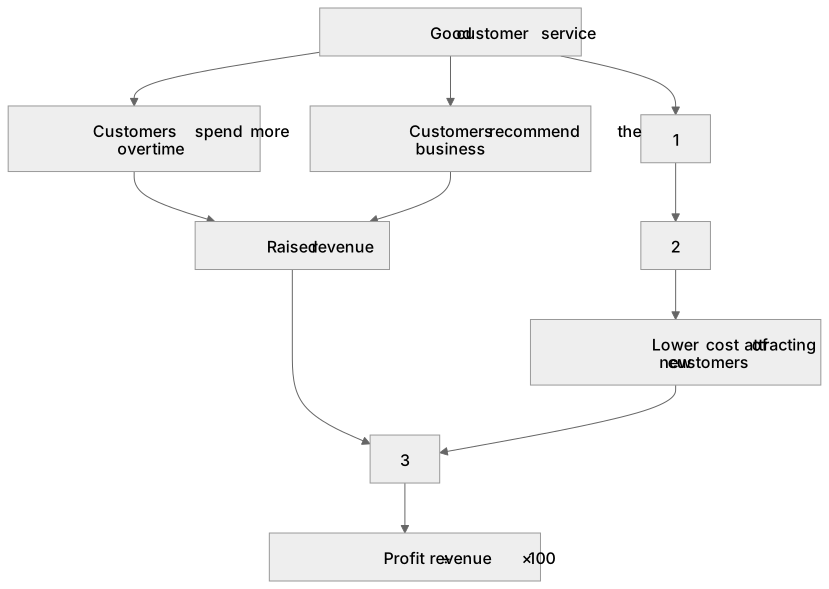
1Box 1
2Box 2
3Box 3
There is more to this lesson
The full lesson goes on to check your understanding and help you earn the marks. Create a free account to carry on, with your progress saved.
A week of Premium from your first lesson · Then the free plan continues · No card, no charge
Test your understanding of Good customer services: profitability.
Active recall beats re-reading. Take an instant quiz now to test what you’ve learned and lock it into long-term memory.
A week of Premium from your first lesson · Then the free plan continues · No card, no charge