AQA · GCSE · Business
Course version: 8132 · Version from Sept 2017
Good customer services: Dangers of poor customer service, including:
Poor customer service creates dangers that can damage a business financially and reputationally.
Checked against the AQA 8132 specification (opens in a new tab) on .
- Point 12 of 19
- 4 key terms
Study notes
From the checked teaching notes for this specification point.
The idea
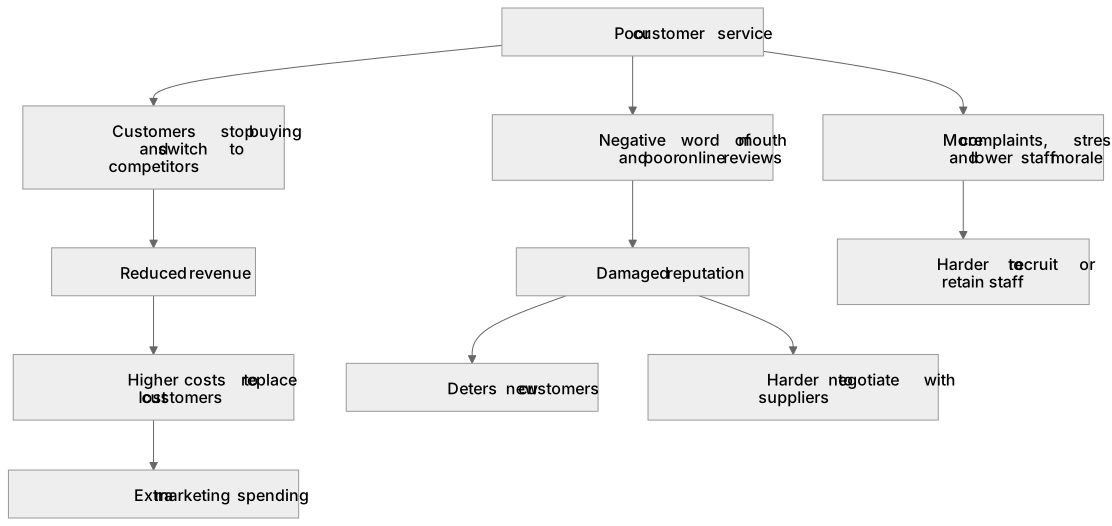
Poor customer service creates dangers that can damage a business financially and reputationally. Dissatisfied customers may stop buying, switch to a competitor and share negative reviews, which reduces revenue and can deter new customers. Replacing lost customers is often expensive because the business must spend more on marketing, and staff may face more complaints, stress and lower morale. A weak reputation can also make it harder to recruit good employees or negotiate with suppliers. For example, a restaurant with slow service and rude staff may lose regular diners, see online ratings fall and then need to spend more on advertising to attract replacements. The dangers therefore include lost sales, higher costs, damaged reputation and reduced customer loyalty.
What earns the marks
- Explains that poor customer service can cause customers to stop buying and switch to competitors, reducing revenue.
- Explains that negative word of mouth and poor online reviews can damage reputation and deter new customers.
- Explains that replacing lost customers can raise costs, for example through extra marketing spending.
- Explains that poor customer service can lower staff morale and make recruitment or retention harder.
- Applies the dangers to a specific business context, such as a retailer losing regular customers after repeated complaints.
Common mistakes and how to put them right
Listing dangers without explaining the effect on the business.
Put it right: Link each danger to revenue, costs, reputation or loyalty.
Assuming all unhappy customers complain formally.
Put it right: Many simply stop buying and tell others, so the business may not hear directly.
Treating reputation damage as only a short-term issue.
Put it right: Lost trust can reduce sales and raise costs over a longer period.
Exam tips
- Use connectives such as because and therefore to show the chain from poor service to a business consequence.
- Refer to the case study context, such as the type of business and its customers, rather than writing in general terms.
- Prioritise two or three dangers and develop them fully instead of listing many briefly.
Try the lesson
The start of the Good customer services: Dangers of poor customer service, including: lesson, made from checked teaching notes for this specification point.
Have a go first
Which of the following is a likely danger for a business that provides poor customer service?
Listen
Poor customer service creates dangers that can damage a business financially and reputationally. Dissatisfied customers may stop buying, switch to a competitor and share negative reviews, which reduces revenue and can deter new customers. Replacing lost customers is often expensive because the business must spend more on marketing, and staff may face more complaints, stress and lower morale. A weak reputation can also make it harder to recruit good employees or negotiate with suppliers. For example, a restaurant with slow service and rude staff may lose regular diners, see online ratings fall and then need to spend more on advertising to attract replacements. The dangers therefore include lost sales, higher costs, damaged reputation and reduced customer loyalty. A strong answer earns marks for these points. Explains that poor customer service can cause customers to stop buying and switch to competitors, reducing revenue. Explains that negative word of mouth and poor online reviews can damage reputation and deter new customers. Explains that replacing lost customers can raise costs, for example through extra marketing spending. Explains that poor customer service can lower staff morale and make recruitment or retention harder. A common slip: Listing dangers without explaining the effect on the business. Instead, link each danger to revenue, costs, reputation or loyalty. Exam tip: Use connectives such as because and therefore to show the chain from poor service to a business consequence.
See it
Key words
Say what each word means before you turn the card.
Customer retention
Try answering aloud or in your head before turning the card.
Business reputation
Try answering aloud or in your head before turning the card.
Cost of replacement customers
Try answering aloud or in your head before turning the card.
Employee morale
Try answering aloud or in your head before turning the card.
See every definition
- Customer retention
- Keeping customers so that dissatisfied ones do not stop buying and switch to a competitor, which would reduce revenue.
- Business reputation
- How a business is viewed, which negative word of mouth and poor online reviews can damage and so deter new customers.
- Cost of replacement customers
- The extra marketing spending a business must make to attract replacements when lost customers have to be replaced.
- Employee morale
- The spirit of staff, which can be lowered when they face more complaints and stress under poor customer service.
Label the diagram
Some boxes have lost their names. Pick the right name for each number.
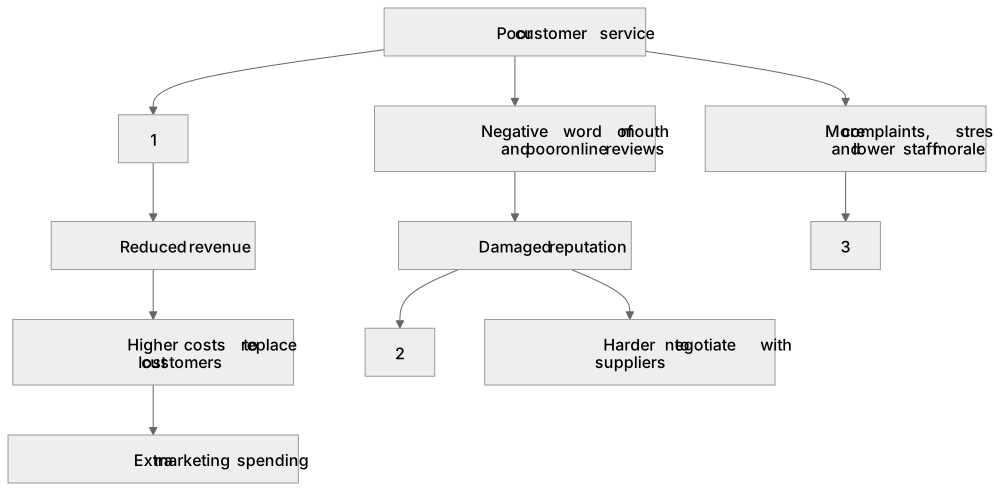
1Box 1
2Box 2
3Box 3
There is more to this lesson
The full lesson goes on to check your understanding and help you earn the marks. Create a free account to carry on, with your progress saved.
A week of Premium from your first lesson · Then the free plan continues · No card, no charge
Test your understanding of Good customer services: Dangers of poor customer service, including:
Active recall beats re-reading. Take an instant quiz now to test what you’ve learned and lock it into long-term memory.
A week of Premium from your first lesson · Then the free plan continues · No card, no charge