AQA · GCSE · Business
Course version: 8132 · Version from Sept 2017
Good customer services: reduction in revenue.
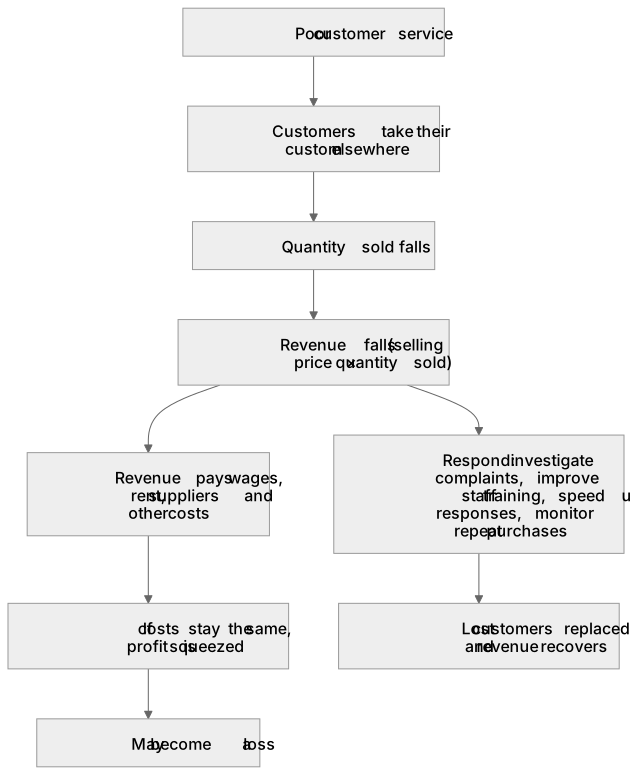
Poor customer service can drive customers away, and when customers stop buying, the money a business receives falls.
Checked against the AQA 8132 specification (opens in a new tab) on .
- Point 15 of 19
- 4 key terms
Study notes
From the checked teaching notes for this specification point.
The idea
Poor customer service can drive customers away, and when customers stop buying, the money a business receives falls. This fall is a reduction in revenue. Revenue is the total income from sales, calculated as selling price × quantity sold, so if a business sells 500 units at £20 each, revenue is £10,000; if poor service causes sales to drop to 400 units, revenue falls to £8,000, a reduction of £2,000. The reduction matters because revenue pays wages, rent, suppliers and other costs. If revenue falls while costs stay the same, profit is squeezed and may become a loss. A business can respond by investigating complaints, improving staff training, speeding up responses and monitoring repeat purchases, so that lost customers are replaced and revenue recovers.
What earns the marks
- Defines revenue as the total income a business receives from selling its goods or services, calculated as selling price × quantity sold.
- Explains that a reduction in revenue means the total income from sales has fallen compared with an earlier period or with the level expected.
- Links poor customer service to lost sales: dissatisfied customers may take their custom elsewhere, reducing the quantity sold and therefore revenue.
- Uses a numerical example, such as 500 units at £20 each giving £10,000, falling to 400 units at £20 each giving £8,000, to show a £2,000 reduction.
- Explains the consequence for the business: lower revenue can reduce profit or create a loss if costs do not fall by the same amount.
- Suggests a suitable response, such as improving staff training, resolving complaints quickly or monitoring customer satisfaction, to protect or rebuild revenue.
Common mistakes and how to put them right
Confusing revenue with profit.
Put it right: State that revenue is calculated as selling price × quantity sold before any costs are subtracted.
Assuming a reduction in revenue always means the business sold fewer units.
Put it right: Note that revenue can also fall if the selling price is reduced, even when the quantity sold stays the same.
Treating a reduction in revenue as automatically meaning the business made a loss.
Put it right: Explain that a loss occurs only if costs are greater than the reduced revenue, so profit may simply be lower rather than negative.
Exam tips
- Define revenue precisely before explaining the reduction, so the examiner can see you understand the term being applied.
- Use a short numerical example with a clear before-and-after calculation to demonstrate the size of the reduction.
- Link the reduction back to customer service and then forward to a consequence such as lower profit, so the chain of reasoning is complete.
Try the lesson
The start of the Good customer services: reduction in revenue. lesson, made from checked teaching notes for this specification point.
Have a go first
A business loses customers because its after-sales service is poor. What is the most likely direct effect on the business?
Listen
Poor customer service can drive customers away, and when customers stop buying, the money a business receives falls. This fall is a reduction in revenue. Revenue is the total income from sales, calculated as selling price × quantity sold, so if a business sells 500 units at £20 each, revenue is £10,000; if poor service causes sales to drop to 400 units, revenue falls to £8,000, a reduction of £2,000. The reduction matters because revenue pays wages, rent, suppliers and other costs. If revenue falls while costs stay the same, profit is squeezed and may become a loss. A business can respond by investigating complaints, improving staff training, speeding up responses and monitoring repeat purchases, so that lost customers are replaced and revenue recovers. A strong answer earns marks for these points. Defines revenue as the total income a business receives from selling its goods or services, calculated as selling price × quantity sold. Explains that a reduction in revenue means the total income from sales has fallen compared with an earlier period or with the level expected. Links poor customer service to lost sales: dissatisfied customers may take their custom elsewhere, reducing the quantity sold and therefore revenue. Uses a numerical example, such as 500 units at £20 each giving £10,000, falling to 400 units at £20 each giving £8,000, to show a £2,000 reduction. A common slip: Confusing revenue with profit: revenue is total income from sales, while profit is what remains after costs are deducted. Instead, state that revenue is calculated as selling price × quantity sold before any costs are subtracted. Exam tip: Define revenue precisely before explaining the reduction, so the examiner can see you understand the term being applied.
See it
Key words
Say what each word means before you turn the card.
Revenue
Try answering aloud or in your head before turning the card.
Reduction in revenue
Try answering aloud or in your head before turning the card.
Profit
Try answering aloud or in your head before turning the card.
Corrective action
Try answering aloud or in your head before turning the card.
See every definition
- Revenue
- The total income from sales, calculated as selling price × quantity sold.
- Reduction in revenue
- A fall in the total income from sales compared with an earlier period or with the level expected.
- Profit
- What remains after costs are deducted, which is squeezed and may become a loss if revenue falls while costs stay the same.
- Corrective action
- Responding by investigating complaints, improving staff training, speeding up responses and monitoring repeat purchases, so that lost customers are replaced and revenue recovers.
Label the diagram
Some boxes have lost their names. Pick the right name for each number.
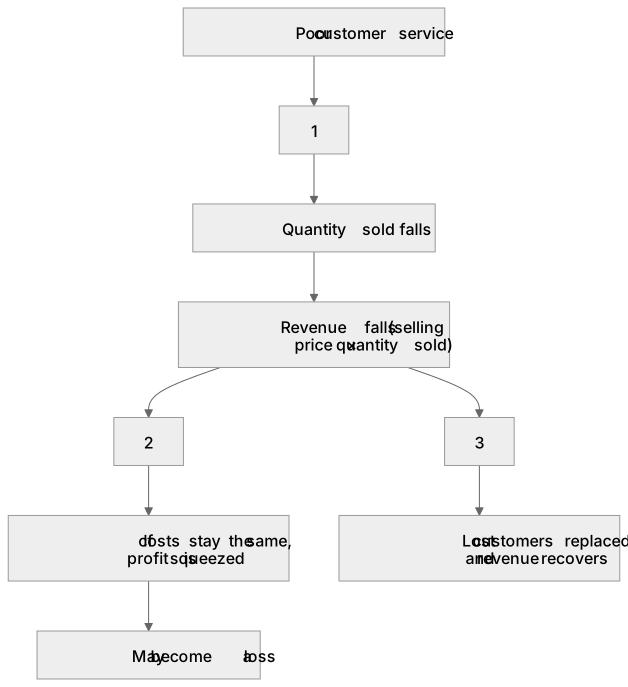
1Box 1
2Box 2
3Box 3
There is more to this lesson
The full lesson goes on to check your understanding and help you earn the marks. Create a free account to carry on, with your progress saved.
A week of Premium from your first lesson · Then the free plan continues · No card, no charge
Test your understanding of Good customer services: reduction in revenue.
Active recall beats re-reading. Take an instant quiz now to test what you’ve learned and lock it into long-term memory.
A week of Premium from your first lesson · Then the free plan continues · No card, no charge