AQA · GCSE · Business
Course version: 8132 · Version from Sept 2017
Provide a product or service that customers will buy
Full specification wording
Identifying and understanding customers: provide a product or service that customers will buy
This clause states the purpose of identifying and satisfying customer needs: to provide a product or service that customers will actually buy.
Checked against the AQA 8132 specification (opens in a new tab) on .
- Point 3 of 7
- 4 key terms
Study notes
From the checked teaching notes for this specification point.
The idea
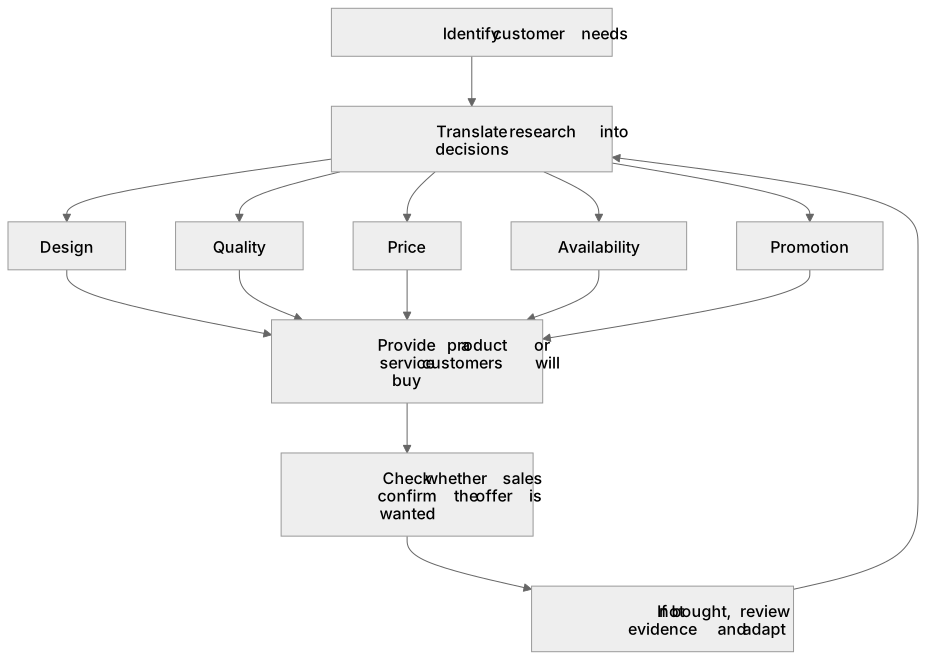
This clause states the purpose of identifying and satisfying customer needs: to provide a product or service that customers will actually buy. A product is a tangible good such as a phone or a loaf of bread; a service is intangible, such as a haircut or a bus journey. Customers buy when the offer gives them value, meaning the benefits and features are worth the price asked. So the business must translate research into decisions on design, quality, price, availability and promotion, then check whether sales confirm the offer is wanted. For example, a gym that finds members want early-morning classes can timetable them before 7am; if attendance rises, the offer is being bought. If not, the business reviews the evidence and adapts, because buying is the test of whether needs were truly met.
What earns the marks
- The clause covers both products and services, so candidates should be able to give a tangible example and an intangible example and explain what makes each buyable.
- Customers buy when perceived benefits exceed or match the price, so value for money, quality and suitability all influence the purchase decision.
- Providing a buyable offer requires the marketing mix to be consistent: a good product at the wrong price or in the wrong place may still fail to sell.
- Sales evidence, such as repeat purchases and demand levels, shows whether the business has genuinely provided something customers will buy.
- If customers do not buy, the business should revisit its customer research and adapt the offer rather than assume the market is wrong.
Common mistakes and how to put them right
Writing only about making a product and ignoring the service option.
Put it right: Use examples of both, such as a laptop and a streaming subscription.
Assuming a good-quality product will always sell.
Put it right: Customers must also find the price, place and promotion acceptable before they buy.
Treating one purchase as proof of success.
Put it right: Repeat buying and sustained demand are stronger evidence that the offer meets needs.
Exam tips
- Anchor answers in a specific business and name the product or service, then explain why a customer in that market would choose to buy it.
- Link back to customer needs explicitly, showing how research shaped the feature, price or availability that makes the offer buyable.
- Use terms such as value for money, demand and repeat purchase accurately to show understanding of why customers buy.
Try the lesson
The start of the Identifying and understanding customers: provide a product or service that customers will buy lesson, made from checked teaching notes for this specification point.
Have a go first
Why is it important for a business to identify and understand the needs of its customers before developing a new product?
Listen
This clause states the purpose of identifying and satisfying customer needs: to provide a product or service that customers will actually buy. A product is a tangible good such as a phone or a loaf of bread; a service is intangible, such as a haircut or a bus journey. Customers buy when the offer gives them value, meaning the benefits and features are worth the price asked. So the business must translate research into decisions on design, quality, price, availability and promotion, then check whether sales confirm the offer is wanted. For example, a gym that finds members want early-morning classes can timetable them before 7am; if attendance rises, the offer is being bought. If not, the business reviews the evidence and adapts, because buying is the test of whether needs were truly met. A strong answer earns marks for these points. The clause covers both products and services, so candidates should be able to give a tangible example and an intangible example and explain what makes each buyable. Customers buy when perceived benefits exceed or match the price, so value for money, quality and suitability all influence the purchase decision. Providing a buyable offer requires the marketing mix to be consistent: a good product at the wrong price or in the wrong place may still fail to sell. Sales evidence, such as repeat purchases and demand levels, shows whether the business has genuinely provided something customers will buy. A common slip: Writing only about making a product and ignoring the service option. Instead, use examples of both, such as a laptop and a streaming subscription. Exam tip: Anchor answers in a specific business and name the product or service, then explain why a customer in that market would choose to buy it.
See it
Key words
Say what each word means before you turn the card.
Product
Try answering aloud or in your head before turning the card.
Service
Try answering aloud or in your head before turning the card.
Value for money
Try answering aloud or in your head before turning the card.
Consistency of the marketing mix
Try answering aloud or in your head before turning the card.
See every definition
- Product
- A tangible good, such as a phone or a loaf of bread, that a business provides for customers to buy.
- Service
- An intangible offer, such as a haircut or a bus journey, that a business provides for customers to buy.
- Value for money
- When the benefits and features of an offer are worth the price asked, so customers buy.
- Consistency of the marketing mix
- Decisions on design, quality, price, availability and promotion fitting together, because a good product at the wrong price or in the wrong place may still fail to sell.
Label the diagram
Some boxes have lost their names. Pick the right name for each number.
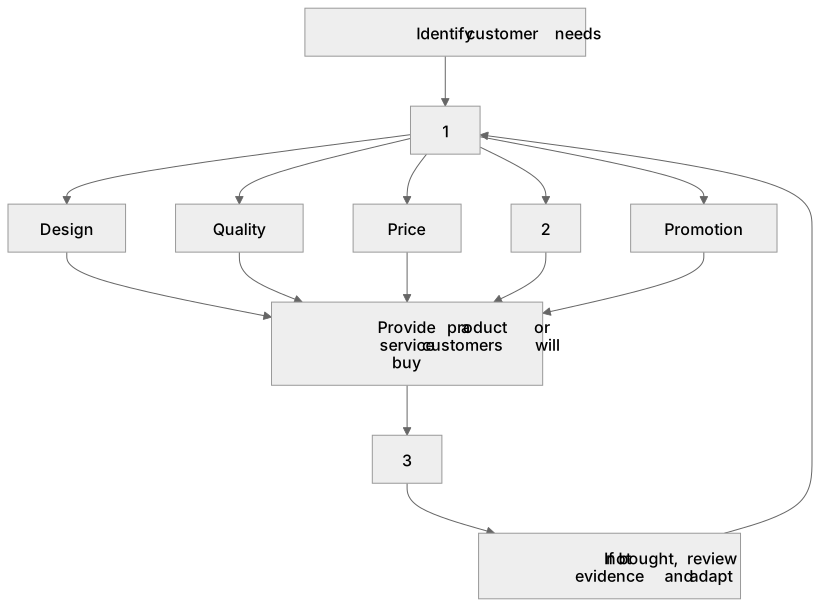
1Box 1
2Box 2
3Box 3
There is more to this lesson
The full lesson goes on to check your understanding and help you earn the marks. Create a free account to carry on, with your progress saved.
A week of Premium from your first lesson · Then the free plan continues · No card, no charge
Test your understanding of Identifying and understanding customers: provide a product or service that customers will buy
Active recall beats re-reading. Take an instant quiz now to test what you’ve learned and lock it into long-term memory.
A week of Premium from your first lesson · Then the free plan continues · No card, no charge