AQA · GCSE · Business
Course version: 8132 · Version from Sept 2017
The importance of external influences on business and how businesses…
Full specification wording
Influences on business: The importance of external influences on business and how businesses change in response to these influences.
External influences are factors outside a business's control that affect its costs, demand, operations and strategy.
Checked against the AQA 8132 specification (opens in a new tab) on .
- Point 1 of 6
- 3 key terms
Study notes
From the checked teaching notes for this specification point.
The idea
External influences are factors outside a business's control that affect its costs, demand, operations and strategy. They include technology, legislation, the economic climate, globalisation and ethical and environmental expectations. Their importance lies in the scale of impact: a rise in interest rates can raise borrowing costs and cut consumer spending, while new technology can lower costs or open new markets. Businesses respond by changing products, processes, prices, marketing or location. For example, a retailer facing higher minimum wage costs might raise prices, automate tills or reduce staff hours. Effective answers explain the influence, analyse its effect on the business, then evaluate how far the response solves the problem. Responses vary by size, sector and resources, so context matters.
What earns the marks
- Identify a relevant external influence, such as technology, legislation, the economic climate, globalisation or ethical expectations.
- Explain how the influence affects the business, for example through costs, demand, pricing or operations.
- Describe a specific response, such as changing products, processes, marketing or location.
- Analyse the consequence of the response for the business, such as effect on profit, competitiveness or reputation.
- Evaluate how effective or appropriate the response is, considering the business's size, sector and resources.
- Use business context and data from the case to support the argument.
Common mistakes and how to put them right
Confusing internal weaknesses with external influences.
Put it right by checking the factor lies outside the business's control.
Describing an influence without linking it to a business response.
Put it right by adding a specific action the business takes.
Listing influences without analysing impact.
Put it right by explaining the effect on costs, demand or profit for each point.
Exam tips
- Use connectives such as because, therefore and this leads to, to build chains of reasoning from influence to impact to response.
- Apply each point to the case business rather than writing generically about businesses in general.
- For evaluation, weigh the response against alternatives and reach a justified conclusion about how far it works.
Try the lesson
The start of the Influences on business: The importance of external influences on business and how businesses change in response to these influences. lesson, made from checked teaching notes for this specification point.
Have a go first
Which of the following is an external influence on a business?
Listen
External influences are factors outside a business's control that affect its costs, demand, operations and strategy. They include technology, legislation, the economic climate, globalisation and ethical and environmental expectations. Their importance lies in the scale of impact: a rise in interest rates can raise borrowing costs and cut consumer spending, while new technology can lower costs or open new markets. Businesses respond by changing products, processes, prices, marketing or location. For example, a retailer facing higher minimum wage costs might raise prices, automate tills or reduce staff hours. Effective answers explain the influence, analyse its effect on the business, then evaluate how far the response solves the problem. Responses vary by size, sector and resources, so context matters. A strong answer earns marks for these points. Identify a relevant external influence, such as technology, legislation, the economic climate, globalisation or ethical expectations. Explain how the influence affects the business, for example through costs, demand, pricing or operations. Describe a specific response, such as changing products, processes, marketing or location. Analyse the consequence of the response for the business, such as effect on profit, competitiveness or reputation. A common slip: Confusing internal weaknesses with external influences. Instead, checking the factor lies outside the business's control. Exam tip: Use connectives such as because, therefore and this leads to, to build chains of reasoning from influence to impact to response.
See it
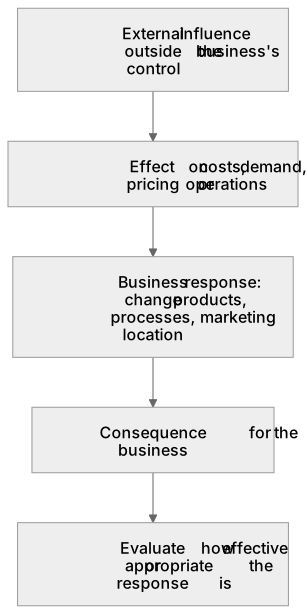
Put it in order
Put these steps in the order they happen.
- 1. Effect on costs, demand, pricing or operations
- 2. Business response: change products, processes, marketing or location
- 3. External influence outside the business's control
- 4. Evaluate how effective or appropriate the response is
- 5. Consequence for the business
Key words
Say what each word means before you turn the card.
External influences
Try answering aloud or in your head before turning the card.
Legislation and ethics
Try answering aloud or in your head before turning the card.
Economic climate and globalisation
Try answering aloud or in your head before turning the card.
See every definition
- External influences
- Factors outside a business's control that affect its costs, demand, operations and strategy.
- Legislation and ethics
- An external influence covering legislation and ethical and environmental expectations.
- Economic climate and globalisation
- External influences that affect a business alongside technology, legislation and ethical and environmental expectations.
Label the diagram
Some boxes have lost their names. Pick the right name for each number.
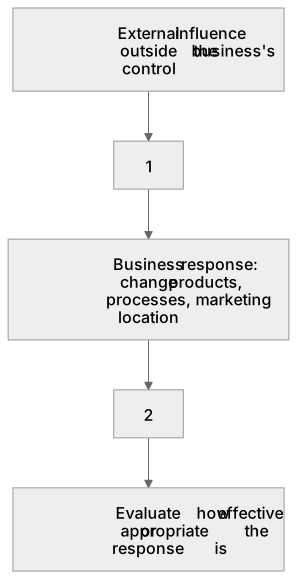
1Box 1
2Box 2
There is more to this lesson
The full lesson goes on to check your understanding and help you earn the marks. Create a free account to carry on, with your progress saved.
A week of Premium from your first lesson · Then the free plan continues · No card, no charge
Test your understanding of Influences on business: The importance of external influences on business and how businesses change in response to these influences.
Active recall beats re-reading. Take an instant quiz now to test what you’ve learned and lock it into long-term memory.
A week of Premium from your first lesson · Then the free plan continues · No card, no charge