AQA · GCSE · Business
Course version: 8132 · Version from Sept 2017
Legislation: Employment law including:
Employment law sets the legal rules covering the employer-employee relationship.
Checked against the AQA 8132 specification (opens in a new tab) on .
- Point 6 of 11
- 4 key terms
Study notes
From the checked teaching notes for this specification point.
The idea
Employment law sets the legal rules covering the employer-employee relationship. It includes contracts of employment, which state pay, hours, duties and notice; recruitment rules against discrimination; health and safety duties; minimum wage and working time limits; protection from unfair dismissal and redundancy; and rights to holidays, rest breaks and leave. For example, a shop must give a written statement of key terms, pay at least the minimum wage, and follow a fair process before dismissing a worker. Breaking these rules can lead to employment tribunals, compensation, fines and reputational damage, so businesses must know and apply the law.
What earns the marks
- Identifies the main areas of employment law: contracts, recruitment and discrimination, pay, working time, health and safety, dismissal and redundancy.
- Explains that contracts of employment set out pay, hours, duties, notice and other key terms for both employer and employee.
- Explains that discrimination law requires fair treatment in recruitment, promotion and dismissal regardless of protected characteristics.
- Explains that dismissal and redundancy must follow fair, lawful procedures, or the business risks a tribunal and compensation.
- Applies employment law to a scenario, for example advising a café on written contracts, minimum wage and fair dismissal steps.
Common mistakes and how to put them right
Listing laws without explaining their effect on the business.
Put it right by stating what the law requires and the consequence of breaking it.
Confusing unfair dismissal with redundancy.
Put it right by noting that dismissal relates to conduct or capability, while redundancy arises when a job disappears.
Ignoring that employment law applies from recruitment onwards.
Put it right by covering job adverts, interviews, contracts and dismissal.
Exam tips
- Use accurate terms such as contract of employment, minimum wage, discrimination and unfair dismissal.
- Link each legal requirement to a business consequence, such as a tribunal claim, fine or damaged reputation.
- Apply the law to the case study business rather than describing it in general terms.
Try the lesson
The start of the Legislation: Employment law including: lesson, made from checked teaching notes for this specification point.
Have a go first
Which of the following is protected by employment law in the UK?
Listen
Employment law sets the legal rules covering the employer-employee relationship. It includes contracts of employment, which state pay, hours, duties and notice; recruitment rules against discrimination; health and safety duties; minimum wage and working time limits; protection from unfair dismissal and redundancy; and rights to holidays, rest breaks and leave. For example, a shop must give a written statement of key terms, pay at least the minimum wage, and follow a fair process before dismissing a worker. Breaking these rules can lead to employment tribunals, compensation, fines and reputational damage, so businesses must know and apply the law. A strong answer earns marks for these points. Identifies the main areas of employment law: contracts, recruitment and discrimination, pay, working time, health and safety, dismissal and redundancy. Explains that contracts of employment set out pay, hours, duties, notice and other key terms for both employer and employee. Explains that discrimination law requires fair treatment in recruitment, promotion and dismissal regardless of protected characteristics. Explains that dismissal and redundancy must follow fair, lawful procedures, or the business risks a tribunal and compensation. A common slip: Listing laws without explaining their effect on the business. Instead, stating what the law requires and the consequence of breaking it. Exam tip: Use accurate terms such as contract of employment, minimum wage, discrimination and unfair dismissal.
See it

Key words
Say what each word means before you turn the card.
Contracts of employment
Try answering aloud or in your head before turning the card.
Discrimination
Try answering aloud or in your head before turning the card.
Unfair dismissal
Try answering aloud or in your head before turning the card.
Minimum wage
Try answering aloud or in your head before turning the card.
See every definition
- Contracts of employment
- These set out pay, hours, duties, notice and other key terms for both employer and employee.
- Discrimination
- Recruitment rules require fair treatment in recruitment, promotion and dismissal regardless of protected characteristics.
- Unfair dismissal
- Protection from unfair dismissal and redundancy applies, and dismissal must follow fair, lawful procedures or the business risks a tribunal and compensation.
- Minimum wage
- Pay must be at least the minimum wage, alongside working time limits and rights to holidays, rest breaks and leave.
Label the diagram
Some boxes have lost their names. Pick the right name for each number.
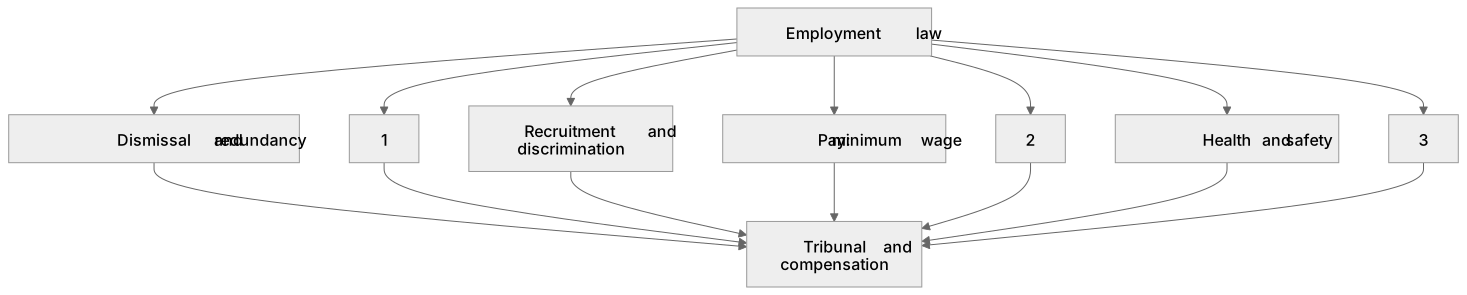
1Box 1
2Box 2
3Box 3
There is more to this lesson
The full lesson goes on to check your understanding and help you earn the marks. Create a free account to carry on, with your progress saved.
A week of Premium from your first lesson · Then the free plan continues · No card, no charge
Test your understanding of Legislation: Employment law including:
Active recall beats re-reading. Take an instant quiz now to test what you’ve learned and lock it into long-term memory.
A week of Premium from your first lesson · Then the free plan continues · No card, no charge