AQA · GCSE · Business
Course version: 8132 · Version from Sept 2017
Students should be aware of the benefits for providing a safe working…
Full specification wording
Legislation: Students should be aware of the benefits for providing a safe working environment.
A safe working environment means protecting employees from hazards such as slips, machinery, chemicals and stress.
Checked against the AQA 8132 specification (opens in a new tab) on .
- Point 5 of 11
- 4 key terms
Study notes
From the checked teaching notes for this specification point.
The idea
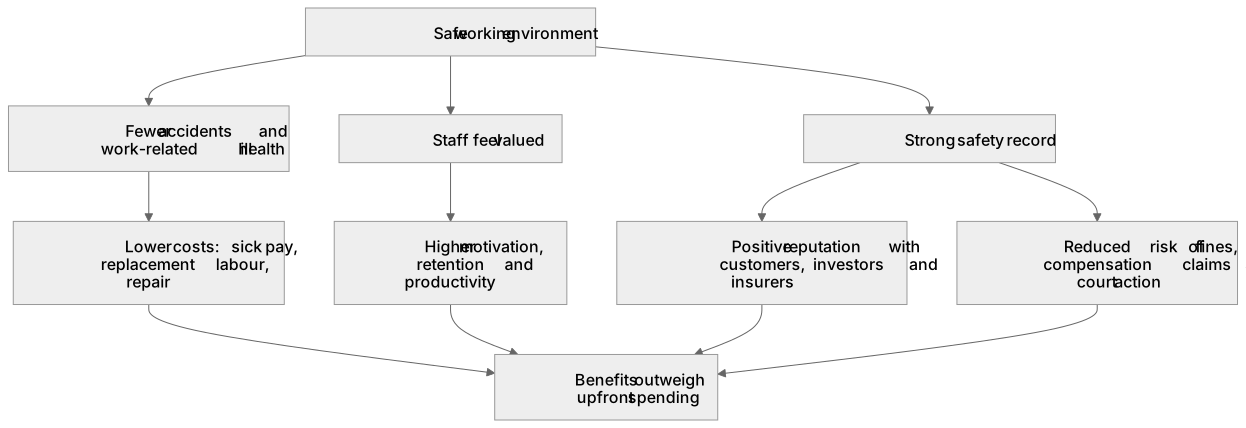
A safe working environment means protecting employees from hazards such as slips, machinery, chemicals and stress. Benefits reach beyond legal compliance. Accidents fall, so sick pay, replacement labour and repair costs drop. Staff feel valued, raising motivation, retention and productivity. A strong safety record builds reputation with customers, investors and insurers, and reduces the risk of fines, compensation claims and court action. For example, a bakery fitting guards to mixers and training staff on flour dust may spend money upfront, yet avoids a serious injury, an investigation and lost output. Safety also supports recruitment, because applicants prefer employers who protect them.
What earns the marks
- Explains that a safe working environment reduces accidents and work-related ill health, lowering costs such as sick pay, temporary cover and damaged equipment.
- Links safety to employee motivation, morale and retention, because workers who feel protected are more likely to stay and work productively.
- Shows how legal compliance avoids fines, compensation claims, court cases and enforced closure, protecting cash flow and continuity.
- Explains reputational benefits: customers, suppliers, investors and insurers respond positively to a business with a strong safety record.
- Applies the benefits to a given business context, for example a warehouse investing in racking inspections and forklift training to cut injury downtime.
Common mistakes and how to put them right
Treating safety purely as a legal duty and ignoring business benefits.
Put it right by explaining at least one cost saving and one motivation or reputation gain.
Assuming safety measures are always a pure cost.
Put it right by weighing short-term spending against avoided accidents, absence and legal penalties.
Confusing a safe working environment with general employee benefits such as pay rises.
Put it right by keeping the focus on hazard control, training and protective equipment.
Exam tips
- Use the case study: name the specific hazard and the specific benefit, such as fewer forklift injuries reducing cover costs.
- Develop each benefit with a chain of reasoning: safer workplace, fewer accidents, lower costs, higher profit.
- Balance the answer by noting that safety measures cost money, then explain why the benefits can still outweigh them.
Try the lesson
The start of the Legislation: Students should be aware of the benefits for providing a safe working environment. lesson, made from checked teaching notes for this specification point.
Have a go first
Which of the following is a benefit to a business of providing a safe working environment?
Listen
A safe working environment means protecting employees from hazards such as slips, machinery, chemicals and stress. Benefits reach beyond legal compliance. Accidents fall, so sick pay, replacement labour and repair costs drop. Staff feel valued, raising motivation, retention and productivity. A strong safety record builds reputation with customers, investors and insurers, and reduces the risk of fines, compensation claims and court action. For example, a bakery fitting guards to mixers and training staff on flour dust may spend money upfront, yet avoids a serious injury, an investigation and lost output. Safety also supports recruitment, because applicants prefer employers who protect them. A strong answer earns marks for these points. Explains that a safe working environment reduces accidents and work-related ill health, lowering costs such as sick pay, temporary cover and damaged equipment. Links safety to employee motivation, morale and retention, because workers who feel protected are more likely to stay and work productively. Shows how legal compliance avoids fines, compensation claims, court cases and enforced closure, protecting cash flow and continuity. Explains reputational benefits: customers, suppliers, investors and insurers respond positively to a business with a strong safety record. A common slip: Treating safety purely as a legal duty and ignoring business benefits. Instead, explaining at least one cost saving and one motivation or reputation gain. Exam tip: Use the case study: name the specific hazard and the specific benefit, such as fewer forklift injuries reducing cover costs.
See it
Key words
Say what each word means before you turn the card.
Employee health, safety and wellbeing
Try answering aloud or in your head before turning the card.
Cost control and productivity
Try answering aloud or in your head before turning the card.
Legal compliance and risk management
Try answering aloud or in your head before turning the card.
Business reputation and stakeholder trust
Try answering aloud or in your head before turning the card.
See every definition
- Employee health, safety and wellbeing
- Protecting employees from hazards such as slips, machinery, chemicals and stress.
- Cost control and productivity
- Accidents fall, so sick pay, replacement labour and repair costs drop, and staff feel valued, raising motivation, retention and productivity.
- Legal compliance and risk management
- A strong safety record reduces the risk of fines, compensation claims and court action.
- Business reputation and stakeholder trust
- A strong safety record builds reputation with customers, investors and insurers.
Label the diagram
Some boxes have lost their names. Pick the right name for each number.
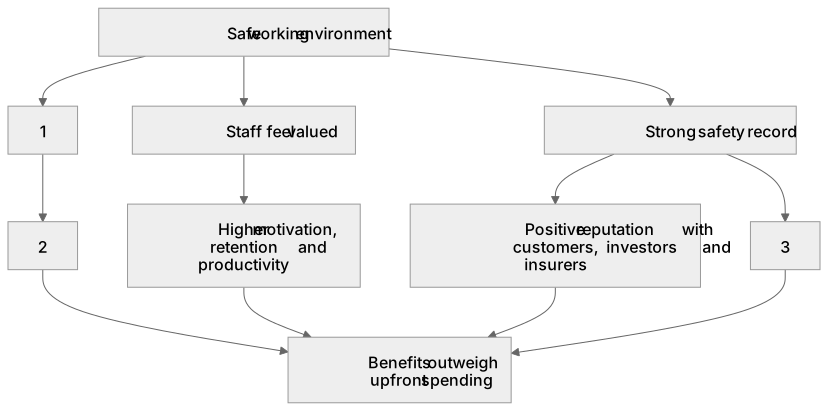
1Box 1
2Box 2
3Box 3
There is more to this lesson
The full lesson goes on to check your understanding and help you earn the marks. Create a free account to carry on, with your progress saved.
A week of Premium from your first lesson · Then the free plan continues · No card, no charge
Test your understanding of Legislation: Students should be aware of the benefits for providing a safe working environment.
Active recall beats re-reading. Take an instant quiz now to test what you’ve learned and lock it into long-term memory.
A week of Premium from your first lesson · Then the free plan continues · No card, no charge