AQA · GCSE · Business
Course version: 8132 · Version from Sept 2017
Students should understand the interdependent nature of business…
Full specification wording
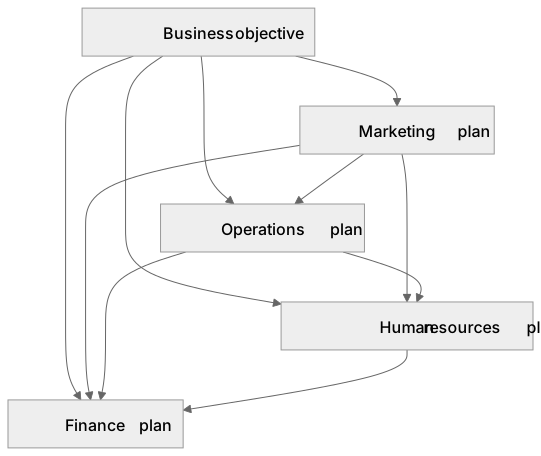
Marketing: Students should understand the interdependent nature of business operations, human resources, marketing and finance. Students should be able to give examples of how business objectives would be split into functional plans with clear links throughout.
Business operations, human resources, marketing and finance do not work in isolation; they are interdependent, meaning a decision in one function affects the others.
Checked against the AQA 8132 specification (opens in a new tab) on .
- Point 1 of 2
- 4 key terms
Study notes
From the checked teaching notes for this specification point.
The idea
Business operations, human resources, marketing and finance do not work in isolation; they are interdependent, meaning a decision in one function affects the others. For example, a marketing plan to launch a new product requires operations to produce it, human resources to recruit or train staff, and finance to fund the campaign and manage cash flow. Business objectives are broad aims, such as increasing market share, and these are split into functional plans that set out what each department will do to contribute. Clear links throughout mean each functional plan supports the overall objective and the plans are consistent with one another. If marketing promises rapid delivery but operations cannot meet it, or finance cannot fund recruitment, the objective fails.
What earns the marks
- Defines interdependence as the way business functions rely on and affect one another.
- Explains how operations, human resources, marketing and finance each contribute to achieving business objectives.
- Gives an example of a business objective being split into functional plans, such as increasing sales leading to a marketing campaign, extra production and recruitment.
- Explains clear links throughout, showing how one function's plan depends on another's actions and resources.
- Uses a specific business context to illustrate the connections between functions.
- Recognises that poor communication or conflicting plans between functions can prevent objectives being met.
Common mistakes and how to put them right
Describing each function separately without showing how they connect.
Put it right: Explain the link, such as marketing demand requiring operations capacity and finance funding.
Confusing a business objective with a functional plan.
Put it right: State the broad objective first, then show the specific departmental plan that supports it.
Assuming finance only pays bills rather than shaping what other functions can do.
Put it right: Explain how budget limits or enables marketing, operations and human resources plans.
Exam tips
- Use a named business example so the interdependence is concrete rather than abstract.
- Structure answers by naming the objective, then the functional plans, then the links between them.
- Use linking words such as which means, therefore and as a result to show cause and effect between functions.
Try the lesson
The start of the Marketing: Students should understand the interdependent nature of business operations, human resources, marketing and finance. Students should be able to give examples of how business objectives would be split into functional plans with clear links throughout. lesson, made from checked teaching notes for this specification point.
Have a go first
A business sets an overall objective to increase its sales by 10% next year. Which functional plan would most directly support this objective?
Listen
Business operations, human resources, marketing and finance do not work in isolation; they are interdependent, meaning a decision in one function affects the others. For example, a marketing plan to launch a new product requires operations to produce it, human resources to recruit or train staff, and finance to fund the campaign and manage cash flow. Business objectives are broad aims, such as increasing market share, and these are split into functional plans that set out what each department will do to contribute. Clear links throughout mean each functional plan supports the overall objective and the plans are consistent with one another. If marketing promises rapid delivery but operations cannot meet it, or finance cannot fund recruitment, the objective fails. A strong answer earns marks for these points. Defines interdependence as the way business functions rely on and affect one another. Explains how operations, human resources, marketing and finance each contribute to achieving business objectives. Gives an example of a business objective being split into functional plans, such as increasing sales leading to a marketing campaign, extra production and recruitment. Explains clear links throughout, showing how one function's plan depends on another's actions and resources. A common slip: Describing each function separately without showing how they connect. Instead, explain the link, such as marketing demand requiring operations capacity and finance funding. Exam tip: Use a named business example so the interdependence is concrete rather than abstract.
See it
Key words
Say what each word means before you turn the card.
Interdependence
Try answering aloud or in your head before turning the card.
Business objectives
Try answering aloud or in your head before turning the card.
Functional plans
Try answering aloud or in your head before turning the card.
Clear links throughout
Try answering aloud or in your head before turning the card.
See every definition
- Interdependence
- The way business functions rely on and affect one another, so a decision in one function affects the others.
- Business objectives
- Broad aims, such as increasing market share, that are split into functional plans.
- Functional plans
- Plans that set out what each department will do to contribute to the overall objective.
- Clear links throughout
- Each functional plan supports the overall objective and the plans are consistent with one another.
Label the diagram
Some boxes have lost their names. Pick the right name for each number.
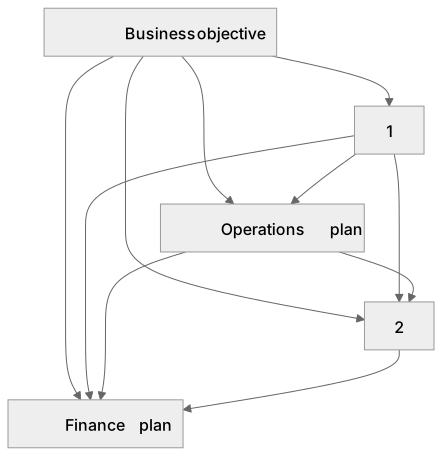
1Box 1
2Box 2
There is more to this lesson
The full lesson goes on to check your understanding and help you earn the marks. Create a free account to carry on, with your progress saved.
A week of Premium from your first lesson · Then the free plan continues · No card, no charge
Test your understanding of Marketing: Students should understand the interdependent nature of business operations, human resources, marketing and finance. Students should be able to give examples of how business objectives would be split into functional plans with clear links throughout.
Active recall beats re-reading. Take an instant quiz now to test what you’ve learned and lock it into long-term memory.
A week of Premium from your first lesson · Then the free plan continues · No card, no charge