AQA · GCSE · Business
Course version: 8132 · Version from Sept 2017
The purpose of marketing, its role within business and how it influences…
Full specification wording
Marketing: The purpose of marketing, its role within business and how it influences business activity.
Marketing is the business function that identifies what customers want and then shapes the product, price, promotion and place so the offer satisfies them profitably.
Checked against the AQA 8132 specification (opens in a new tab) on .
- Point 2 of 2
- 4 key terms
Study notes
From the checked teaching notes for this specification point.
The idea
Marketing is the business function that identifies what customers want and then shapes the product, price, promotion and place so the offer satisfies them profitably. Its purpose is to create value for both customer and firm: customers gain goods or services that meet needs, while the business builds demand, sales and repeat custom. Within a business, marketing links market research, design, production, finance and distribution, so decisions are coordinated rather than isolated. It influences business activity by directing what is produced, how much is made, which segments are targeted and how resources are allocated.
For example: Research showing rising demand for reusable bottles may lead a firm to redesign packaging, set a premium price, promote environmental benefits and sell through outdoor retailers, changing production schedules and budgets.
What earns the marks
- Defines marketing as identifying and satisfying customer needs profitably, not merely advertising.
- Explains that marketing coordinates product, price, promotion and place decisions.
- Shows how marketing research informs design, production volume and resource allocation.
- Explains how marketing influences targeting, positioning and competitive strategy.
- Uses a business example to show marketing changing business activity, such as output, budgets or distribution.
Common mistakes and how to put them right
Treating marketing as only advertising.
Put it right by explaining it also covers research, product design, pricing and distribution.
Assuming marketing guarantees sales.
Put it right by noting it raises the chance of satisfying customers but external factors and competitors still matter.
Ignoring the link to other functions.
Put it right by showing how marketing information affects production, finance and staffing decisions.
Exam tips
- Use a named business or product to show marketing influencing a real decision.
- Link each marketing activity to a business consequence such as sales, costs or customer loyalty.
- Answer the command word directly: define, explain or analyse rather than listing marketing terms.
Try the lesson
The start of the Marketing: The purpose of marketing, its role within business and how it influences business activity. lesson, made from checked teaching notes for this specification point.
Have a go first
Which statement best describes the main purpose of marketing within a business?
Listen
Marketing is the business function that identifies what customers want and then shapes the product, price, promotion and place so the offer satisfies them profitably. Its purpose is to create value for both customer and firm: customers gain goods or services that meet needs, while the business builds demand, sales and repeat custom. Within a business, marketing links market research, design, production, finance and distribution, so decisions are coordinated rather than isolated. It influences business activity by directing what is produced, how much is made, which segments are targeted and how resources are allocated. For example, research showing rising demand for reusable bottles may lead a firm to redesign packaging, set a premium price, promote environmental benefits and sell through outdoor retailers, changing production schedules and budgets. A strong answer earns marks for these points. Defines marketing as identifying and satisfying customer needs profitably, not merely advertising. Explains that marketing coordinates product, price, promotion and place decisions. Shows how marketing research informs design, production volume and resource allocation. Explains how marketing influences targeting, positioning and competitive strategy. A common slip: Treating marketing as only advertising. Instead, explaining it also covers research, product design, pricing and distribution. Exam tip: Use a named business or product to show marketing influencing a real decision.
See it
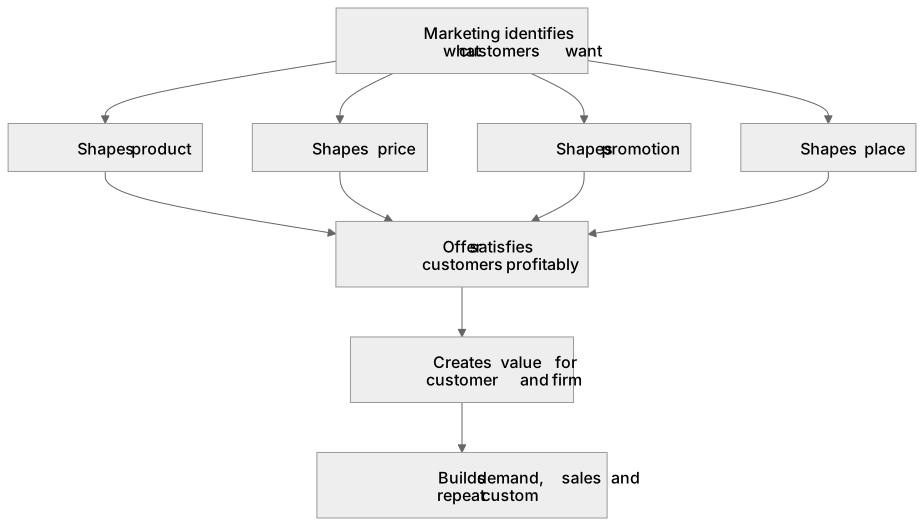
Key words
Say what each word means before you turn the card.
Customer focus
Try answering aloud or in your head before turning the card.
Coordination across business functions
Try answering aloud or in your head before turning the card.
Value creation and profitability
Try answering aloud or in your head before turning the card.
Responsiveness to market change
Try answering aloud or in your head before turning the card.
See every definition
- Customer focus
- Identifying what customers want and shaping the offer so it satisfies them profitably.
- Coordination across business functions
- Linking market research, design, production, finance and distribution so decisions are coordinated rather than isolated.
- Value creation and profitability
- Creating value for both customer and firm, as customers gain goods or services that meet needs while the business builds demand, sales and repeat custom.
- Responsiveness to market change
- Directing what is produced, how much is made, which segments are targeted and how resources are allocated in response to market research.
Label the diagram
Some boxes have lost their names. Pick the right name for each number.
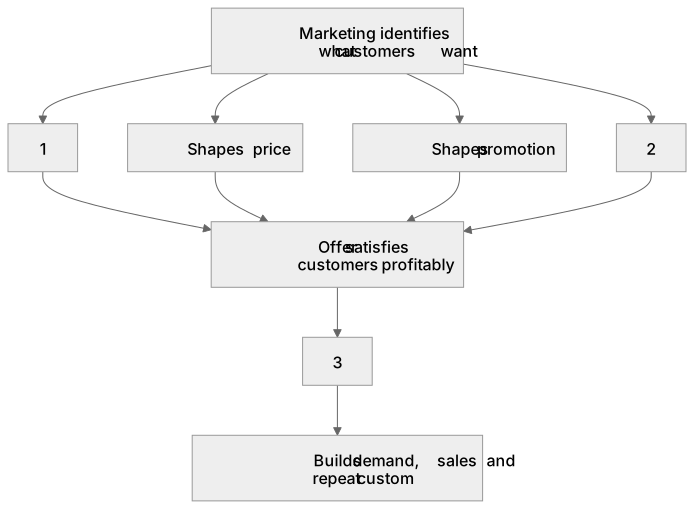
1Box 1
2Box 2
3Box 3
There is more to this lesson
The full lesson goes on to check your understanding and help you earn the marks. Create a free account to carry on, with your progress saved.
A week of Premium from your first lesson · Then the free plan continues · No card, no charge
Test your understanding of Marketing: The purpose of marketing, its role within business and how it influences business activity.
Active recall beats re-reading. Take an instant quiz now to test what you’ve learned and lock it into long-term memory.
A week of Premium from your first lesson · Then the free plan continues · No card, no charge