AQA · GCSE · Business
Course version: 8132 · Version from Sept 2017
How organisational structure may affect the different ways of communication.
Full specification wording
Organisational structures: how organisational structure may affect the different ways of communication.
Organisational structure is the way a business arranges roles, authority and reporting lines.
Checked against the AQA 8132 specification (opens in a new tab) on .
- Point 7 of 8
- 4 key terms
Study notes
From the checked teaching notes for this specification point.
The idea
Organisational structure is the way a business arranges roles, authority and reporting lines. A tall structure has many layers, so messages pass through several managers; this can slow communication and cause distortion. A flat structure has few layers, so staff may speak directly to senior managers, speeding decisions but increasing managers' workload. Centralised structures concentrate decisions at the top, so communication is mainly downward. Decentralised structures give local managers authority, so lateral and upward communication grows. Formal channels, such as reports and meetings, follow the structure; informal channels, such as conversations, cross it.
For example: A tall retailer may need a weekly briefing to reach shop-floor staff, while a flat design agency may use a daily stand-up.
What earns the marks
- Defines organisational structure as the arrangement of roles, authority and reporting relationships.
- Explains that tall structures create more layers, so messages pass through more people and may be slower or distorted.
- Explains that flat structures reduce layers, so communication can be faster and more direct, but managers may be overloaded.
- Distinguishes centralised structures, where decisions and communication flow mainly from the top, from decentralised structures, where local managers communicate more laterally and upward.
- Contrasts formal channels, such as reports, meetings and appraisals, with informal channels, such as conversations and social contact.
- Applies the link to a business example, showing how structure shapes the direction, speed and channel of communication.
Common mistakes and how to put them right
Treating structure and communication as unrelated.
Put it right: Show that reporting lines determine who communicates with whom, how quickly and through which channel.
Assuming flat structures always improve communication.
Put it right: Explain that fewer layers can speed messages but may overload managers and reduce clear authority.
Confusing centralised with decentralised.
Put it right: Centralised means decisions concentrate at the top, so communication is mainly downward; decentralised means authority is spread, so lateral and upward communication increases.
Exam tips
- Use a named business context and link each structural feature to a specific communication effect, such as speed, direction or risk of distortion.
- When comparing tall and flat structures, refer to the number of layers and the resulting chain of communication.
- Use business terms accurately, including chain of command, span of control, centralised, decentralised, formal and informal communication.
Try the lesson
The start of the Organisational structures: how organisational structure may affect the different ways of communication. lesson, made from checked teaching notes for this specification point.
Have a go first
A business has a tall organisational structure with a narrow span of control. How is a manager most likely to communicate daily instructions to the small team of staff who report directly to them?
Listen
Organisational structure is the way a business arranges roles, authority and reporting lines. A tall structure has many layers, so messages pass through several managers; this can slow communication and cause distortion. A flat structure has few layers, so staff may speak directly to senior managers, speeding decisions but increasing managers' workload. Centralised structures concentrate decisions at the top, so communication is mainly downward. Decentralised structures give local managers authority, so lateral and upward communication grows. Formal channels, such as reports and meetings, follow the structure; informal channels, such as conversations, cross it. For example, a tall retailer may need a weekly briefing to reach shop-floor staff, while a flat design agency may use a daily stand-up. A strong answer earns marks for these points. Defines organisational structure as the arrangement of roles, authority and reporting relationships. Explains that tall structures create more layers, so messages pass through more people and may be slower or distorted. Explains that flat structures reduce layers, so communication can be faster and more direct, but managers may be overloaded. Distinguishes centralised structures, where decisions and communication flow mainly from the top, from decentralised structures, where local managers communicate more laterally and upward. A common slip: Treating structure and communication as unrelated. Instead, show that reporting lines determine who communicates with whom, how quickly and through which channel. Exam tip: Use a named business context and link each structural feature to a specific communication effect, such as speed, direction or risk of distortion.
See it
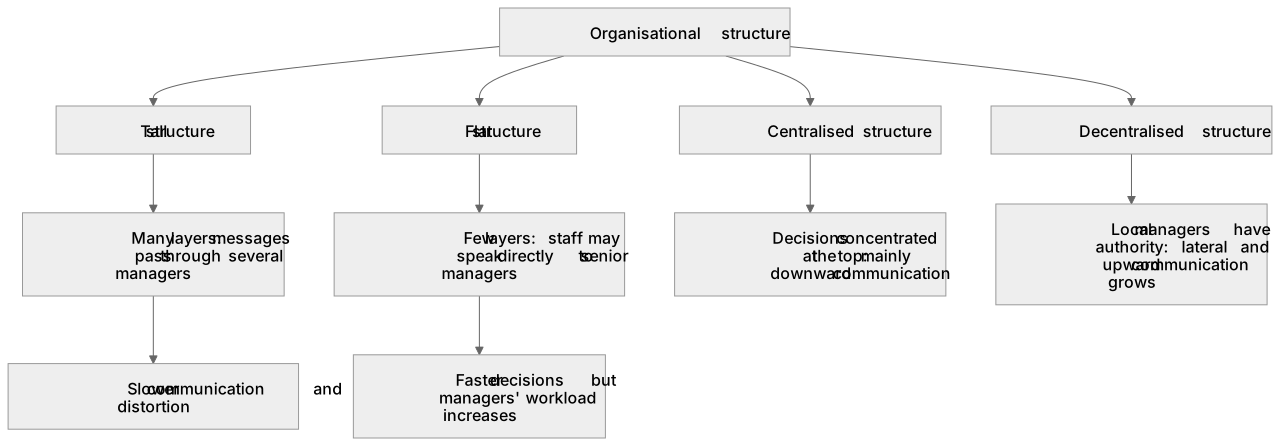
Key words
Say what each word means before you turn the card.
Organisational structure
Try answering aloud or in your head before turning the card.
Centralised structures
Try answering aloud or in your head before turning the card.
Decentralised structures
Try answering aloud or in your head before turning the card.
Formal channels
Try answering aloud or in your head before turning the card.
See every definition
- Organisational structure
- The way a business arranges roles, authority and reporting lines.
- Centralised structures
- Structures that concentrate decisions at the top, so communication is mainly downward.
- Decentralised structures
- Structures that give local managers authority, so lateral and upward communication grows.
- Formal channels
- Channels such as reports and meetings that follow the structure, unlike informal channels such as conversations, which cross it.
Label the diagram
Some boxes have lost their names. Pick the right name for each number.
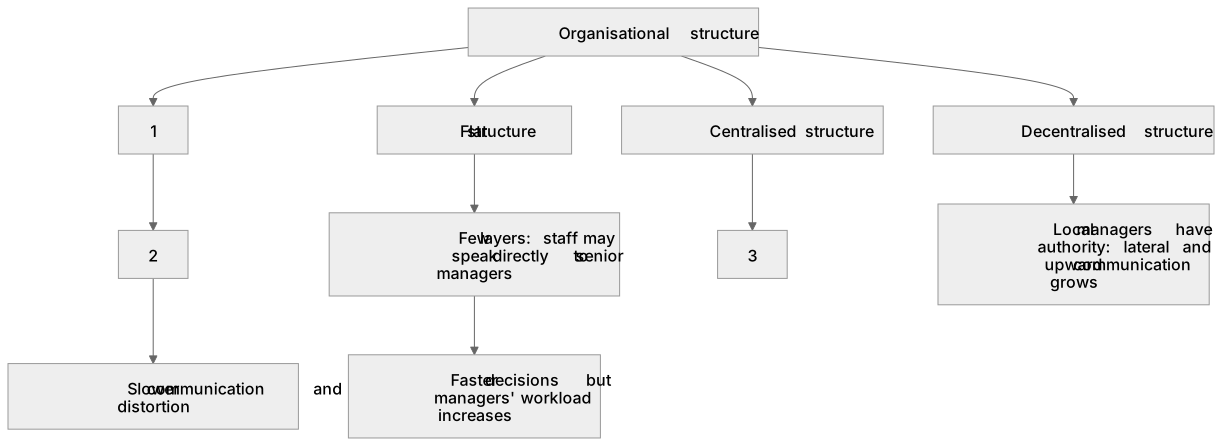
1Box 1
2Box 2
3Box 3
There is more to this lesson
The full lesson goes on to check your understanding and help you earn the marks. Create a free account to carry on, with your progress saved.
A week of Premium from your first lesson · Then the free plan continues · No card, no charge
Test your understanding of Organisational structures: how organisational structure may affect the different ways of communication.
Active recall beats re-reading. Take an instant quiz now to test what you’ve learned and lock it into long-term memory.
A week of Premium from your first lesson · Then the free plan continues · No card, no charge