AQA · GCSE · Business
Course version: 8132 · Version from Sept 2017
Internal organisational structures, span of control, chain of command,…
Full specification wording
Organisational structures: internal organisational structures, span of control, chain of command, delayering and delegation
This topic covers five key aspects of organisational structures: internal structures, span of control, chain of command, delayering, and delegation.
Checked against the AQA 8132 specification (opens in a new tab) on .
- Point 4 of 8
- 4 key terms
Study notes
From the checked teaching notes for this specification point.
The idea
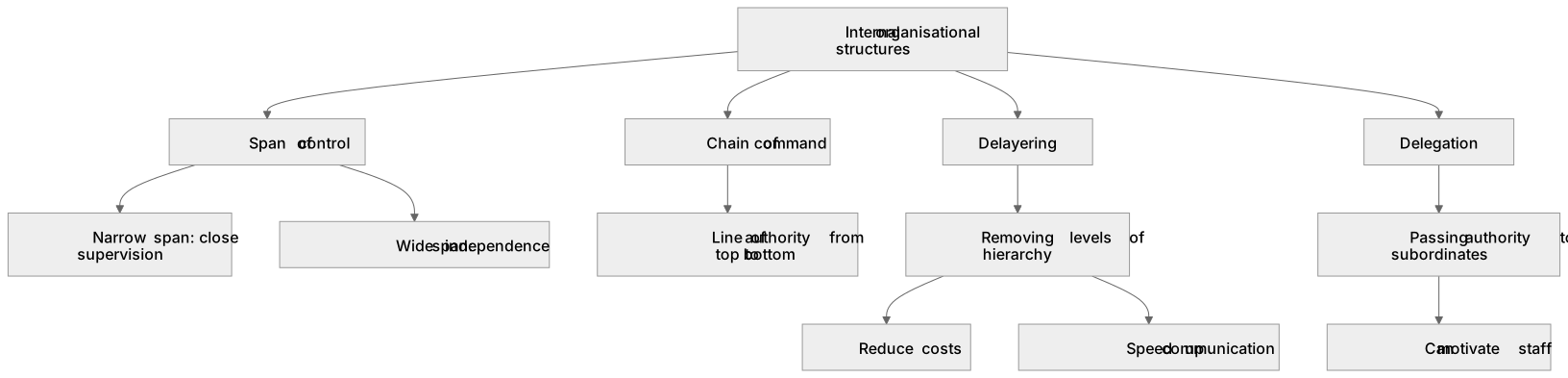
This topic covers five key aspects of organisational structures: internal structures, span of control, chain of command, delayering, and delegation. Internal structures dictate how a business organises its employees, typically into tall or flat hierarchies. Span of control is the number of subordinates directly managed by a supervisor; a narrow span allows close supervision, while a wide span gives independence. Chain of command is the line of authority from top to bottom. Delayering involves removing levels of hierarchy to reduce costs and speed up communication. Delegation is passing authority to subordinates to complete tasks, which can motivate staff. You must explain these terms and analyse their impacts on business efficiency.
What earns the marks
- Define internal organisational structures as the formal arrangement of roles, responsibilities, and reporting relationships within a business.
- Explain span of control as the number of employees directly reporting to a manager, and distinguish between narrow and wide spans.
- Describe chain of command as the hierarchy of authority through which instructions are passed, and explain its role in accountability.
- Explain delayering as the removal of one or more levels of management to reduce costs and improve communication.
- Define delegation as the assignment of authority to a subordinate for a specific task, and explain its benefits and risks.
- Apply these concepts to analyse how they affect efficiency, motivation, and decision-making in a given business.
Common mistakes and how to put them right
Confusing span of control with chain of command.
Put it right: Span of control is about the number of subordinates, while chain of command is about the line of authority.
Thinking delayering always improves motivation.
Put it right: It can increase workload and job insecurity, potentially demotivating remaining staff.
Believing delegation means giving away all responsibility.
Put it right: The manager remains accountable for the task, so delegation involves transferring authority, not ultimate responsibility.
Exam tips
- Use diagrams or descriptions of tall and flat structures to show span of control and chain of command; this can clarify your explanation and earn application marks.
- When discussing delayering, consider both financial benefits and potential negative effects on employee morale.
- For delegation, give a concrete example such as a team leader allowing a subordinate to handle customer complaints, and explain the impact on motivation and efficiency.
Try the lesson
The start of the Organisational structures: internal organisational structures, span of control, chain of command, delayering and delegation lesson, made from checked teaching notes for this specification point.
Have a go first
What is meant by the span of control of a manager?
Listen
This topic covers five key aspects of organisational structures: internal structures, span of control, chain of command, delayering, and delegation. Internal structures dictate how a business organises its employees, typically into tall or flat hierarchies. Span of control is the number of subordinates directly managed by a supervisor; a narrow span allows close supervision, while a wide span gives independence. Chain of command is the line of authority from top to bottom. Delayering involves removing levels of hierarchy to reduce costs and speed up communication. Delegation is passing authority to subordinates to complete tasks, which can motivate staff. You must explain these terms and analyse their impacts on business efficiency. A strong answer earns marks for these points. Define internal organisational structures as the formal arrangement of roles, responsibilities, and reporting relationships within a business. Explain span of control as the number of employees directly reporting to a manager, and distinguish between narrow and wide spans. Describe chain of command as the hierarchy of authority through which instructions are passed, and explain its role in accountability. Explain delayering as the removal of one or more levels of management to reduce costs and improve communication. A common slip: Confusing span of control with chain of command. Instead, span of control is about the number of subordinates, while chain of command is about the line of authority. Exam tip: Use diagrams or descriptions of tall and flat structures to show span of control and chain of command; this can clarify your explanation and earn application marks.
See it
Key words
Say what each word means before you turn the card.
Span of control
Try answering aloud or in your head before turning the card.
Chain of command
Try answering aloud or in your head before turning the card.
Delayering
Try answering aloud or in your head before turning the card.
Delegation
Try answering aloud or in your head before turning the card.
See every definition
- Span of control
- The number of subordinates directly managed by a supervisor; a narrow span allows close supervision, while a wide span gives independence.
- Chain of command
- The line of authority from top to bottom through which instructions are passed.
- Delayering
- Removing levels of hierarchy to reduce costs and speed up communication.
- Delegation
- Passing authority to subordinates to complete tasks, which can motivate staff.
Label the diagram
Some boxes have lost their names. Pick the right name for each number.
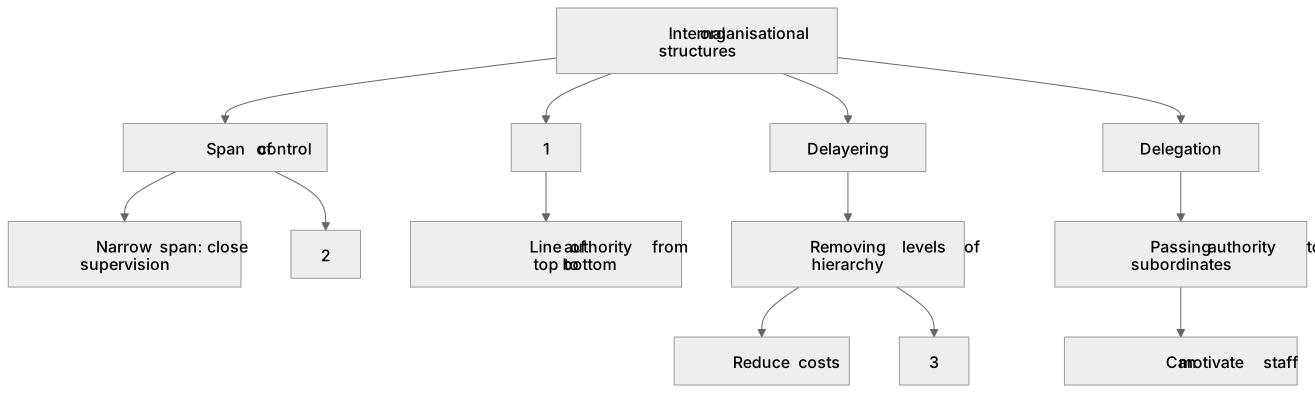
1Box 1
2Box 2
3Box 3
There is more to this lesson
The full lesson goes on to check your understanding and help you earn the marks. Create a free account to carry on, with your progress saved.
A week of Premium from your first lesson · Then the free plan continues · No card, no charge
Test your understanding of Organisational structures: internal organisational structures, span of control, chain of command, delayering and delegation
Active recall beats re-reading. Take an instant quiz now to test what you’ve learned and lock it into long-term memory.
A week of Premium from your first lesson · Then the free plan continues · No card, no charge