AQA · GCSE · Business
Course version: 8132 · Version from Sept 2017
Why businesses have internal organisational structures, including an…
Full specification wording
Organisational structures: why businesses have internal organisational structures, including an understanding of different job roles and responsibilities throughout the business
An organisational structure is the way a business arranges who reports to whom and who does what.
Checked against the AQA 8132 specification (opens in a new tab) on .
- Point 5 of 8
- 4 key terms
Study notes
From the checked teaching notes for this specification point.
The idea
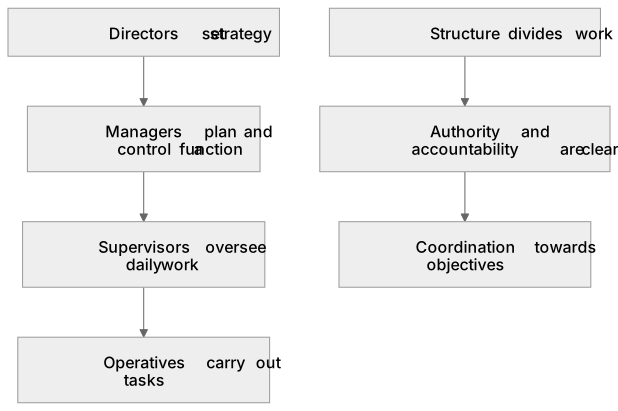
An organisational structure is the way a business arranges who reports to whom and who does what. Businesses need one so that work is divided sensibly, authority is clear and effort is coordinated towards objectives. Without it, two staff might duplicate a task while another task is missed. Structure also shows accountability: if quality falls, managers can trace who was responsible. Job roles differ throughout the business. Directors set strategy, managers plan and control a function such as operations, supervisors oversee daily work, and operatives carry out tasks. Responsibilities include decision-making, budgeting, training and reporting. A small firm may have few layers, with the owner handling several roles; a large firm separates them. Structure also helps communication, motivation through promotion routes, and legal compliance such as health and safety duties.
What earns the marks
- Defines organisational structure as the arrangement of roles, authority and reporting relationships within a business.
- Explains that structure divides work and allocates tasks so that activities are not duplicated or omitted.
- Explains that structure clarifies lines of authority and accountability, allowing responsibility to be traced.
- Describes a range of job roles, such as directors, managers, supervisors and operatives, and links each to responsibilities.
- Explains how structure supports coordination, communication and achievement of business objectives.
- Uses a business example, such as a small café where the owner covers finance and staffing, to show how roles vary with size.
Common mistakes and how to put them right
Treating structure as only a diagram of boxes.
Put it right: Explain the reporting relationships and responsibilities the diagram represents.
Assuming every business has the same roles.
Put it right: Recognise that roles and responsibilities vary with size, sector and objectives.
Confusing authority with responsibility.
Put it right: Distinguish the right to make decisions from the duty to complete a task.
Exam tips
- Link each job role to a specific responsibility rather than listing job titles alone.
- Use a named or realistic business context so the explanation of why structure exists is applied, not generic.
- When asked about responsibilities, refer to decision-making, supervision, reporting and task completion to widen coverage.
Try the lesson
The start of the Organisational structures: why businesses have internal organisational structures, including an understanding of different job roles and responsibilities throughout the business lesson, made from checked teaching notes for this specification point.
Have a go first
Which of the following is a primary reason why a growing business introduces an internal organisational structure?
Listen
An organisational structure is the way a business arranges who reports to whom and who does what. Businesses need one so that work is divided sensibly, authority is clear and effort is coordinated towards objectives. Without it, two staff might duplicate a task while another task is missed. Structure also shows accountability: if quality falls, managers can trace who was responsible. Job roles differ throughout the business. Directors set strategy, managers plan and control a function such as operations, supervisors oversee daily work, and operatives carry out tasks. Responsibilities include decision-making, budgeting, training and reporting. A small firm may have few layers, with the owner handling several roles; a large firm separates them. Structure also helps communication, motivation through promotion routes, and legal compliance such as health and safety duties. A strong answer earns marks for these points. Defines organisational structure as the arrangement of roles, authority and reporting relationships within a business. Explains that structure divides work and allocates tasks so that activities are not duplicated or omitted. Explains that structure clarifies lines of authority and accountability, allowing responsibility to be traced. Describes a range of job roles, such as directors, managers, supervisors and operatives, and links each to responsibilities. A common slip: Treating structure as only a diagram of boxes. Instead, explain the reporting relationships and responsibilities the diagram represents. Exam tip: Link each job role to a specific responsibility rather than listing job titles alone.
See it
Key words
Say what each word means before you turn the card.
Division of work
Try answering aloud or in your head before turning the card.
Authority and accountability
Try answering aloud or in your head before turning the card.
Job roles and responsibilities
Try answering aloud or in your head before turning the card.
Coordination towards objectives
Try answering aloud or in your head before turning the card.
See every definition
- Division of work
- The way a business arranges tasks so that work is divided sensibly and activities are not duplicated or omitted.
- Authority and accountability
- Authority is the right to make decisions, while accountability means responsibility can be traced if something goes wrong.
- Job roles and responsibilities
- Directors set strategy, managers plan and control a function, supervisors oversee daily work and operatives carry out tasks, with duties including decision-making, budgeting, training and reporting.
- Coordination towards objectives
- The way a structure coordinates effort and supports communication so that business objectives are achieved.
Label the diagram
Some boxes have lost their names. Pick the right name for each number.
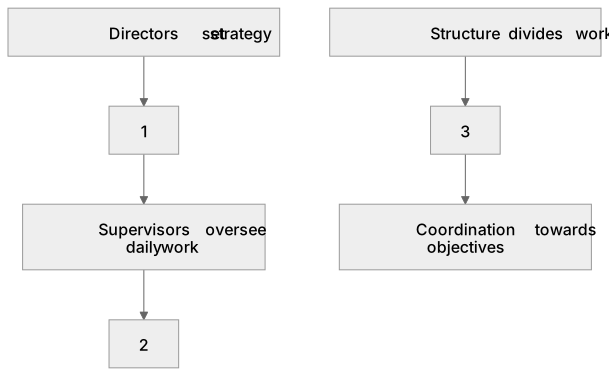
1Box 1
2Box 2
3Box 3
There is more to this lesson
The full lesson goes on to check your understanding and help you earn the marks. Create a free account to carry on, with your progress saved.
A week of Premium from your first lesson · Then the free plan continues · No card, no charge
Test your understanding of Organisational structures: why businesses have internal organisational structures, including an understanding of different job roles and responsibilities throughout the business
Active recall beats re-reading. Take an instant quiz now to test what you’ve learned and lock it into long-term memory.
A week of Premium from your first lesson · Then the free plan continues · No card, no charge