AQA · GCSE · Business
Course version: 8132 · Version from Sept 2017
Methods of recruitment and selection of employees
Full specification wording
Recruitment and selection of employees: Methods of recruitment and selection of employees
Recruitment is the process of attracting candidates to fill a vacancy; selection is choosing the best candidate.
Checked against the AQA 8132 specification (opens in a new tab) on .
- Point 2 of 8
- 4 key terms
Study notes
From the checked teaching notes for this specification point.
The idea
Recruitment is the process of attracting candidates to fill a vacancy; selection is choosing the best candidate. Methods include internal recruitment (promotion, transfer) and external recruitment (job centres, agencies, advertising, online). Selection methods include application forms, CVs, cover letters, interviews, tests, and references. Internal recruitment is cheaper and faster but limits new ideas; external recruitment brings fresh talent but costs more and takes longer. Selection aims to match the person to the job specification and person specification. For example, a small business might use a job centre to find a sales assistant, then interview shortlisted candidates. The method chosen affects cost, time, and quality of hire.
What earns the marks
- Define recruitment as attracting candidates and selection as choosing the best candidate.
- Distinguish internal recruitment (e.g., promotion, transfer) from external recruitment (e.g., job centres, agencies, advertising).
- Explain at least two selection methods, such as interviews, application forms, CVs, tests, or references.
- Discuss advantages and disadvantages of internal versus external recruitment, e.g., cost, time, fresh ideas.
- Apply recruitment and selection methods to a business context, showing how they meet the job and person specifications.
Common mistakes and how to put them right
Confusing recruitment with selection.
Put it right: Clearly separate the two stages.
Assuming internal recruitment is always best.
Put it right: Weigh advantages against disadvantages.
Ignoring the person specification.
Put it right: Link selection methods to the person specification.
Exam tips
- Use business-specific examples, such as a local shop using a job centre or an online advert.
- When evaluating, consider cost, time, and quality of hire for each method.
- Structure answers to show clear understanding of both recruitment and selection, not just one.
Try the lesson
The start of the Recruitment and selection of employees: Methods of recruitment and selection of employees lesson, made from checked teaching notes for this specification point.
Have a go first
Which method of recruitment involves a business advertising a vacancy on its own website so that anyone visiting the site can see it?
Listen
Recruitment is the process of attracting candidates to fill a vacancy; selection is choosing the best candidate. Methods include internal recruitment (promotion, transfer) and external recruitment (job centres, agencies, advertising, online). Selection methods include application forms, CVs, cover letters, interviews, tests, and references. Internal recruitment is cheaper and faster but limits new ideas; external recruitment brings fresh talent but costs more and takes longer. Selection aims to match the person to the job specification and person specification. For example, a small business might use a job centre to find a sales assistant, then interview shortlisted candidates. The method chosen affects cost, time, and quality of hire. A strong answer earns marks for these points. Define recruitment as attracting candidates and selection as choosing the best candidate. Distinguish internal recruitment (e.g., promotion, transfer) from external recruitment (e.g., job centres, agencies, advertising). Explain at least two selection methods, such as interviews, application forms, CVs, tests, or references. Discuss advantages and disadvantages of internal versus external recruitment, e.g., cost, time, fresh ideas. A common slip: Confusing recruitment with selection: recruitment is attracting applicants; selection is choosing among them. Instead, clearly separate the two stages. Exam tip: Use business-specific examples, such as a local shop using a job centre or an online advert.
See it
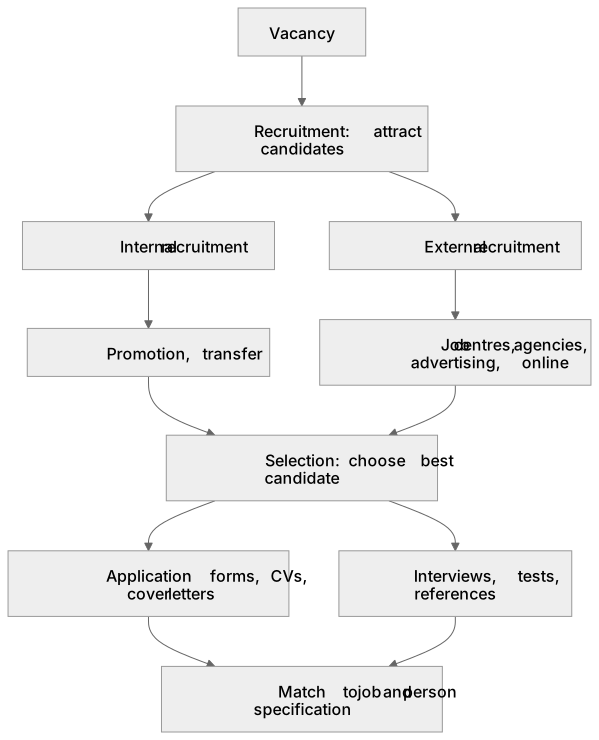
Key words
Say what each word means before you turn the card.
Recruitment process
Try answering aloud or in your head before turning the card.
Selection methods
Try answering aloud or in your head before turning the card.
Internal vs external recruitment
Try answering aloud or in your head before turning the card.
Cost and time implications
Try answering aloud or in your head before turning the card.
See every definition
- Recruitment process
- The process of attracting candidates to fill a vacancy.
- Selection methods
- Choosing the best candidate, using methods such as application forms, CVs, cover letters, interviews, tests, and references.
- Internal vs external recruitment
- Internal recruitment includes promotion and transfer, while external recruitment includes job centres, agencies, advertising, and online.
- Cost and time implications
- Internal recruitment is cheaper and faster but limits new ideas, while external recruitment brings fresh talent but costs more and takes longer.
Label the diagram
Some boxes have lost their names. Pick the right name for each number.
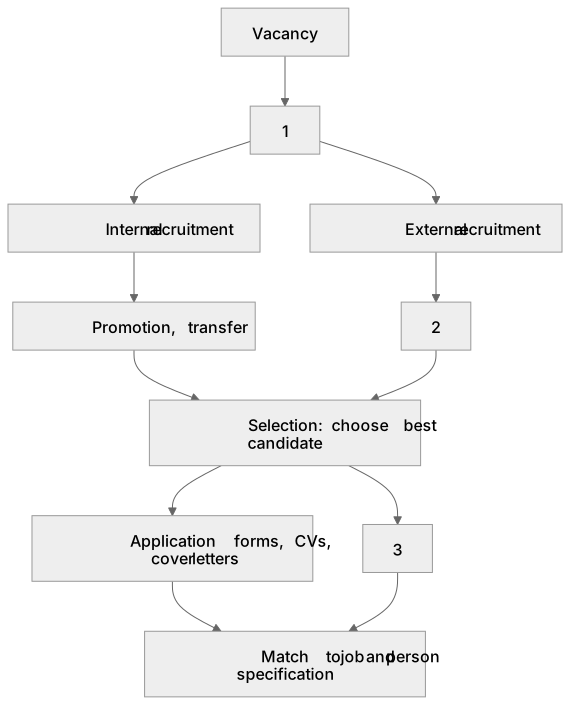
1Box 1
2Box 2
3Box 3
There is more to this lesson
The full lesson goes on to check your understanding and help you earn the marks. Create a free account to carry on, with your progress saved.
A week of Premium from your first lesson · Then the free plan continues · No card, no charge
Test your understanding of Recruitment and selection of employees: Methods of recruitment and selection of employees
Active recall beats re-reading. Take an instant quiz now to test what you’ve learned and lock it into long-term memory.
A week of Premium from your first lesson · Then the free plan continues · No card, no charge