AQA · GCSE · Business
Course version: 8132 · Version from Sept 2017
Role of objectives in running a business
Full specification wording
Setting business aims and objectives: Role of objectives in running a business
Objectives are the specific, measurable targets that translate a business's overall aim into action.
Checked against the AQA 8132 specification (opens in a new tab) on .
- Point 3 of 10
- 4 key terms
Study notes
From the checked teaching notes for this specification point.
The idea
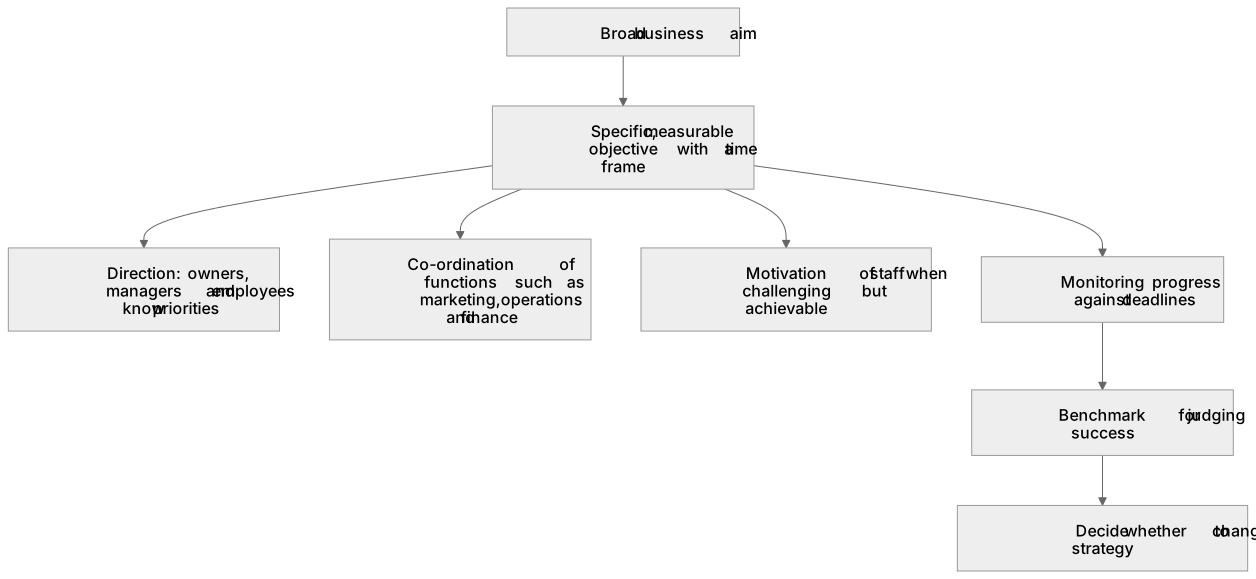
Objectives are the specific, measurable targets that translate a business's overall aim into action. They give direction so owners, managers and employees know what to prioritise, and they allow progress to be monitored against deadlines. For example, a business aiming to grow might set an objective to increase sales by 10% within 12 months; a business aiming to improve cash flow might set an objective to reduce average debtor days from 45 to 30. Objectives also motivate staff when they are challenging but achievable, and they help co-ordinate different functions such as marketing, operations and finance. They provide a benchmark for judging success and for deciding whether to change strategy. Without objectives, a business may drift, waste resources or pursue conflicting goals.
What earns the marks
- Objectives convert a broad aim into a specific, measurable target with a time frame, so that success can be judged objectively.
- Objectives provide direction and co-ordination: different departments can align their plans, such as marketing increasing promotion while operations raises capacity.
- Objectives motivate employees when they are challenging yet achievable, and can be linked to appraisal or reward systems.
- Objectives allow managers to monitor progress, compare actual performance with the target, and take corrective action if the business is off track.
- Objectives help a business decide priorities when resources are limited, for example choosing between spending on staff training or new machinery.
Common mistakes and how to put them right
Confusing an aim with an objective.
Put it right by ensuring each objective includes a measurable outcome and a deadline.
Writing objectives that are too vague to monitor, such as 'do better'.
Put it right by adding a number and a time period, for example 'increase repeat purchases by 15% within 6 months'.
Assuming objectives are only for profit-seeking businesses.
Put it right by recognising that social enterprises, charities and public-sector organisations also set objectives, such as numbers of people helped or service waiting times.
Exam tips
- Use the command word to judge depth: 'state' needs a brief point, while 'explain' needs a cause-and-effect chain showing how the objective affects the business.
- Apply each objective to the context given in the case study, naming the business and its market rather than writing generically.
- When discussing motivation, link the objective to a specific group of employees and say how they might respond, rather than claiming all workers are motivated in the same way.
Try the lesson
The start of the Setting business aims and objectives: Role of objectives in running a business lesson, made from checked teaching notes for this specification point.
Have a go first
How do clear objectives primarily assist the managers of a retail business in their day-to-day operations?
Listen
Objectives are the specific, measurable targets that translate a business's overall aim into action. They give direction so owners, managers and employees know what to prioritise, and they allow progress to be monitored against deadlines. For example, a business aiming to grow might set an objective to increase sales by 10% within 12 months; a business aiming to improve cash flow might set an objective to reduce average debtor days from 45 to 30. Objectives also motivate staff when they are challenging but achievable, and they help co-ordinate different functions such as marketing, operations and finance. They provide a benchmark for judging success and for deciding whether to change strategy. Without objectives, a business may drift, waste resources or pursue conflicting goals. A strong answer earns marks for these points. Objectives convert a broad aim into a specific, measurable target with a time frame, so that success can be judged objectively. Objectives provide direction and co-ordination: different departments can align their plans, such as marketing increasing promotion while operations raises capacity. Objectives motivate employees when they are challenging yet achievable, and can be linked to appraisal or reward systems. Objectives allow managers to monitor progress, compare actual performance with the target, and take corrective action if the business is off track. A common slip: Confusing an aim with an objective: an aim is a general statement of purpose, while an objective is a specific, measurable target with a time frame. Instead, ensuring each objective includes a measurable outcome and a deadline. Exam tip: Use the command word to judge depth: 'state' needs a brief point, while 'explain' needs a cause-and-effect chain showing how the objective affects the business.
See it
Key words
Say what each word means before you turn the card.
Purpose and direction
Try answering aloud or in your head before turning the card.
Measuring and monitoring performance
Try answering aloud or in your head before turning the card.
Motivation and co-ordination of staff
Try answering aloud or in your head before turning the card.
Resource allocation and prioritisation
Try answering aloud or in your head before turning the card.
See every definition
- Purpose and direction
- Objectives give direction so owners, managers and employees know what to prioritise.
- Measuring and monitoring performance
- Objectives allow progress to be monitored against deadlines and provide a benchmark for judging success.
- Motivation and co-ordination of staff
- Objectives motivate staff when they are challenging but achievable, and they help co-ordinate different functions such as marketing, operations and finance.
- Resource allocation and prioritisation
- Objectives help a business decide priorities when resources are limited.
Label the diagram
Some boxes have lost their names. Pick the right name for each number.
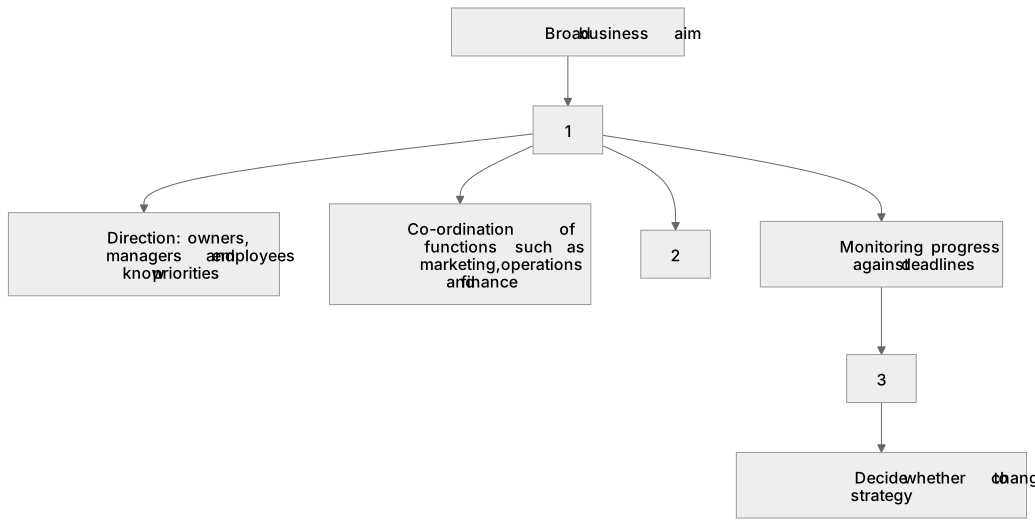
1Box 1
2Box 2
3Box 3
There is more to this lesson
The full lesson goes on to check your understanding and help you earn the marks. Create a free account to carry on, with your progress saved.
A week of Premium from your first lesson · Then the free plan continues · No card, no charge
Test your understanding of Setting business aims and objectives: Role of objectives in running a business
Active recall beats re-reading. Take an instant quiz now to test what you’ve learned and lock it into long-term memory.
A week of Premium from your first lesson · Then the free plan continues · No card, no charge