AQA · GCSE · Business
Course version: 8132 · Version from Sept 2017
Setting business aims and objectives: Purpose of setting objectives
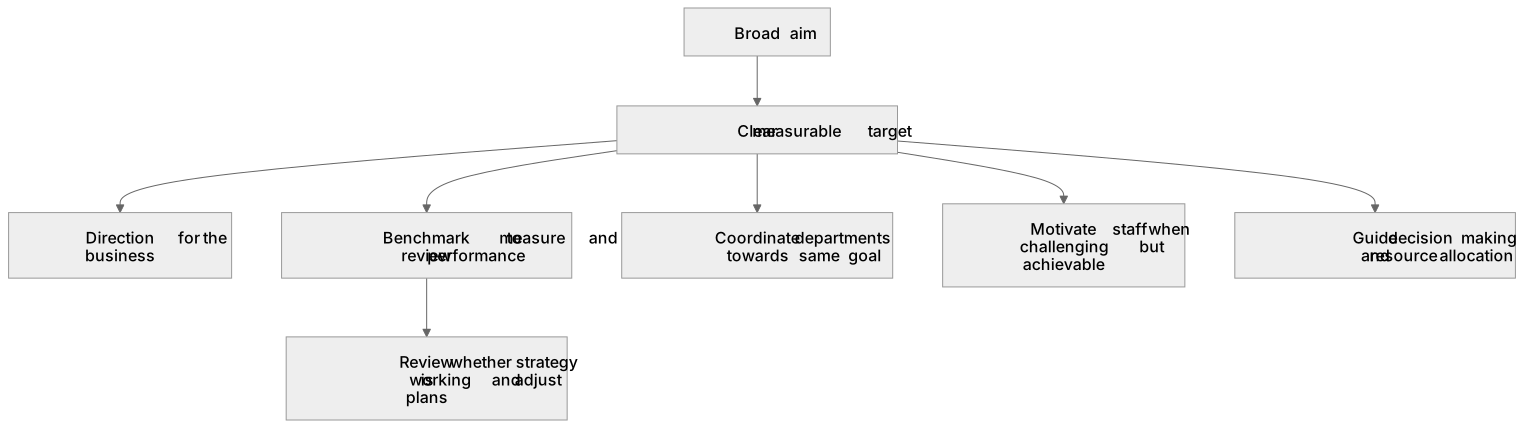
Setting objectives gives a business a clear sense of direction and turns its broad aims into targets that can be measured and reviewed.
Checked against the AQA 8132 specification (opens in a new tab) on .
- Point 2 of 10
- 4 key terms
Study notes
From the checked teaching notes for this specification point.
The idea
Setting objectives gives a business a clear sense of direction and turns its broad aims into targets that can be measured and reviewed. Objectives provide a benchmark for judging performance, so managers can compare actual sales, costs or output against the target and decide whether action is needed. They help coordinate departments, because everyone can work towards the same measurable goal, and they motivate staff when targets are challenging but achievable. Objectives also guide decision making and resource allocation, since money and time can be directed to the activities that matter most. In addition, they allow progress to be monitored over time, so a business can review whether its strategy is working and adjust plans if it is not.
What earns the marks
- Explains that objectives provide direction, turning a broad aim into a clear target for the business to pursue.
- Explains that objectives allow performance to be measured and reviewed against a benchmark, so progress can be judged.
- Explains that objectives help coordinate different parts of a business so that effort is focused on the same goal.
- Explains that objectives can motivate employees when they are clear, challenging and achievable.
- Explains that objectives support decision making and the allocation of resources such as finance, staff and time.
Common mistakes and how to put them right
Listing purposes without explaining them.
Put it right: Develop each point, for example stating that measurement allows a business to compare actual performance with the target and act on any gap.
Claiming objectives always motivate staff.
Put it right: Motivation depends on whether targets are seen as fair and achievable, and unrealistic targets can demotivate.
Confusing the purpose of objectives with the purpose of aims.
Put it right: Aims give overall direction while objectives provide measurable targets that allow progress to be tracked.
Exam tips
- Use connectives such as because, so that and which means to turn a point into an explanation.
- Support each purpose with a brief business example, such as a target to reduce unit costs by 4% guiding a purchasing decision.
- If the question asks for more than one purpose, develop each one separately rather than repeating the same idea in different words.
Try the lesson
The start of the Setting business aims and objectives: Purpose of setting objectives lesson, made from checked teaching notes for this specification point.
Have a go first
A manufacturing company has recently updated its targets. What is a primary purpose of the business setting these clear objectives?
Listen
Setting objectives gives a business a clear sense of direction and turns its broad aims into targets that can be measured and reviewed. Objectives provide a benchmark for judging performance, so managers can compare actual sales, costs or output against the target and decide whether action is needed. They help coordinate departments, because everyone can work towards the same measurable goal, and they motivate staff when targets are challenging but achievable. Objectives also guide decision making and resource allocation, since money and time can be directed to the activities that matter most. In addition, they allow progress to be monitored over time, so a business can review whether its strategy is working and adjust plans if it is not. A strong answer earns marks for these points. Explains that objectives provide direction, turning a broad aim into a clear target for the business to pursue. Explains that objectives allow performance to be measured and reviewed against a benchmark, so progress can be judged. Explains that objectives help coordinate different parts of a business so that effort is focused on the same goal. Explains that objectives can motivate employees when they are clear, challenging and achievable. A common slip: Listing purposes without explaining them. Instead, develop each point, for example stating that measurement allows a business to compare actual performance with the target and act on any gap. Exam tip: Use connectives such as because, so that and which means to turn a point into an explanation.
See it
Key words
Say what each word means before you turn the card.
Direction and focus
Try answering aloud or in your head before turning the card.
Measuring and reviewing performance
Try answering aloud or in your head before turning the card.
Coordination across a business
Try answering aloud or in your head before turning the card.
Motivation and decision making
Try answering aloud or in your head before turning the card.
See every definition
- Direction and focus
- Setting objectives gives a business a clear sense of direction and turns its broad aims into targets that can be measured and reviewed.
- Measuring and reviewing performance
- Objectives provide a benchmark for judging performance, so managers can compare actual sales, costs or output against the target and decide whether action is needed.
- Coordination across a business
- Objectives help coordinate departments, because everyone can work towards the same measurable goal.
- Motivation and decision making
- Objectives motivate staff when targets are challenging but achievable, and they guide decision making and resource allocation, since money and time can be directed to the activities that matter most.
Label the diagram
Some boxes have lost their names. Pick the right name for each number.
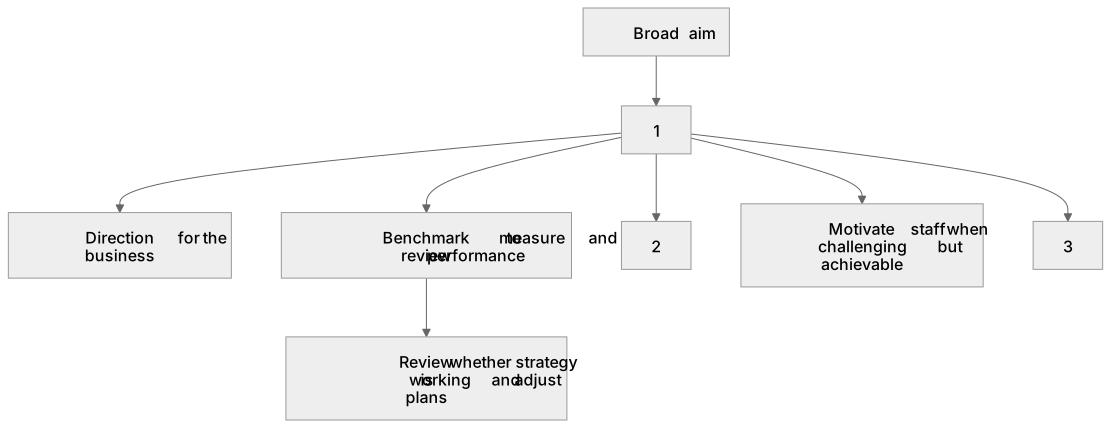
1Box 1
2Box 2
3Box 3
There is more to this lesson
The full lesson goes on to check your understanding and help you earn the marks. Create a free account to carry on, with your progress saved.
A week of Premium from your first lesson · Then the free plan continues · No card, no charge
Test your understanding of Setting business aims and objectives: Purpose of setting objectives
Active recall beats re-reading. Take an instant quiz now to test what you’ve learned and lock it into long-term memory.
A week of Premium from your first lesson · Then the free plan continues · No card, no charge