AQA · GCSE · Business
Course version: 8132 · Version from Sept 2017
Understand how and why the objectives set may change as businesses evolve.…
Full specification wording
Setting business aims and objectives: understand how and why the objectives set may change as businesses evolve. Students should consider how the objectives of larger more established businesses might differ from smaller start-up businesses, eg becoming the dominant business in the market, international expansion, increasing shareholder value and ethical and environmental considerations
Business objectives are the specific, measurable targets a business sets to achieve its aims.
Checked against the AQA 8132 specification (opens in a new tab) on .
- Point 9 of 10
- 4 key terms
Study notes
From the checked teaching notes for this specification point.
The idea
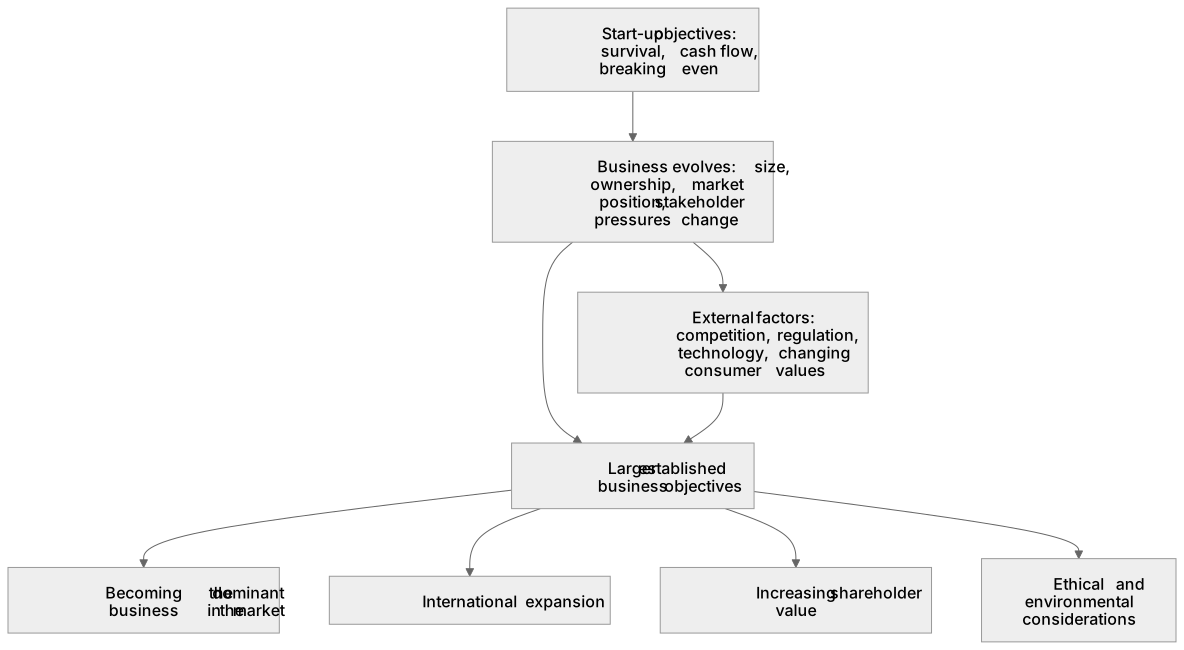
Business objectives are the specific, measurable targets a business sets to achieve its aims. As a business evolves, its objectives change because its size, ownership, market position and stakeholder pressures change. A start-up often focuses on survival, breaking even and attracting initial customers. A larger, established business may pursue market dominance, international expansion, increasing shareholder value, or ethical and environmental goals. For example, a small café may aim to survive its first year; a multinational chain may aim to open 50 stores abroad. Objectives also shift due to competition, regulation, technology and changing consumer values. Understanding this helps explain why no single objective fits all businesses at all stages.
What earns the marks
- Start-ups commonly prioritise survival, cash flow and breaking even because resources are limited and failure rates are high.
- Established larger businesses may set objectives such as becoming the dominant business in the market, which can involve aggressive marketing or acquisitions.
- International expansion becomes a realistic objective when a business has sufficient capital, brand strength and operational capacity.
- Increasing shareholder value is a key objective for companies with shareholders, often achieved through profit growth, dividends or share price rises.
- Ethical and environmental considerations may become more prominent as businesses grow and face greater public scrutiny or regulation.
- Objectives change as businesses evolve because internal factors (size, ownership, leadership) and external factors (competition, legislation, social trends) alter what is achievable and desirable.
Common mistakes and how to put them right
Assuming all businesses aim to maximise profit.
Put it right: Objectives vary and may include survival, market share, international expansion, shareholder value, or ethical and environmental goals.
Believing objectives are fixed once set.
Put it right: Objectives are dynamic and should be reviewed as the business evolves and its internal and external environment changes.
Confusing aims with objectives.
Put it right: Aims are broad, long-term intentions, while objectives are specific, measurable targets that help achieve aims.
Exam tips
- Use real or hypothetical examples to contrast a start-up and a larger business, such as a local bakery versus a multinational retailer.
- When explaining why objectives change, link to specific changes in the business, such as growth in size, new competitors, or new regulations.
- For higher marks, analyse the impact of changing objectives on functional areas like marketing, finance, operations and human resources.
Try the lesson
The start of the Setting business aims and objectives: understand how and why the objectives set may change as businesses evolve. Students should consider how the objectives of larger more established businesses might differ from smaller start-up businesses, eg becoming the dominant business in the market, international expansion, increasing shareholder value and ethical and environmental considerations lesson, made from checked teaching notes for this specification point.
Have a go first
A small start-up bakery has just opened and its main objective is to survive its first year of trading. Which objective is most likely to become its aim once it has grown into a large, established business?
Listen
Business objectives are the specific, measurable targets a business sets to achieve its aims. As a business evolves, its objectives change because its size, ownership, market position and stakeholder pressures change. A start-up often focuses on survival, breaking even and attracting initial customers. A larger, established business may pursue market dominance, international expansion, increasing shareholder value, or ethical and environmental goals. For example, a small café may aim to survive its first year; a multinational chain may aim to open 50 stores abroad. Objectives also shift due to competition, regulation, technology and changing consumer values. Understanding this helps explain why no single objective fits all businesses at all stages. A strong answer earns marks for these points. Start-ups commonly prioritise survival, cash flow and breaking even because resources are limited and failure rates are high. Established larger businesses may set objectives such as becoming the dominant business in the market, which can involve aggressive marketing or acquisitions. International expansion becomes a realistic objective when a business has sufficient capital, brand strength and operational capacity. Increasing shareholder value is a key objective for companies with shareholders, often achieved through profit growth, dividends or share price rises. A common slip: Assuming all businesses aim to maximise profit. Instead, objectives vary and may include survival, market share, international expansion, shareholder value, or ethical and environmental goals. Exam tip: Use real or hypothetical examples to contrast a start-up and a larger business, such as a local bakery versus a multinational retailer.
See it
Key words
Say what each word means before you turn the card.
Business evolution and growth
Try answering aloud or in your head before turning the card.
Stakeholder influence on objectives
Try answering aloud or in your head before turning the card.
Market position and competitiveness
Try answering aloud or in your head before turning the card.
Ethical and environmental responsibility
Try answering aloud or in your head before turning the card.
See every definition
- Business evolution and growth
- The process by which a business changes as its size, ownership, market position and stakeholder pressures change.
- Stakeholder influence on objectives
- The way pressures from stakeholders change as a business evolves, altering what is achievable and desirable.
- Market position and competitiveness
- A business's standing in its market, which changes as competition, regulation, technology and consumer values shift.
- Ethical and environmental responsibility
- Considerations that may become more prominent as businesses grow and face greater public scrutiny or regulation.
Label the diagram
Some boxes have lost their names. Pick the right name for each number.
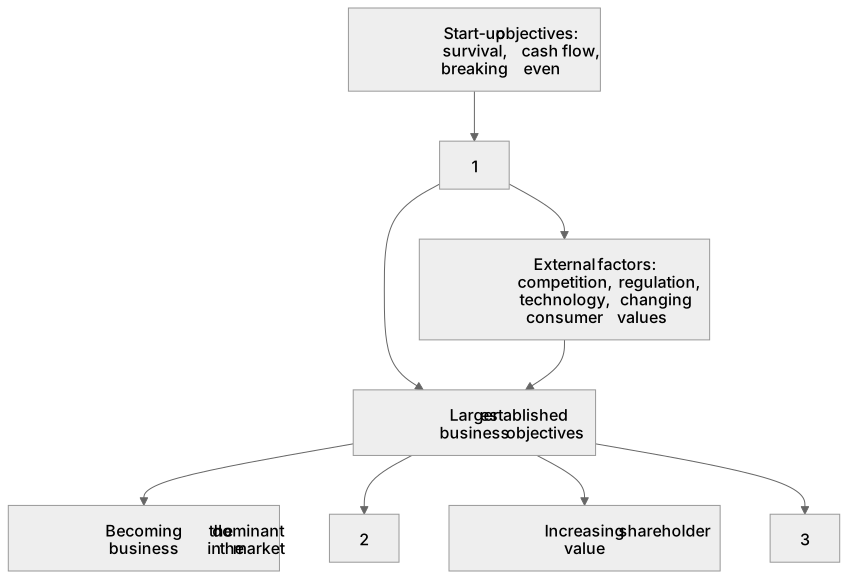
1Box 1
2Box 2
3Box 3
There is more to this lesson
The full lesson goes on to check your understanding and help you earn the marks. Create a free account to carry on, with your progress saved.
A week of Premium from your first lesson · Then the free plan continues · No card, no charge
Test your understanding of Setting business aims and objectives: understand how and why the objectives set may change as businesses evolve. Students should consider how the objectives of larger more established businesses might differ from smaller start-up businesses, eg becoming the dominant business in the market, international expansion, increasing shareholder value and ethical and environmental considerations
Active recall beats re-reading. Take an instant quiz now to test what you’ve learned and lock it into long-term memory.
A week of Premium from your first lesson · Then the free plan continues · No card, no charge