AQA · GCSE · Business
Course version: 8132 · Version from Sept 2017
Setting business aims and objectives: What are business aims and objectives
Full specification wording
Setting business aims and objectives: What are business aims and objectives
An aim is the long-term overall purpose of a business, the broad direction it wants to move in, such as survival, growth or providing a service to the community.
Checked against the AQA 8132 specification (opens in a new tab) on .
- Point 1 of 10
- 4 key terms
Study notes
From the checked teaching notes for this specification point.
The idea
An aim is the long-term overall purpose of a business, the broad direction it wants to move in, such as survival, growth or providing a service to the community. An objective is a specific, measurable target that helps the business work towards that aim, for example raising sales revenue by 10% within twelve months or reducing waste by 5 tonnes per year. Aims and objectives differ in timescale and precision: aims are general and long term, while objectives are precise, often time-bound and can be checked. They also differ between businesses: a new sole trader may aim simply to survive, whereas an established plc may aim to maximise profit or increase market share. Objectives can be set for the whole business or for a department, and they should be consistent with each other so that effort is not wasted.
What earns the marks
- Defines an aim as the long-term overall purpose or direction of a business, giving a valid example such as survival, growth or customer satisfaction.
- Defines an objective as a specific, measurable target that supports an aim, giving a valid example such as increasing sales by 10% in a year.
- Explains at least one clear difference between aims and objectives, for example timescale, level of detail or whether progress can be measured.
- Applies the distinction to a business context, such as contrasting a new business aiming to survive with an established business aiming to grow.
- Recognises that aims and objectives can exist at different levels, such as whole-business aims and departmental objectives, and that they should be consistent.
Common mistakes and how to put them right
Treating aims and objectives as identical.
Put it right: An aim is a broad long-term purpose while an objective is a precise measurable target.
Giving an objective that cannot be measured, such as to be the best.
Put it right: Add a measurable element, such as to increase market share by 5% within two years.
Assuming every business has the same aim.
Put it right: Aims vary with size, age, ownership and market conditions, so a new firm may prioritise survival while a large firm may prioritise growth.
Exam tips
- Define both terms before comparing them, so the examiner can see you know the difference.
- Use a named or described business context to show application rather than writing in the abstract.
- When asked to explain, link the objective back to the aim it supports, showing the chain from broad purpose to measurable target.
Try the lesson
The start of the Setting business aims and objectives: What are business aims and objectives lesson, made from checked teaching notes for this specification point.
Have a go first
A new entrepreneur is writing a business plan. Which of the following best describes a business aim they might include?
Listen
An aim is the long-term overall purpose of a business, the broad direction it wants to move in, such as survival, growth or providing a service to the community. An objective is a specific, measurable target that helps the business work towards that aim, for example raising sales revenue by 10% within twelve months or reducing waste by 5 tonnes per year. Aims and objectives differ in timescale and precision: aims are general and long term, while objectives are precise, often time-bound and can be checked. They also differ between businesses: a new sole trader may aim simply to survive, whereas an established plc may aim to maximise profit or increase market share. Objectives can be set for the whole business or for a department, and they should be consistent with each other so that effort is not wasted. A strong answer earns marks for these points. Defines an aim as the long-term overall purpose or direction of a business, giving a valid example such as survival, growth or customer satisfaction. Defines an objective as a specific, measurable target that supports an aim, giving a valid example such as increasing sales by 10% in a year. Explains at least one clear difference between aims and objectives, for example timescale, level of detail or whether progress can be measured. Applies the distinction to a business context, such as contrasting a new business aiming to survive with an established business aiming to grow. A common slip: Treating aims and objectives as identical. Instead, an aim is a broad long-term purpose while an objective is a precise measurable target. Exam tip: Define both terms before comparing them, so the examiner can see you know the difference.
See it
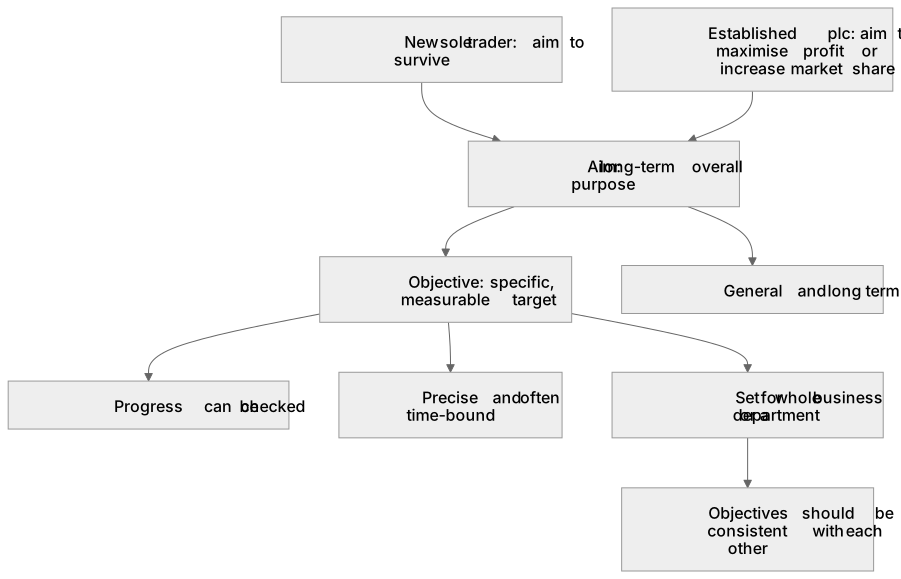
Key words
Say what each word means before you turn the card.
Aim
Try answering aloud or in your head before turning the card.
Objective
Try answering aloud or in your head before turning the card.
Long-term versus short-term planning
Try answering aloud or in your head before turning the card.
Variation of aims between businesses
Try answering aloud or in your head before turning the card.
See every definition
- Aim
- The long-term overall purpose of a business, the broad direction it wants to move in, such as survival, growth or providing a service to the community.
- Objective
- A specific, measurable target that helps the business work towards an aim, often time-bound and able to be checked.
- Long-term versus short-term planning
- Aims are general and long term, while objectives are precise, often time-bound and can be checked.
- Variation of aims between businesses
- A new sole trader may aim simply to survive, whereas an established plc may aim to maximise profit or increase market share.
Label the diagram
Some boxes have lost their names. Pick the right name for each number.
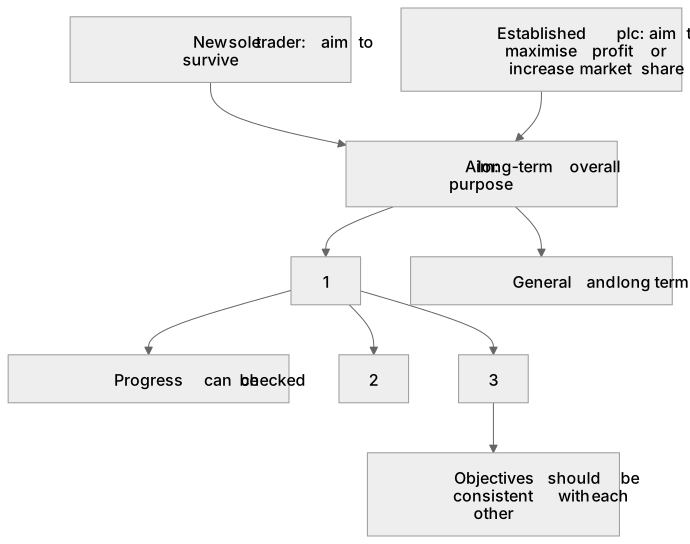
1Box 1
2Box 2
3Box 3
There is more to this lesson
The full lesson goes on to check your understanding and help you earn the marks. Create a free account to carry on, with your progress saved.
A week of Premium from your first lesson · Then the free plan continues · No card, no charge
Test your understanding of Setting business aims and objectives: What are business aims and objectives
Active recall beats re-reading. Take an instant quiz now to test what you’ve learned and lock it into long-term memory.
A week of Premium from your first lesson · Then the free plan continues · No card, no charge