AQA · GCSE · Business
Course version: 8132 · Version from Sept 2017
Evaluate the suitability of sources of finance for new and established…
Full specification wording
Sources of finance: evaluate the suitability of sources of finance for new and established businesses.
Every business needs finance, but suitability depends on purpose, amount, time period, cost and the firm's age and risk profile.
Checked against the AQA 8132 specification (opens in a new tab) on .
- Point 5 of 5
- 2 key terms
Study notes
From the checked teaching notes for this specification point.
The idea
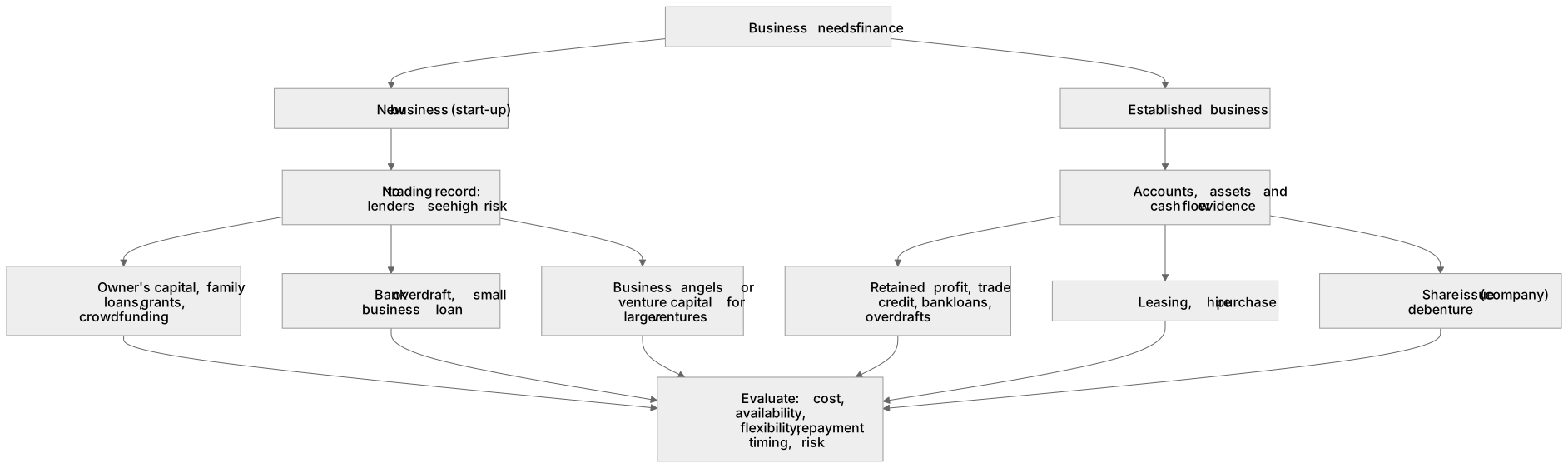
Every business needs finance, but suitability depends on purpose, amount, time period, cost and the firm's age and risk profile. A new business (start-up) has no trading record, so lenders see high risk: owner's capital, family loans, retained profit (usually absent), bank overdraft, small business loan, grants, crowdfunding and, for larger ventures, business angels or venture capital may be considered. An established business has accounts, assets and cash flow evidence, so it can access retained profit, trade credit, bank loans, overdrafts, leasing, hire purchase, share issue (for a company) or debenture. Evaluate by weighing cost (interest, fees, dilution of control), availability, flexibility, repayment timing and risk against the specific need, such as buying a delivery van versus funding seasonal stock.
What earns the marks
- Links each source to a suitable purpose and time frame: short-term overdraft or trade credit for working capital, medium-term leasing or hire purchase for equipment, long-term loan or share issue for expansion.
- Analyses cost and control implications: interest and arrangement fees raise total repayment, while issuing shares dilutes ownership and voting control; retained profit avoids both but is limited.
- Evaluates by reaching a supported judgement that compares at least two sources for a stated business context, weighing risk, cost, flexibility and availability before recommending one.
- Uses business terminology accurately, for example distinguishing internal from external finance and short-term from long-term finance.
Common mistakes and how to put them right
Listing sources without linking them to the business's age or purpose.
Put it right: State why the source fits this business and this need.
Treating all borrowing as equally risky or equally cheap.
Put it right: Compare interest, fees, security required and repayment schedule for each option.
Assuming a new business can issue shares or debentures.
Put it right: Only limited companies can issue shares, and debentures are typically used by larger established firms.
Ignoring the effect on ownership and control.
Put it right: Explain that external equity finance can dilute the owner's share and decision-making power.
Exam tips
- Read the case study carefully and name the specific finance need, amount and time period before choosing sources.
- Use connectives such as because, therefore and however to build chains of reasoning rather than isolated points.
- For evaluation questions, compare at least two realistic options and finish with a justified recommendation that answers the question directly.
- Apply the context: refer to the named business, its size, age and sector instead of writing generically.
Try the lesson
The start of the Sources of finance: evaluate the suitability of sources of finance for new and established businesses. lesson, made from checked teaching notes for this specification point.
Have a go first
A newly formed sole trader needs a small amount of finance to buy tools and has no trading history. Which source of finance is most suitable for this business?
Listen
Every business needs finance, but suitability depends on purpose, amount, time period, cost and the firm's age and risk profile. A new business (start-up) has no trading record, so lenders see high risk: owner's capital, family loans, retained profit (usually absent), bank overdraft, small business loan, grants, crowdfunding and, for larger ventures, business angels or venture capital may be considered. An established business has accounts, assets and cash flow evidence, so it can access retained profit, trade credit, bank loans, overdrafts, leasing, hire purchase, share issue (for a company) or debenture. Evaluate by weighing cost (interest, fees, dilution of control), availability, flexibility, repayment timing and risk against the specific need, such as buying a delivery van versus funding seasonal stock. A strong answer earns marks for these points. Identifies a range of internal and external sources: owner's capital, retained profit, sale of assets, bank loan, overdraft, trade credit, leasing, hire purchase, share issue, debenture, crowdfunding, grant, business angel and venture capital. Explains how business age and trading history affect access: a start-up lacks accounts and collateral, so lenders charge higher interest or refuse finance, while an established firm can borrow against assets and profit records. Links each source to a suitable purpose and time frame: short-term overdraft or trade credit for working capital, medium-term leasing or hire purchase for equipment, long-term loan or share issue for expansion. Analyses cost and control implications: interest and arrangement fees raise total repayment, while issuing shares dilutes ownership and voting control; retained profit avoids both but is limited. A common slip: Listing sources without linking them to the business's age or purpose. Instead, state why the source fits this business and this need. Exam tip: Read the case study carefully and name the specific finance need, amount and time period before choosing sources.
See it
Key words
Say what each word means before you turn the card.
Internal versus external sources of finance
Try answering aloud or in your head before turning the card.
Short-term, medium-term and long-term finance
Try answering aloud or in your head before turning the card.
See every definition
- Internal versus external sources of finance
- Finance raised from within the business, such as retained profit or sale of assets, is internal, while finance from outside, such as a bank loan, is external.
- Short-term, medium-term and long-term finance
- Sources are matched to a time frame, such as a short-term overdraft or trade credit for working capital, medium-term leasing or hire purchase for equipment, and a long-term loan or share issue for expansion.
Label the diagram
Some boxes have lost their names. Pick the right name for each number.
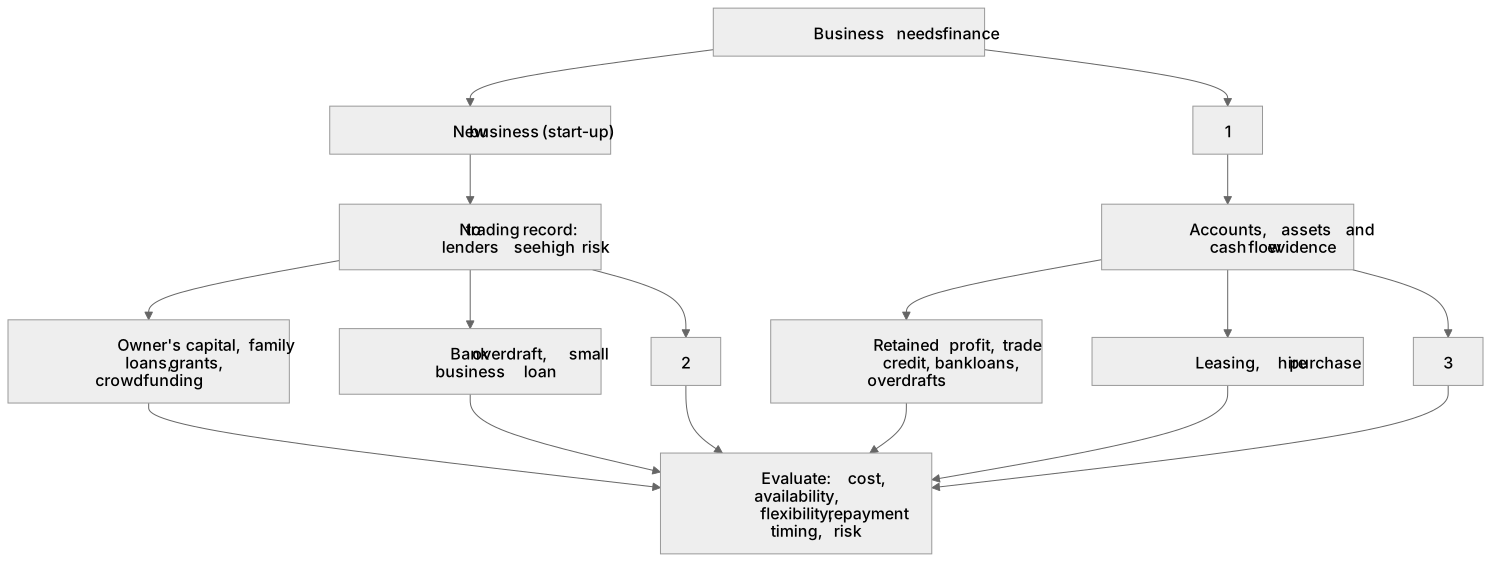
1Box 1
2Box 2
3Box 3
There is more to this lesson
The full lesson goes on to check your understanding and help you earn the marks. Create a free account to carry on, with your progress saved.
A week of Premium from your first lesson · Then the free plan continues · No card, no charge
Test your understanding of Sources of finance: evaluate the suitability of sources of finance for new and established businesses.
Active recall beats re-reading. Take an instant quiz now to test what you’ve learned and lock it into long-term memory.
A week of Premium from your first lesson · Then the free plan continues · No card, no charge