AQA · GCSE · Business
Course version: 8132 · Version from Sept 2017
Analyse the advantages and disadvantages of each method for a given…
Full specification wording
Sources of finance: analyse the advantages and disadvantages of each method for a given situation
For a given business situation, you must analyse the advantages and disadvantages of each source of finance.
Checked against the AQA 8132 specification (opens in a new tab) on .
- Point 4 of 5
- 2 key terms
Study notes
From the checked teaching notes for this specification point.
The idea
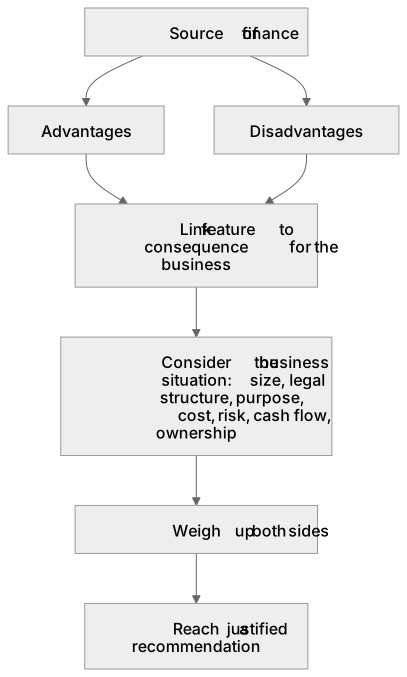
For a given business situation, you must analyse the advantages and disadvantages of each source of finance. This means going beyond listing pros and cons: you need to develop chains of reasoning that link the source's features to consequences for the business. For example, a small business needing quick cash for stock might use an overdraft because it is flexible and fast, but the high interest rate could reduce profit. A profitable limited company expanding might issue shares to raise large sums without repayment, but the owners may lose control. Consider the business's size, legal structure, purpose (short-term vs long-term), cost, risk, and impact on cash flow and ownership. The best answer weighs up both sides and reaches a justified conclusion.
What earns the marks
- Develop arguments that explain how each advantage or disadvantage affects the business, not just state them.
- Consider the specific context: type of business, amount needed, duration, and existing financial position.
- Compare sources: e.g., a loan has fixed repayments but interest; an overdraft is flexible but expensive and repayable on demand.
- Evaluate trade-offs: e.g., share issue avoids debt but dilutes control; retained profit avoids interest but may be limited.
- Reach a justified recommendation that follows from the analysis, considering both pros and cons.
- Use business terminology accurately (e.g., 'dilution of control', 'security', 'cash flow').
Common mistakes and how to put them right
Listing advantages and disadvantages without linking them to the specific situation.
Put it right: Apply to the context given.
Ignoring the disadvantages of a chosen source.
Put it right: A balanced analysis must consider both sides.
Failing to make a clear judgement or recommendation.
Put it right: Analysis should lead to a conclusion.
Confusing short-term and long-term needs.
Put it right: e.g., using an overdraft for a long-term investment is usually inappropriate.
Exam tips
- Use connectives like 'because', 'therefore', 'however' to build chains of reasoning.
- Refer explicitly to the business in the case study (e.g., 'for a small sole trader...').
- Structure your answer: briefly outline the source, then analyse its pros and cons in context, then conclude.
- For higher marks, consider alternative sources and explain why your recommendation is better than the alternatives.
Try the lesson
The start of the Sources of finance: analyse the advantages and disadvantages of each method for a given situation lesson, made from checked teaching notes for this specification point.
Have a go first
A small bakery needs to buy a new £15,000 delivery van. The owner is considering using an overdraft to pay for it. Which statement explains a disadvantage of using an overdraft in this situation?
Listen
For a given business situation, you must analyse the advantages and disadvantages of each source of finance. This means going beyond listing pros and cons: you need to develop chains of reasoning that link the source's features to consequences for the business. For example, a small business needing quick cash for stock might use an overdraft because it is flexible and fast, but the high interest rate could reduce profit. A profitable limited company expanding might issue shares to raise large sums without repayment, but the owners may lose control. Consider the business's size, legal structure, purpose (short-term vs long-term), cost, risk, and impact on cash flow and ownership. The best answer weighs up both sides and reaches a justified conclusion. A strong answer earns marks for these points. Develop arguments that explain how each advantage or disadvantage affects the business, not just state them. Consider the specific context: type of business, amount needed, duration, and existing financial position. Compare sources: e.g., a loan has fixed repayments but interest; an overdraft is flexible but expensive and repayable on demand. Evaluate trade-offs: e.g., share issue avoids debt but dilutes control; retained profit avoids interest but may be limited. Exam tip: Use connectives like 'because', 'therefore', 'however' to build chains of reasoning.
See it
Key words
Say what each word means before you turn the card.
Application to context
Try answering aloud or in your head before turning the card.
Short-term vs long-term financing
Try answering aloud or in your head before turning the card.
See every definition
- Application to context
- Linking each advantage or disadvantage to the specific business situation, such as its type, amount needed, duration and existing financial position, rather than listing them generally.
- Short-term vs long-term financing
- Distinguishing between sources suited to short-term needs and those suited to long-term needs, since using an overdraft for a long-term investment is usually inappropriate.
Label the diagram
Some boxes have lost their names. Pick the right name for each number.
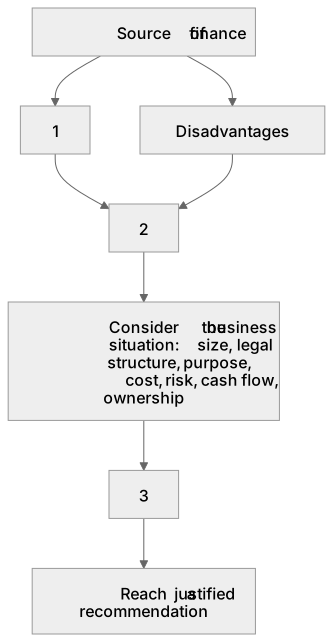
1Box 1
2Box 2
3Box 3
There is more to this lesson
The full lesson goes on to check your understanding and help you earn the marks. Create a free account to carry on, with your progress saved.
A week of Premium from your first lesson · Then the free plan continues · No card, no charge
Test your understanding of Sources of finance: analyse the advantages and disadvantages of each method for a given situation
Active recall beats re-reading. Take an instant quiz now to test what you’ve learned and lock it into long-term memory.
A week of Premium from your first lesson · Then the free plan continues · No card, no charge