AQA · GCSE · Business
Course version: 8132 · Version from Sept 2017
Understand what is meant by a stakeholder and who the main stakeholders of…
Full specification wording
Stakeholders: understand what is meant by a stakeholder and who the main stakeholders of a business are, including owners, employees, customers, local community and suppliers
A stakeholder is any individual or group with an interest in a business and who can affect or be affected by its activities.
Checked against the AQA 8132 specification (opens in a new tab) on .
- Point 5 of 7
- 4 key terms
Study notes
From the checked teaching notes for this specification point.
The idea
A stakeholder is any individual or group with an interest in a business and who can affect or be affected by its activities. The main stakeholders are owners, employees, customers, the local community and suppliers. Owners provide capital and expect returns; employees provide labour and seek secure work and fair pay; customers buy goods or services and expect quality and value; the local community experiences effects such as jobs, traffic or pollution; suppliers provide materials or services and depend on prompt payment and continued orders. For example, a bakery's owners, bakers, shoppers, neighbours and flour supplier all have a stake. Stakeholder influence varies with power and interest, so businesses often balance competing needs when making decisions.
What earns the marks
- Defines a stakeholder as any individual or group with an interest in a business and who can affect or be affected by its activities.
- Identifies owners as stakeholders who provide capital, bear risk and expect a return on investment.
- Identifies employees as stakeholders who provide labour and seek secure employment, fair pay and safe working conditions.
- Identifies customers as stakeholders who purchase goods or services and expect quality, value and reliable service.
- Identifies the local community as a stakeholder affected by employment, traffic, noise, pollution or local spending.
- Identifies suppliers as stakeholders who provide materials or services and depend on prompt payment and continued orders.
- Explains that different stakeholders have different interests and levels of influence, so businesses may need to balance competing demands.
Common mistakes and how to put them right
Treating shareholders as the only stakeholders.
Put it right: Recognise that employees, customers, the local community and suppliers also have a stake.
Confusing stakeholders with shareholders.
Put it right: Shareholders are owners, but stakeholders include all groups affected by or interested in the business.
Assuming all stakeholders have equal influence.
Put it right: Influence depends on power and interest, so some groups can affect decisions more than others.
Exam tips
- Use the definition of a stakeholder in the introduction, then name each main group and give a specific interest.
- Apply each stakeholder group to the business context in the case study rather than listing generic groups.
- When explaining influence, refer to power and interest to show why some stakeholders matter more in a decision.
Try the lesson
The start of the Stakeholders: understand what is meant by a stakeholder and who the main stakeholders of a business are, including owners, employees, customers, local community and suppliers lesson, made from checked teaching notes for this specification point.
Have a go first
Which of the following best describes what is meant by a stakeholder of a business?
Listen
A stakeholder is any individual or group with an interest in a business and who can affect or be affected by its activities. The main stakeholders are owners, employees, customers, the local community and suppliers. Owners provide capital and expect returns; employees provide labour and seek secure work and fair pay; customers buy goods or services and expect quality and value; the local community experiences effects such as jobs, traffic or pollution; suppliers provide materials or services and depend on prompt payment and continued orders. For example, a bakery's owners, bakers, shoppers, neighbours and flour supplier all have a stake. Stakeholder influence varies with power and interest, so businesses often balance competing needs when making decisions. A strong answer earns marks for these points. Defines a stakeholder as any individual or group with an interest in a business and who can affect or be affected by its activities. Identifies owners as stakeholders who provide capital, bear risk and expect a return on investment. Identifies employees as stakeholders who provide labour and seek secure employment, fair pay and safe working conditions. Identifies customers as stakeholders who purchase goods or services and expect quality, value and reliable service. A common slip: Treating shareholders as the only stakeholders. Instead, recognise that employees, customers, the local community and suppliers also have a stake. Exam tip: Use the definition of a stakeholder in the introduction, then name each main group and give a specific interest.
See it
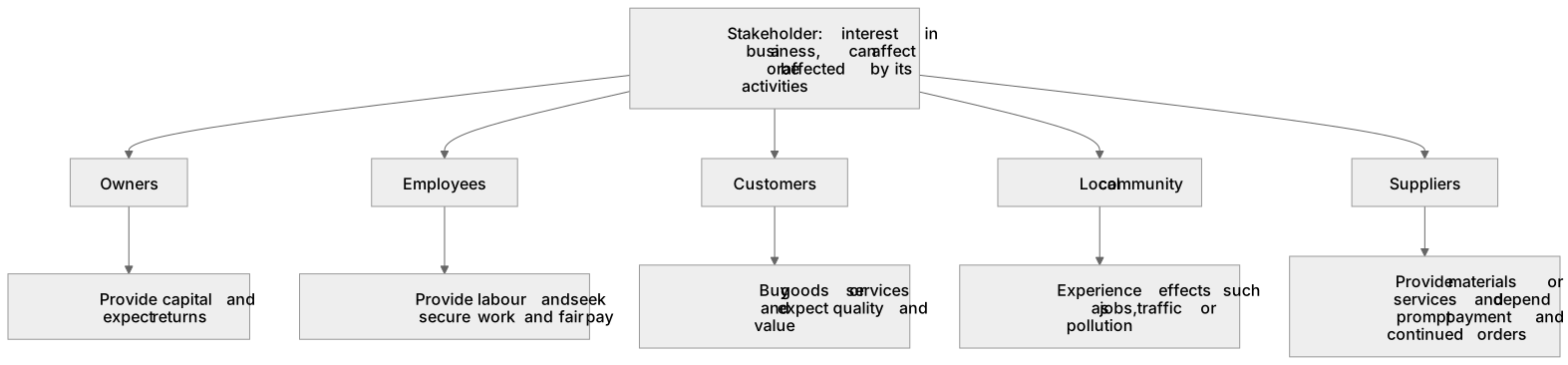
Key words
Say what each word means before you turn the card.
Stakeholder
Try answering aloud or in your head before turning the card.
Owners
Try answering aloud or in your head before turning the card.
Employees
Try answering aloud or in your head before turning the card.
Suppliers
Try answering aloud or in your head before turning the card.
See every definition
- Stakeholder
- Any individual or group with an interest in a business and who can affect or be affected by its activities.
- Owners
- Stakeholders who provide capital, bear risk and expect a return on investment.
- Employees
- Stakeholders who provide labour and seek secure employment, fair pay and safe working conditions.
- Suppliers
- Stakeholders who provide materials or services and depend on prompt payment and continued orders.
Label the diagram
Some boxes have lost their names. Pick the right name for each number.
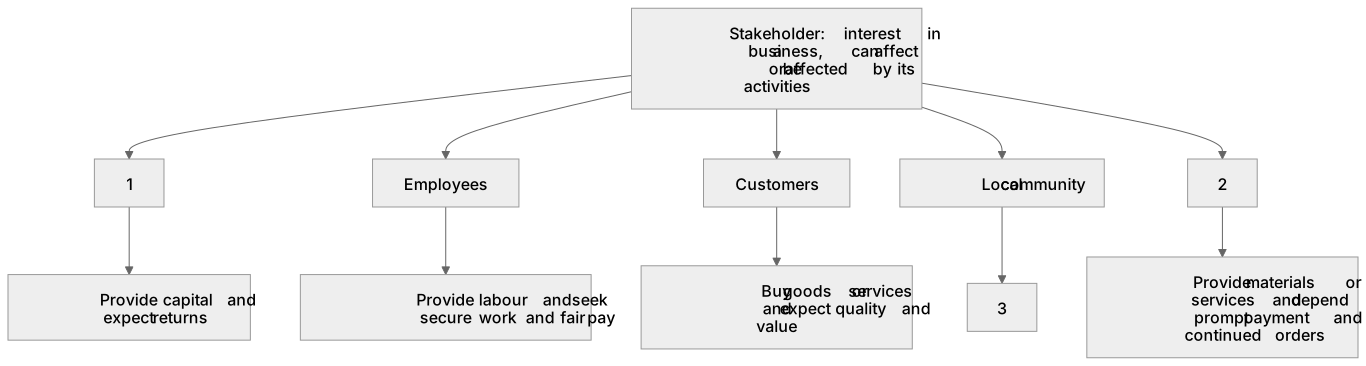
1Box 1
2Box 2
3Box 3
There is more to this lesson
The full lesson goes on to check your understanding and help you earn the marks. Create a free account to carry on, with your progress saved.
A week of Premium from your first lesson · Then the free plan continues · No card, no charge
Test your understanding of Stakeholders: understand what is meant by a stakeholder and who the main stakeholders of a business are, including owners, employees, customers, local community and suppliers
Active recall beats re-reading. Take an instant quiz now to test what you’ve learned and lock it into long-term memory.
A week of Premium from your first lesson · Then the free plan continues · No card, no charge