AQA · GCSE · Business
Course version: 8132 · Version from Sept 2017
Understand stakeholders’ main objectives including maximising pay for…
Full specification wording
Stakeholders: understand stakeholders’ main objectives including maximising pay for workers, minimising environmental impact on local community and high dividend payments for owners
Stakeholders pursue different objectives.
Checked against the AQA 8132 specification (opens in a new tab) on .
- Point 6 of 7
- 4 key terms
Study notes
From the checked teaching notes for this specification point.
The idea
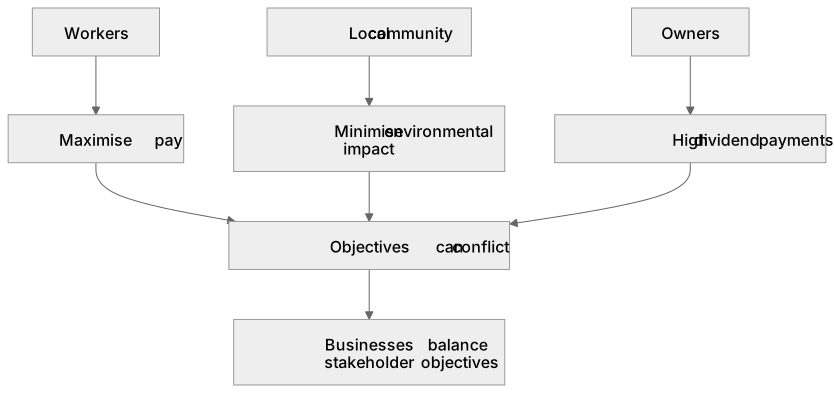
Stakeholders pursue different objectives. Workers aim to maximise pay, which means seeking higher wages, bonuses or benefits from their employment. The local community aims to minimise environmental impact, such as reducing pollution, noise, traffic and waste, to protect local quality of life. Owners aim for high dividend payments, meaning a share of profit distributed to shareholders, alongside potential capital growth. These objectives can conflict: higher pay and higher dividends may reduce retained profit, while cutting environmental impact can raise costs. For example, a factory deciding whether to invest in cleaner machinery must weigh community benefits against owner returns and worker pay. Businesses therefore balance stakeholder objectives when making decisions.
What earns the marks
- States that workers aim to maximise pay, including wages, bonuses and benefits.
- States that the local community aims to minimise environmental impact, such as pollution, noise, traffic and waste.
- States that owners aim for high dividend payments, which are a share of profit paid to shareholders.
- Explains that stakeholder objectives can conflict, for example higher pay or lower environmental impact may reduce profit available for dividends.
- Explains that businesses must balance competing stakeholder objectives when making decisions.
Common mistakes and how to put them right
Confusing dividends with wages.
Put it right: Dividends are payments to owners or shareholders from profit, while wages are payments to workers.
Assuming all owners always want maximum dividends.
Put it right: Some owners may prefer reinvestment for growth, but the specification focuses on high dividend payments as a main objective.
Treating environmental impact as only a legal issue.
Put it right: The local community may seek to minimise environmental impact even when the business meets legal minimum standards.
Exam tips
- Link each objective to the correct stakeholder group: workers to pay, local community to environmental impact, owners to dividends.
- Use a conflict example to show understanding of why objectives cannot always all be met at once.
- Apply the objectives to the case study business rather than writing generally about all businesses.
Try the lesson
The start of the Stakeholders: understand stakeholders’ main objectives including maximising pay for workers, minimising environmental impact on local community and high dividend payments for owners lesson, made from checked teaching notes for this specification point.
Have a go first
Which of the following is the main objective of the owners of a business?
Listen
Stakeholders pursue different objectives. Workers aim to maximise pay, which means seeking higher wages, bonuses or benefits from their employment. The local community aims to minimise environmental impact, such as reducing pollution, noise, traffic and waste, to protect local quality of life. Owners aim for high dividend payments, meaning a share of profit distributed to shareholders, alongside potential capital growth. These objectives can conflict: higher pay and higher dividends may reduce retained profit, while cutting environmental impact can raise costs. For example, a factory deciding whether to invest in cleaner machinery must weigh community benefits against owner returns and worker pay. Businesses therefore balance stakeholder objectives when making decisions. A strong answer earns marks for these points. States that workers aim to maximise pay, including wages, bonuses and benefits. States that the local community aims to minimise environmental impact, such as pollution, noise, traffic and waste. States that owners aim for high dividend payments, which are a share of profit paid to shareholders. Explains that stakeholder objectives can conflict, for example higher pay or lower environmental impact may reduce profit available for dividends. A common slip: Confusing dividends with wages. Instead, dividends are payments to owners or shareholders from profit, while wages are payments to workers. Exam tip: Link each objective to the correct stakeholder group: workers to pay, local community to environmental impact, owners to dividends.
See it
Key words
Say what each word means before you turn the card.
Worker pay and rewards
Try answering aloud or in your head before turning the card.
Environmental impact on local community
Try answering aloud or in your head before turning the card.
Dividend payments to owners
Try answering aloud or in your head before turning the card.
Stakeholder objectives
Try answering aloud or in your head before turning the card.
See every definition
- Worker pay and rewards
- Workers aim to maximise pay, which means seeking higher wages, bonuses or benefits from their employment.
- Environmental impact on local community
- The local community aims to minimise environmental impact, such as reducing pollution, noise, traffic and waste, to protect local quality of life.
- Dividend payments to owners
- Owners aim for high dividend payments, meaning a share of profit distributed to shareholders, alongside potential capital growth.
- Stakeholder objectives
- Stakeholders pursue different objectives, and businesses must balance these competing objectives when making decisions.
Label the diagram
Some boxes have lost their names. Pick the right name for each number.
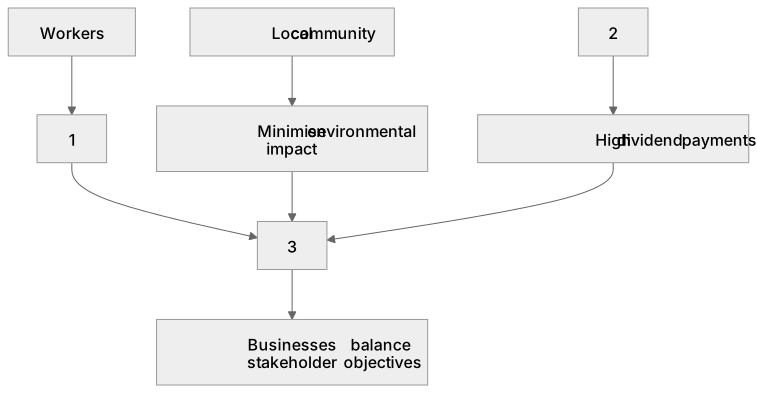
1Box 1
2Box 2
3Box 3
There is more to this lesson
The full lesson goes on to check your understanding and help you earn the marks. Create a free account to carry on, with your progress saved.
A week of Premium from your first lesson · Then the free plan continues · No card, no charge
Test your understanding of Stakeholders: understand stakeholders’ main objectives including maximising pay for workers, minimising environmental impact on local community and high dividend payments for owners
Active recall beats re-reading. Take an instant quiz now to test what you’ve learned and lock it into long-term memory.
A week of Premium from your first lesson · Then the free plan continues · No card, no charge