AQA · GCSE · Business
Course version: 8132 · Version from Sept 2017
Technology: E-commerce
E-commerce is the buying and selling of goods and services online.
Checked against the AQA 8132 specification (opens in a new tab) on .
- Point 1 of 5
Study notes
From the checked teaching notes for this specification point.
The idea
E-commerce is the buying and selling of goods and services online. It allows businesses to reach a wider market, operate 24/7, and reduce physical store costs. For example, a small clothing retailer can sell nationwide via its website. However, e-commerce also brings challenges such as increased competition, cybersecurity risks, and the need for reliable logistics. It requires investment in technology and can change the competitive landscape. The impact on stakeholders, such as customers gaining convenience and employees needing new skills, should also be considered.
What earns the marks
- Define e-commerce as online transactions of goods and services.
- Explain advantages: wider market, 24/7 trading, lower overheads.
- Explain disadvantages: competition, security issues, logistics complexity.
- Analyse how e-commerce affects business functions like marketing and operations.
- Evaluate the impact of e-commerce on small versus large businesses.
Common mistakes and how to put them right
Thinking e-commerce only involves selling physical goods.
Put it right: It includes services and digital products.
Assuming e-commerce eliminates all costs.
Put it right: It still requires website maintenance and marketing.
Overlooking cybersecurity risks, which can lead to data breaches and loss of customer trust.
Exam tips
- Use examples of well-known e-commerce businesses to illustrate points.
- Discuss both benefits and drawbacks to show balanced evaluation.
- Relate e-commerce to other topics like technology and globalisation for synoptic answers.
Try the lesson
The start of the Technology: E-commerce lesson, made from checked teaching notes for this specification point.
Have a go first
What does the term e-commerce mean for a business?
Listen
E-commerce is the buying and selling of goods and services online. It allows businesses to reach a wider market, operate 24/7, and reduce physical store costs. For example, a small clothing retailer can sell nationwide via its website. However, e-commerce also brings challenges such as increased competition, cybersecurity risks, and the need for reliable logistics. It requires investment in technology and can change the competitive landscape. The impact on stakeholders, such as customers gaining convenience and employees needing new skills, should also be considered. A strong answer earns marks for these points. Define e-commerce as online transactions of goods and services. Explain advantages: wider market, 24/7 trading, lower overheads. Explain disadvantages: competition, security issues, logistics complexity. Analyse how e-commerce affects business functions like marketing and operations. Exam tip: Use examples of well-known e-commerce businesses to illustrate points.
See it

Label the diagram
Some boxes have lost their names. Pick the right name for each number.
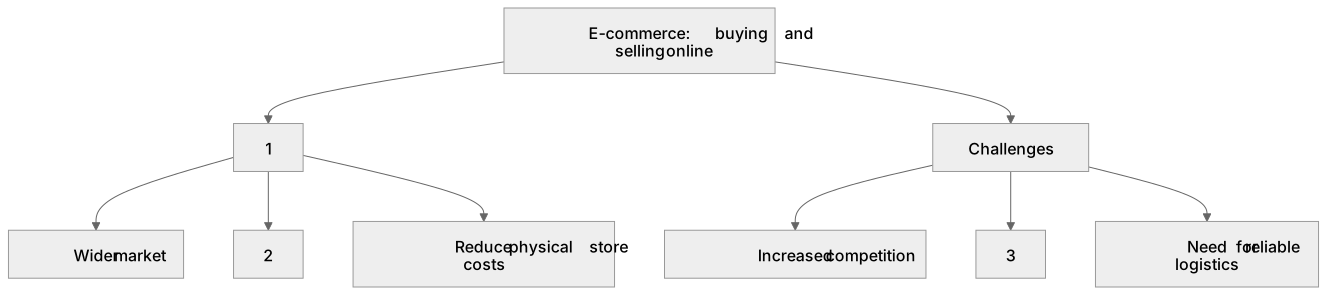
1Box 1
2Box 2
3Box 3
There is more to this lesson
The full lesson goes on to check your understanding and help you earn the marks. Create a free account to carry on, with your progress saved.
A week of Premium from your first lesson · Then the free plan continues · No card, no charge
Test your understanding of Technology: E-commerce
Active recall beats re-reading. Take an instant quiz now to test what you’ve learned and lock it into long-term memory.
A week of Premium from your first lesson · Then the free plan continues · No card, no charge