AQA · GCSE · Business
Course version: 8132 · Version from Sept 2017
The economic climate on businesses: Level of employment
Level of employment means how many people in an economy have paid work, and it matters because employed people usually earn income they can spend on goods and services.
Checked against the AQA 8132 specification (opens in a new tab) on .
- Point 6 of 8
- 2 key terms
Study notes
From the checked teaching notes for this specification point.
The idea
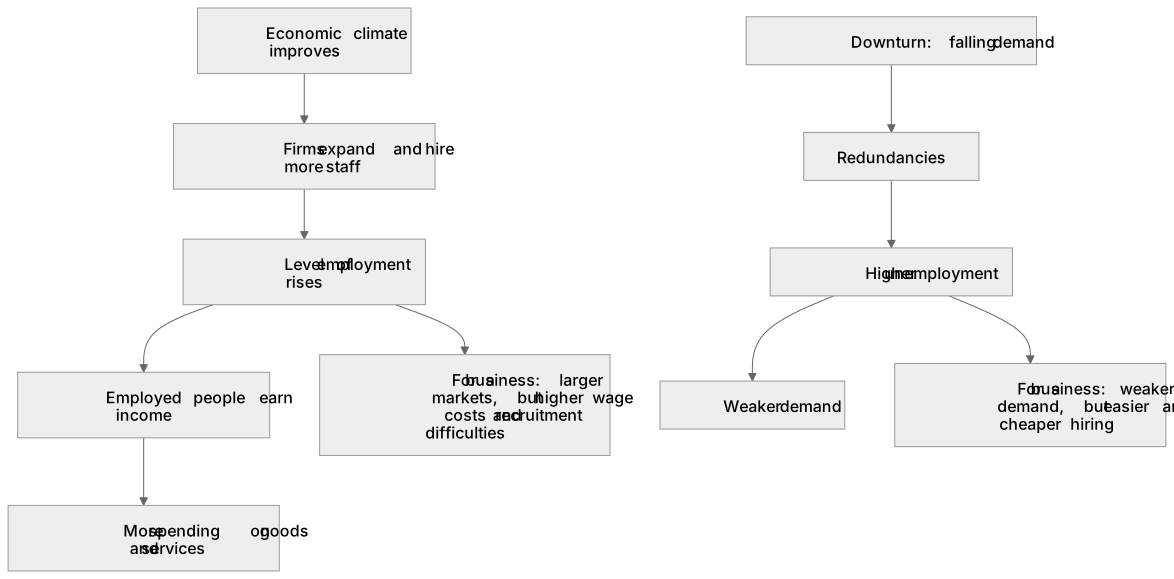
Level of employment means how many people in an economy have paid work, and it matters because employed people usually earn income they can spend on goods and services. When the economic climate improves, firms may expand and hire more staff, so employment rises; in a downturn, falling demand can lead to redundancies and higher unemployment. For a business, a high level of employment can mean larger markets but also higher wage costs and recruitment difficulties, while a low level can mean weaker demand but easier, cheaper hiring. A local example: a town where a large employer closes loses many jobs, so nearby shops face lower footfall and sales.
What earns the marks
- Defines level of employment as the proportion or number of people in an economy who have paid work, distinguishing it from unemployment.
- Explains that employment levels rise when businesses expand output and hire staff during an upturn, and fall through redundancies in a downturn.
- Links employment to income and consumer demand, showing that employed people are more likely to spend on goods and services.
- Analyses effects on a business: higher employment can widen the customer base but raise wage costs and make recruitment harder.
- Evaluates that the impact depends on the business's market, for example luxury goods are more affected by employment changes than everyday essentials.
Common mistakes and how to put them right
Confusing level of employment with level of unemployment.
Put it right: Employment counts people in paid work, while unemployment counts people actively seeking work without a job.
Assuming high employment always benefits every business.
Put it right: It can raise wage costs and recruitment difficulty, so effects vary by firm.
Treating employment as fixed and unrelated to the economic climate.
Put it right: Hiring and redundancies respond to changes in demand and confidence.
Exam tips
- Define the term briefly, then apply it to the case business rather than writing generally about the economy.
- Use a chain of reasoning: economic climate changes, firms change staffing, incomes change, demand for the case business changes.
Try the lesson
The start of the The economic climate on businesses: Level of employment lesson, made from checked teaching notes for this specification point.
Have a go first
Which term describes the number of people who have paid work in a country at a given time?
Listen
Level of employment means how many people in an economy have paid work, and it matters because employed people usually earn income they can spend on goods and services. When the economic climate improves, firms may expand and hire more staff, so employment rises; in a downturn, falling demand can lead to redundancies and higher unemployment. For a business, a high level of employment can mean larger markets but also higher wage costs and recruitment difficulties, while a low level can mean weaker demand but easier, cheaper hiring. A local example: a town where a large employer closes loses many jobs, so nearby shops face lower footfall and sales. A strong answer earns marks for these points. Defines level of employment as the proportion or number of people in an economy who have paid work, distinguishing it from unemployment. Explains that employment levels rise when businesses expand output and hire staff during an upturn, and fall through redundancies in a downturn. Links employment to income and consumer demand, showing that employed people are more likely to spend on goods and services. Analyses effects on a business: higher employment can widen the customer base but raise wage costs and make recruitment harder. A common slip: Confusing level of employment with level of unemployment. Instead, employment counts people in paid work, while unemployment counts people actively seeking work without a job. Exam tip: Define the term briefly, then apply it to the case business rather than writing generally about the economy.
See it
Key words
Say what each word means before you turn the card.
Level of employment
Try answering aloud or in your head before turning the card.
Unemployment
Try answering aloud or in your head before turning the card.
See every definition
- Level of employment
- How many people in an economy have paid work, which matters because employed people usually earn income they can spend on goods and services.
- Unemployment
- Counts people actively seeking work without a job, and higher unemployment can follow redundancies in a downturn.
Label the diagram
Some boxes have lost their names. Pick the right name for each number.
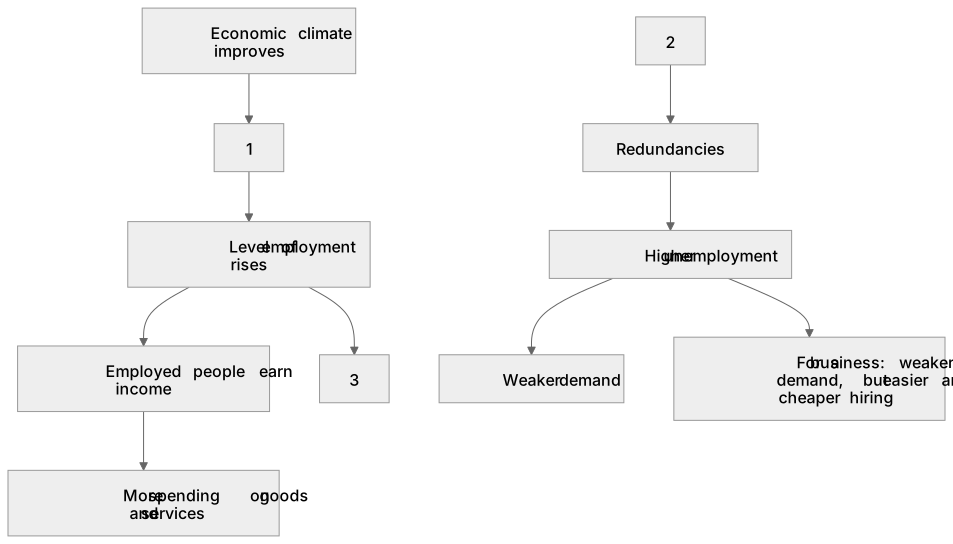
1Box 1
2Box 2
3Box 3
There is more to this lesson
The full lesson goes on to check your understanding and help you earn the marks. Create a free account to carry on, with your progress saved.
A week of Premium from your first lesson · Then the free plan continues · No card, no charge
Test your understanding of The economic climate on businesses: Level of employment
Active recall beats re-reading. Take an instant quiz now to test what you’ve learned and lock it into long-term memory.
A week of Premium from your first lesson · Then the free plan continues · No card, no charge