AQA · GCSE · Business
Course version: 8132 · Version from Sept 2017
Students should be able to identify how and why businesses might be…
Full specification wording
The economic climate on businesses: Students should be able to identify how and why businesses might be affected by changes in levels of employment.
Levels of employment measure the number of people of working age in paid work.
Checked against the AQA 8132 specification (opens in a new tab) on .
- Point 5 of 8
- 4 key terms
Study notes
From the checked teaching notes for this specification point.
The idea
Levels of employment measure the number of people of working age in paid work. When employment rises, more people earn income, increasing consumer spending and demand. Businesses may need to recruit, raising wage costs and competition for staff. Unemployment refers to the number of people in the labour force actively seeking work. When unemployment rises, demand often falls, especially for discretionary items, but firms may find it easier to recruit and hold down wages. Low unemployment can cause skills shortages, while high unemployment means a larger, cheaper labour supply.
For example: A restaurant in a low-unemployment area may struggle to hire chefs, while in a high-unemployment area it finds staff easily but faces weaker demand.
What earns the marks
- Defines employment level as the number of people of working age in paid work, and unemployment as the number of people in the labour force actively seeking work, excluding the economically inactive.
- Explains how higher employment raises household income and consumer demand, benefiting many businesses.
- Explains how higher employment can increase recruitment costs and wage pressures due to labour shortages.
- Explains how higher unemployment reduces demand for discretionary goods but increases the supply of available labour.
- Analyses how changes in employment affect a business's costs, revenue and staffing decisions.
- Evaluates that the impact depends on the type of business, such as whether it sells essentials or luxuries, and local labour market conditions.
Common mistakes and how to put them right
Confusing employment level with the employment rate.
Put it right: Define it as the total number of people of working age in work, not a proportion or percentage.
Assuming unemployment is simply the inverse of employment.
Put it right: Unemployment only includes those actively seeking work, excluding the economically inactive such as retirees or full-time students.
Assuming higher employment always benefits all businesses.
Put it right: Consider both demand and cost effects, as it can raise wage costs and reduce labour availability.
Exam tips
- Use a real or hypothetical local example, such as a town with a new factory opening, to show how employment changes affect demand and recruitment.
- Link employment changes to both revenue (via demand) and costs (via wages and recruitment) to show balanced analysis.
Try the lesson
The start of the The economic climate on businesses: Students should be able to identify how and why businesses might be affected by changes in levels of employment. lesson, made from checked teaching notes for this specification point.
Have a go first
In a local area, the level of employment rises because a large new factory opens. What is the most likely effect on nearby shops?
Listen
Levels of employment measure the number of people of working age in paid work. When employment rises, more people earn income, increasing consumer spending and demand. Businesses may need to recruit, raising wage costs and competition for staff. Unemployment refers to the number of people in the labour force actively seeking work. When unemployment rises, demand often falls, especially for discretionary items, but firms may find it easier to recruit and hold down wages. Low unemployment can cause skills shortages, while high unemployment means a larger, cheaper labour supply. For example, a restaurant in a low-unemployment area may struggle to hire chefs, while in a high-unemployment area it finds staff easily but faces weaker demand. A strong answer earns marks for these points. Defines employment level as the number of people of working age in paid work, and unemployment as the number of people in the labour force actively seeking work, excluding the economically inactive. Explains how higher employment raises household income and consumer demand, benefiting many businesses. Explains how higher employment can increase recruitment costs and wage pressures due to labour shortages. Explains how higher unemployment reduces demand for discretionary goods but increases the supply of available labour. A common slip: Confusing employment level with the employment rate. Instead, define it as the total number of people of working age in work, not a proportion or percentage. Exam tip: Use a real or hypothetical local example, such as a town with a new factory opening, to show how employment changes affect demand and recruitment.
See it
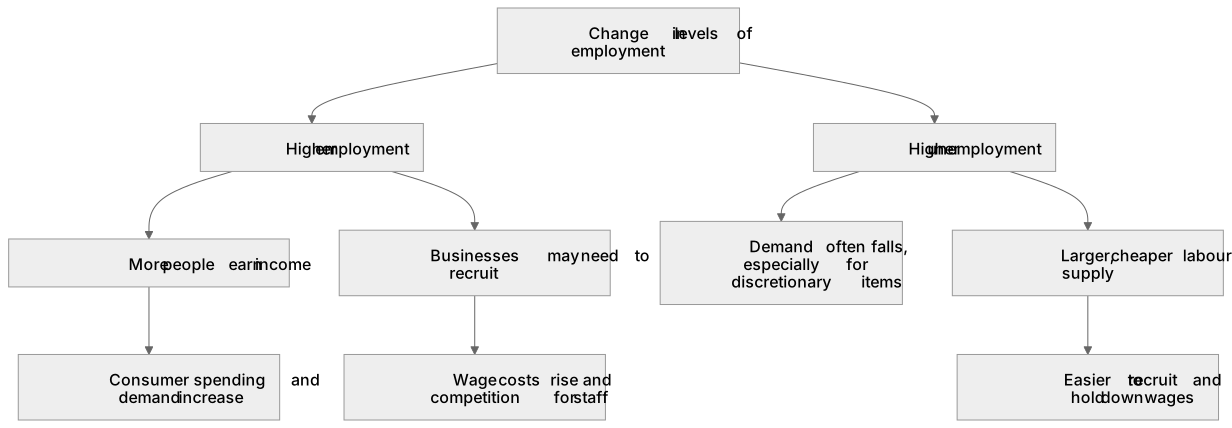
Key words
Say what each word means before you turn the card.
Levels of employment
Try answering aloud or in your head before turning the card.
Unemployment
Try answering aloud or in your head before turning the card.
Consumer income and demand
Try answering aloud or in your head before turning the card.
Labour supply and wage costs
Try answering aloud or in your head before turning the card.
See every definition
- Levels of employment
- The number of people of working age in paid work.
- Unemployment
- The number of people in the labour force actively seeking work.
- Consumer income and demand
- When employment rises, more people earn income, increasing consumer spending and demand.
- Labour supply and wage costs
- Low unemployment can cause skills shortages, while high unemployment means a larger, cheaper labour supply.
Label the diagram
Some boxes have lost their names. Pick the right name for each number.
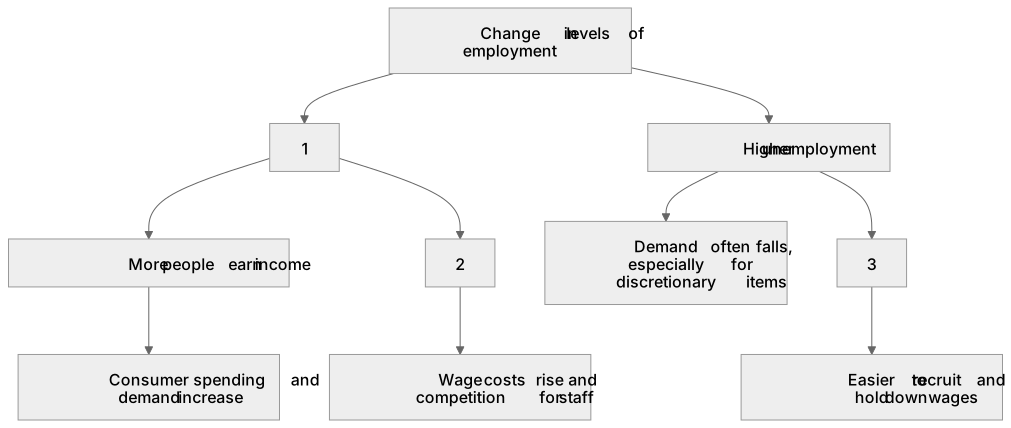
1Box 1
2Box 2
3Box 3
There is more to this lesson
The full lesson goes on to check your understanding and help you earn the marks. Create a free account to carry on, with your progress saved.
A week of Premium from your first lesson · Then the free plan continues · No card, no charge
Test your understanding of The economic climate on businesses: Students should be able to identify how and why businesses might be affected by changes in levels of employment.
Active recall beats re-reading. Take an instant quiz now to test what you’ve learned and lock it into long-term memory.
A week of Premium from your first lesson · Then the free plan continues · No card, no charge