AQA · GCSE · Business
Course version: 8132 · Version from Sept 2017
Students should be able to demonstrate and understand how businesses might…
Full specification wording
The economic climate on businesses: Students should be able to demonstrate and understand how businesses might be affected by changes in the rate of interest.
Interest rates are the price of borrowing money, set by the Bank of England.
Checked against the AQA 8132 specification (opens in a new tab) on .
- Point 4 of 8
Study notes
From the checked teaching notes for this specification point.
The idea
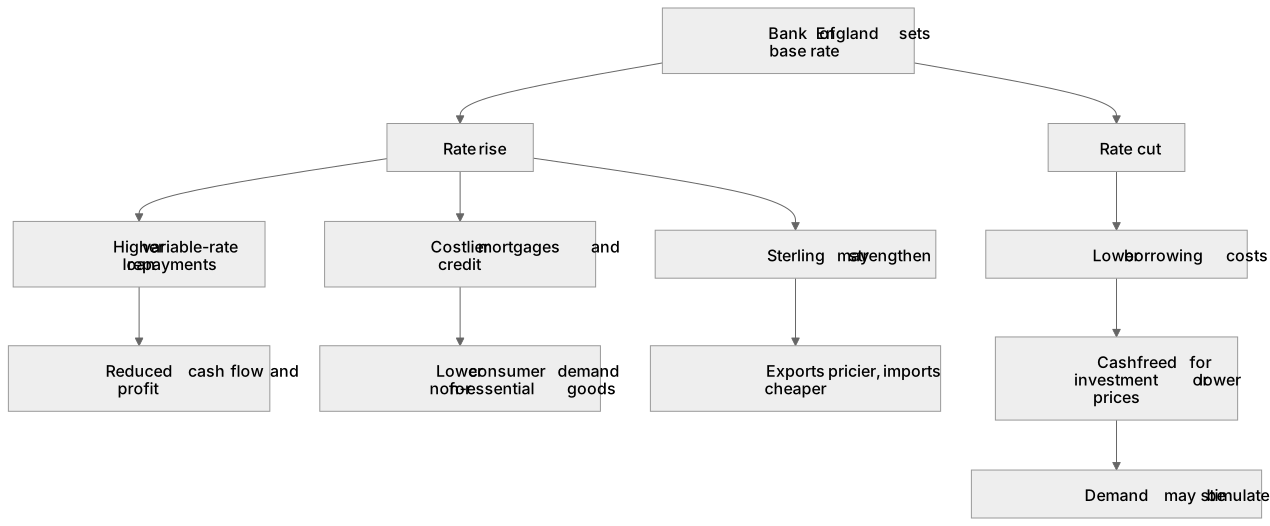
Interest rates are the price of borrowing money, set by the Bank of England. A rise affects businesses through higher loan repayments, reducing cash flow and profit, especially for firms with variable-rate debt. Consumer demand may fall as mortgages and credit become costlier, hitting discretionary spending. A cut lowers borrowing costs, freeing cash for investment or price reductions, and can stimulate demand. Businesses must also consider exchange rates: higher UK rates can strengthen sterling, making exports pricier and imports cheaper. The impact depends on a firm's borrowing, customer sensitivity and export reliance.
For example: A café with a £50,000 variable-rate loan sees monthly repayments rise when rates increase, squeezing margins if sales are unchanged.
What earns the marks
- Defines interest rate as the cost of borrowing or reward for saving, and identifies the Bank of England as the setter of the base rate.
- Explains how a rise increases variable-rate loan repayments, reducing cash flow and potentially profit.
- Explains how a rise reduces consumer disposable income, lowering demand for non-essential goods and services.
- Explains how a cut reduces borrowing costs, enabling investment or lower prices, and may stimulate demand.
- Analyses how exchange rate effects from interest rate changes alter export competitiveness and import costs.
- Evaluates that impact depends on factors such as proportion of variable-rate debt, demand elasticity and export reliance.
Common mistakes and how to put them right
Confusing interest rates with inflation.
Put it right: Define each separately and link them only through monetary policy.
Assuming all businesses are equally affected.
Put it right: Analyse the firm's borrowing and customer sensitivity.
Ignoring exchange rate effects.
Put it right: Include the export/import channel in analysis.
Exam tips
- Use a specific business context, such as a small retailer with a variable-rate loan, to show the chain of impact.
- Structure answers as cause (rate change) → effect on costs/demand → impact on the business, using connectives like 'therefore' and 'however'.
- For evaluation, weigh the impact against the firm's circumstances, such as fixed-rate debt or essential products, to reach a supported judgement.
Try the lesson
The start of the The economic climate on businesses: Students should be able to demonstrate and understand how businesses might be affected by changes in the rate of interest. lesson, made from checked teaching notes for this specification point.
Have a go first
A bakery has a variable-rate loan. The rate of interest rises. What is the most likely effect on the bakery's monthly loan repayment?
Listen
Interest rates are the price of borrowing money, set by the Bank of England. A rise affects businesses through higher loan repayments, reducing cash flow and profit, especially for firms with variable-rate debt. Consumer demand may fall as mortgages and credit become costlier, hitting discretionary spending. A cut lowers borrowing costs, freeing cash for investment or price reductions, and can stimulate demand. Businesses must also consider exchange rates: higher UK rates can strengthen sterling, making exports pricier and imports cheaper. The impact depends on a firm's borrowing, customer sensitivity and export reliance. For example, a café with a £50,000 variable-rate loan sees monthly repayments rise when rates increase, squeezing margins if sales are unchanged. A strong answer earns marks for these points. Defines interest rate as the cost of borrowing or reward for saving, and identifies the Bank of England as the setter of the base rate. Explains how a rise increases variable-rate loan repayments, reducing cash flow and potentially profit. Explains how a rise reduces consumer disposable income, lowering demand for non-essential goods and services. Explains how a cut reduces borrowing costs, enabling investment or lower prices, and may stimulate demand. A common slip: Confusing interest rates with inflation: interest rates are the cost of borrowing, while inflation is the rate of price increase. Instead, define each separately and link them only through monetary policy. Exam tip: Use a specific business context, such as a small retailer with a variable-rate loan, to show the chain of impact.
See it
Label the diagram
Some boxes have lost their names. Pick the right name for each number.
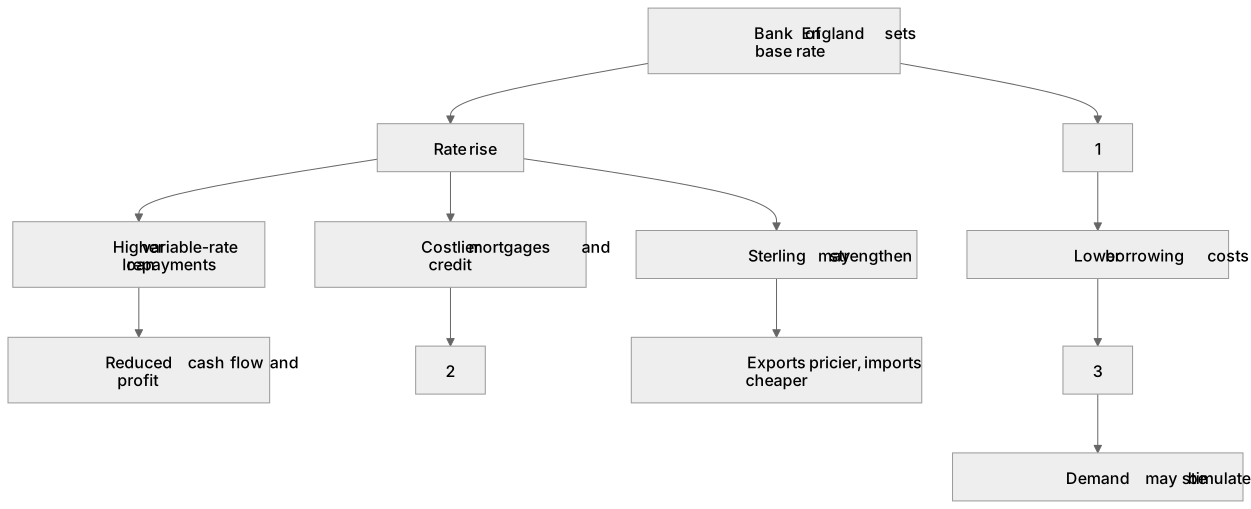
1Box 1
2Box 2
3Box 3
There is more to this lesson
The full lesson goes on to check your understanding and help you earn the marks. Create a free account to carry on, with your progress saved.
A week of Premium from your first lesson · Then the free plan continues · No card, no charge
Test your understanding of The economic climate on businesses: Students should be able to demonstrate and understand how businesses might be affected by changes in the rate of interest.
Active recall beats re-reading. Take an instant quiz now to test what you’ve learned and lock it into long-term memory.
A week of Premium from your first lesson · Then the free plan continues · No card, no charge