AQA · GCSE · Business
Course version: 8132 · Version from Sept 2017
Price, product, promotion and place (4Ps): 2 for 1 offers
Full specification wording
The elements of the marketing mix: price, product, promotion and place (4Ps): 2 for 1 offers
A 2 for 1 offer lets a customer buy two items for the price of one, so the effective price per item is halved.
Checked against the AQA 8132 specification (opens in a new tab) on .
- Point 48 of 80
- 3 key terms
Study notes
From the checked teaching notes for this specification point.
The idea
A 2 for 1 offer lets a customer buy two items for the price of one, so the effective price per item is halved. For example, two pizzas priced at £5 each cost £5 in total, which is £2.50 each. It is a price promotion and a sales promotion: it cuts the unit price and encourages extra purchases. It can clear stock, raise footfall or introduce a new product. The business must check that the extra units sold and the revenue gained cover the discount given away. It may also attract customers who would have bought only one item, so the promotion can reduce revenue per unit and lower gross profit. It differs from multibuy offers such as 3 for 2, where the customer pays for two items out of three. It is assessed by comparing sales revenue, units sold and gross profit during and after the promotion.
What earns the marks
- Defines a 2 for 1 offer as a promotion in which a customer pays for one item and receives a second item free.
- Calculates the effective unit price correctly, for example two items at £5 each become £5 for the pair, which is £2.50 per item.
- Classifies the offer as both a price tactic and a sales promotion within the marketing mix.
- Explains a business aim such as increasing sales volume, clearing excess stock, attracting new customers or encouraging trial of a product.
- Evaluates the trade-off between extra units sold and the discount given, including the risk that some customers would have paid full price for one item.
- Distinguishes 2 for 1 from other multibuy mechanics such as 3 for 2 or 'buy one get one half price'.
Common mistakes and how to put them right
Calculating the saving incorrectly.
Put it right: If two items each cost £5, the customer pays £5 and saves £5, so the effective price per item is £2.50, not £5.
Treating 2 for 1 as always profitable.
Put it right: The business gives away one item, so it must sell enough extra units or attract enough new customers to offset the lost revenue and any extra costs.
Confusing 2 for 1 with 3 for 2.
Put it right: In 2 for 1 the customer pays for one item and gets one free, while in 3 for 2 the customer pays for two items and gets the third free.
Exam tips
- Show the arithmetic clearly when a price is given, stating the total paid and the effective price per item.
- Link the offer to a specific business aim, such as clearing seasonal stock or increasing market share, rather than saying only that it boosts sales.
- In evaluation, compare the short-term sales increase with the effect on revenue per unit and gross profit margin.
Try the lesson
The start of the The elements of the marketing mix: price, product, promotion and place (4Ps): 2 for 1 offers lesson, made from checked teaching notes for this specification point.
Have a go first
In a 2 for 1 offer, how many items does a customer pay for?
Listen
A 2 for 1 offer lets a customer buy two items for the price of one, so the effective price per item is halved. For example, two pizzas priced at £5 each cost £5 in total, which is £2.50 each. It is a price promotion and a sales promotion: it cuts the unit price and encourages extra purchases. It can clear stock, raise footfall or introduce a new product. The business must check that the extra units sold and the revenue gained cover the discount given away. It may also attract customers who would have bought only one item, so the promotion can reduce revenue per unit and lower gross profit. It differs from multibuy offers such as 3 for 2, where the customer pays for two items out of three. It is assessed by comparing sales revenue, units sold and gross profit during and after the promotion. A strong answer earns marks for these points. Defines a 2 for 1 offer as a promotion in which a customer pays for one item and receives a second item free. Calculates the effective unit price correctly, for example two items at £5 each become £5 for the pair, which is £2.50 per item. Classifies the offer as both a price tactic and a sales promotion within the marketing mix. Explains a business aim such as increasing sales volume, clearing excess stock, attracting new customers or encouraging trial of a product. Exam tip: Show the arithmetic clearly when a price is given, stating the total paid and the effective price per item.
See it

Key words
Say what each word means before you turn the card.
Price
Try answering aloud or in your head before turning the card.
Sales promotion
Try answering aloud or in your head before turning the card.
Sales volume
Try answering aloud or in your head before turning the card.
See every definition
- Price
- The amount a customer pays for an item, which a 2 for 1 offer effectively halves per item.
- Sales promotion
- An offer such as 2 for 1 that encourages extra purchases and can clear stock, raise footfall or introduce a new product.
- Sales volume
- The number of units sold, which a 2 for 1 offer aims to increase and which is compared during and after the promotion.
Label the diagram
Some boxes have lost their names. Pick the right name for each number.
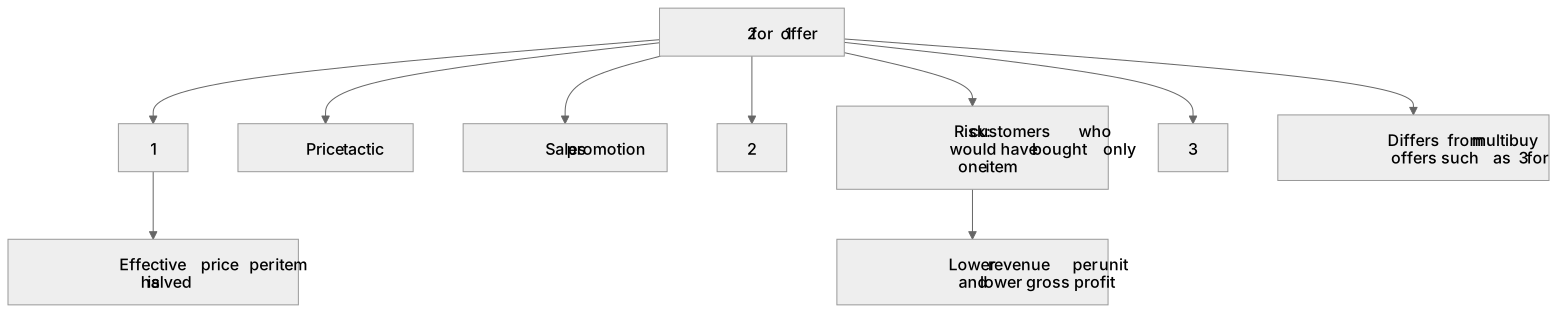
1Box 1
2Box 2
3Box 3
There is more to this lesson
The full lesson goes on to check your understanding and help you earn the marks. Create a free account to carry on, with your progress saved.
A week of Premium from your first lesson · Then the free plan continues · No card, no charge
Test your understanding of The elements of the marketing mix: price, product, promotion and place (4Ps): 2 for 1 offers
Active recall beats re-reading. Take an instant quiz now to test what you’ve learned and lock it into long-term memory.
A week of Premium from your first lesson · Then the free plan continues · No card, no charge