AQA · GCSE · Business
Course version: 8132 · Version from Sept 2017
Price, product, promotion and place (4Ps): point of sales displays
Full specification wording
The elements of the marketing mix: price, product, promotion and place (4Ps): point of sales displays
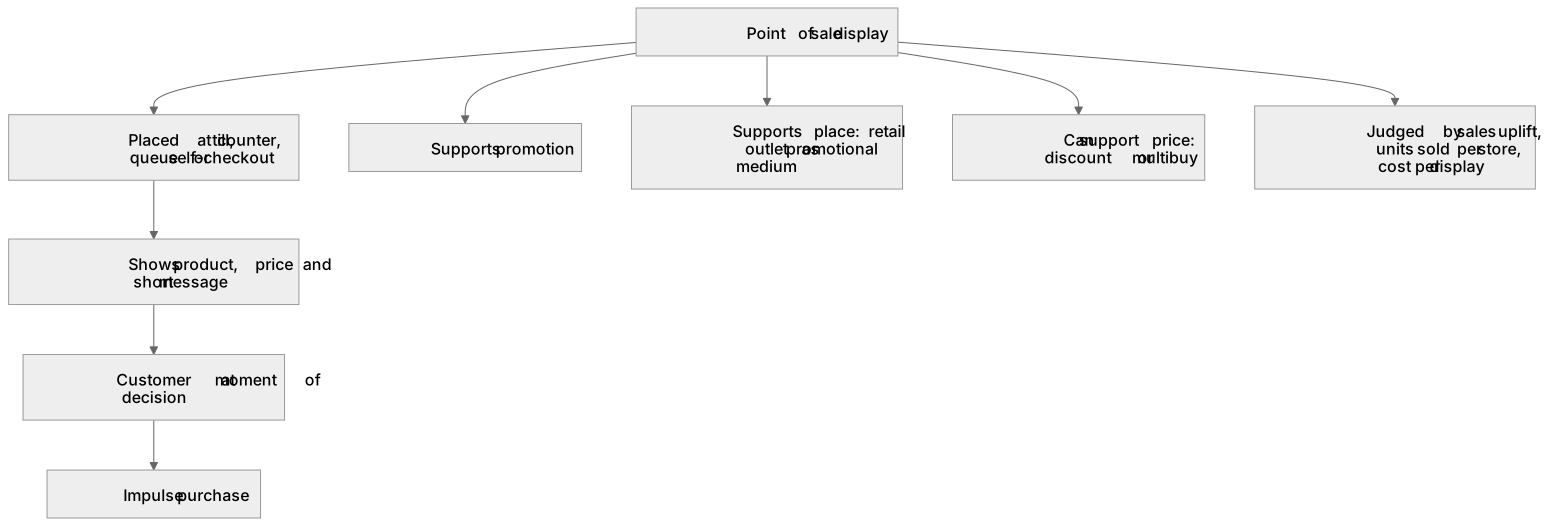
A point of sale display is promotional material placed where customers pay or queue, such as a till counter, card reader or self-checkout.
Checked against the AQA 8132 specification (opens in a new tab) on .
- Point 47 of 80
- 4 key terms
Study notes
From the checked teaching notes for this specification point.
The idea
A point of sale display is promotional material placed where customers pay or queue, such as a till counter, card reader or self-checkout. It prompts impulse purchases by showing a product, its price and a short message at the moment of decision. For example, a chocolate bar at a supermarket till uses a small stand and a sign reading 'Only £1'. The display must suit the outlet: a compact stand for a small shop, a shelf-ready unit for a chain. It supports promotion and place because it puts the product in front of customers at the point of purchase. It can also support price by highlighting a discount or multibuy. Businesses judge it by sales uplift, units sold per store and cost per display. It is not the same as a shop window or a television advert, which act earlier in the buying process.
What earns the marks
- Defines a point of sale display as promotional material sited at the till, counter, queue or self-checkout where payment occurs.
- Explains that it targets impulse buying by placing a product and its price in front of the customer at the moment of decision.
- Links the display to the promotion element of the marketing mix and to place because it uses the retail outlet itself as the promotional medium.
- Gives a concrete example, such as a counter stand of chocolate bars priced at £1, and states the intended effect on sales.
- Outlines how a business evaluates the display, for example by comparing sales before and after installation or by calculating cost per additional unit sold.
- Distinguishes point of sale displays from other promotional methods such as shop windows, posters or broadcast advertising.
Common mistakes and how to put them right
Confusing point of sale displays with shop window displays.
Put it right: A shop window attracts passing trade from outside, while a point of sale display sits at the till or queue and prompts a final impulse purchase.
Treating the display as only a price promotion.
Put it right: The display is a promotional and placement device that can carry price information, but it can also promote a new product or a brand without any discount.
Assuming every display raises sales.
Put it right: A cluttered till area, poor stock availability or a display that blocks the queue can reduce sales or annoy customers, so the business must test and review it.
Exam tips
- Anchor answers in the marketing mix by naming promotion and place, then explain how the display works at the point of purchase.
- Use a named retail context, such as a supermarket till or a pharmacy counter, and state the product, the message and the expected customer response.
- When asked to evaluate, weigh the low cost and impulse effect against risks such as clutter, limited space and stock running out.
Try the lesson
The start of the The elements of the marketing mix: price, product, promotion and place (4Ps): point of sales displays lesson, made from checked teaching notes for this specification point.
Have a go first
Which element of the marketing mix is a point of sales display used to support?
Listen
A point of sale display is promotional material placed where customers pay or queue, such as a till counter, card reader or self-checkout. It prompts impulse purchases by showing a product, its price and a short message at the moment of decision. For example, a chocolate bar at a supermarket till uses a small stand and a sign reading 'Only £1'. The display must suit the outlet: a compact stand for a small shop, a shelf-ready unit for a chain. It supports promotion and place because it puts the product in front of customers at the point of purchase. It can also support price by highlighting a discount or multibuy. Businesses judge it by sales uplift, units sold per store and cost per display. It is not the same as a shop window or a television advert, which act earlier in the buying process. A strong answer earns marks for these points. Defines a point of sale display as promotional material sited at the till, counter, queue or self-checkout where payment occurs. Explains that it targets impulse buying by placing a product and its price in front of the customer at the moment of decision. Links the display to the promotion element of the marketing mix and to place because it uses the retail outlet itself as the promotional medium. Gives a concrete example, such as a counter stand of chocolate bars priced at £1, and states the intended effect on sales. Exam tip: Anchor answers in the marketing mix by naming promotion and place, then explain how the display works at the point of purchase.
See it
Key words
Say what each word means before you turn the card.
Promotion
Try answering aloud or in your head before turning the card.
Place
Try answering aloud or in your head before turning the card.
Impulse purchasing
Try answering aloud or in your head before turning the card.
Marketing mix integration
Try answering aloud or in your head before turning the card.
See every definition
- Promotion
- One element of the marketing mix that a point of sale display supports by putting the product in front of customers at the point of purchase.
- Place
- One element of the marketing mix that a point of sale display supports because it uses the retail outlet itself as the promotional medium.
- Impulse purchasing
- Buying prompted by a display that shows a product, its price and a short message at the moment of decision.
- Marketing mix integration
- Supporting promotion and place together, and also price by highlighting a discount or multibuy, through a display at the point of purchase.
Label the diagram
Some boxes have lost their names. Pick the right name for each number.
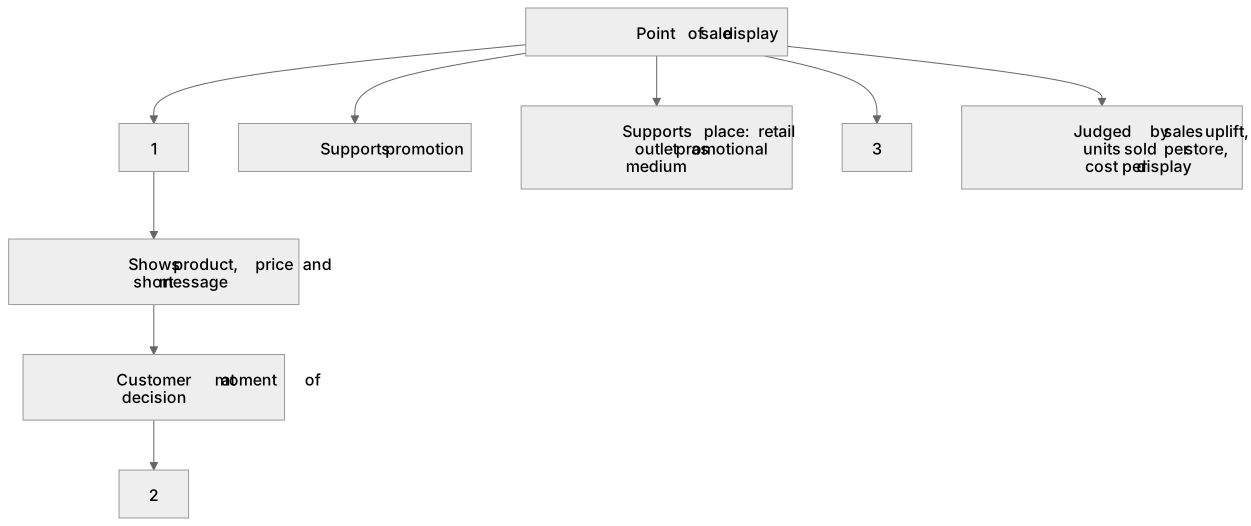
1Box 1
2Box 2
3Box 3
There is more to this lesson
The full lesson goes on to check your understanding and help you earn the marks. Create a free account to carry on, with your progress saved.
A week of Premium from your first lesson · Then the free plan continues · No card, no charge
Test your understanding of The elements of the marketing mix: price, product, promotion and place (4Ps): point of sales displays
Active recall beats re-reading. Take an instant quiz now to test what you’ve learned and lock it into long-term memory.
A week of Premium from your first lesson · Then the free plan continues · No card, no charge