AQA · GCSE · Business
Course version: 8132 · Version from Sept 2017
Price, product, promotion and place (4Ps): create or increase sales
Full specification wording
The elements of the marketing mix: price, product, promotion and place (4Ps): create or increase sales
Promotion is one of the four Ps of the marketing mix, and its commercial purpose is to create sales where none existed before or to increase the level of sales a business already achieves.
Checked against the AQA 8132 specification (opens in a new tab) on .
- Point 65 of 80
- 4 key terms
Study notes
From the checked teaching notes for this specification point.
The idea
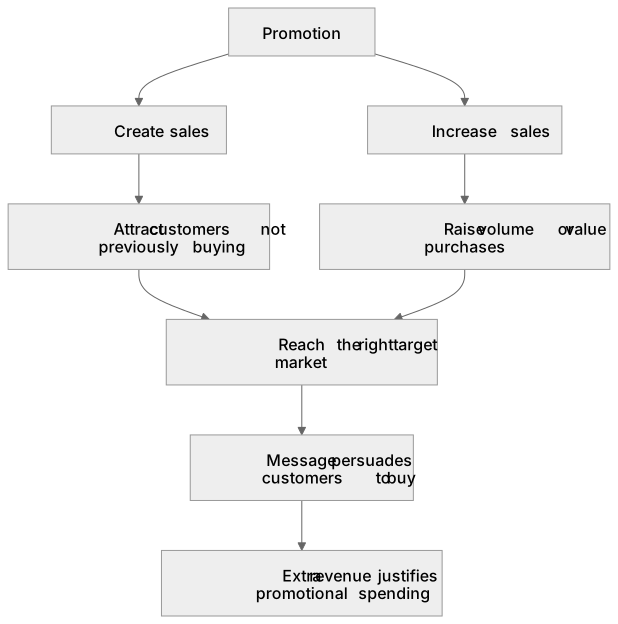
Promotion is one of the four Ps of the marketing mix, and its commercial purpose is to create sales where none existed before or to increase the level of sales a business already achieves. Creating sales means generating demand from customers who were not previously buying the product, for example a new mobile phone network using a launch advertising campaign to win its first subscribers. Increasing sales means raising the volume or value of purchases from existing and new customers, for example a supermarket running a two-for-one promotion that lifts the number of units bought per visit. Both outcomes depend on the promotion reaching the right target market, communicating a message that persuades customers to buy, and being timed and budgeted so that the extra revenue justifies the promotional spending.
What earns the marks
- Explains that promotion aims to create sales by attracting customers who were not previously buying the product, such as a new business launching with an advertising campaign.
- Explains that promotion aims to increase sales by raising the volume or value of purchases, for example through special offers, loyalty schemes or seasonal campaigns.
- Links the promotional method chosen to the target market, showing that the message and medium must reach the customers most likely to buy.
- Considers the cost of the promotion against the extra sales revenue it generates, recognising that promotion is only worthwhile if it adds more revenue than it costs.
- Applies the point to a given business context, for example explaining how a small bakery might use social media promotion to create sales among local customers.
- Evaluates the extent to which a particular promotional activity is likely to create or increase sales, using the context provided in the case material.
Common mistakes and how to put them right
Treating promotion as automatically successful.
Put it right: Candidates should explain that sales only rise if the message reaches the target market and persuades customers, not simply because money was spent.
Confusing creating sales with increasing sales.
Put it right: Candidates should distinguish winning new customers from raising purchases by existing customers, and use the correct term for the scenario.
Ignoring the cost side of promotion.
Put it right: Candidates should weigh the promotional spend against the additional revenue so that the judgement about success is balanced.
Exam tips
- Read the case study carefully and use the specific business, product and customers named in it rather than writing about promotion in general.
- When asked to analyse or evaluate, develop each point by explaining the chain from promotional activity to customer response to sales outcome.
- For evaluation questions, reach a supported judgement that considers both the likely sales benefit and the cost or risk of the promotion.
Try the lesson
The start of the The elements of the marketing mix: price, product, promotion and place (4Ps): create or increase sales lesson, made from checked teaching notes for this specification point.
Have a go first
A small bakery wants to create or increase sales of its new range of cakes. Which element of the marketing mix is most directly used when the bakery decides to run a 'buy one get one free' offer?
Listen
Promotion is one of the four Ps of the marketing mix, and its commercial purpose is to create sales where none existed before or to increase the level of sales a business already achieves. Creating sales means generating demand from customers who were not previously buying the product, for example a new mobile phone network using a launch advertising campaign to win its first subscribers. Increasing sales means raising the volume or value of purchases from existing and new customers, for example a supermarket running a two-for-one promotion that lifts the number of units bought per visit. Both outcomes depend on the promotion reaching the right target market, communicating a message that persuades customers to buy, and being timed and budgeted so that the extra revenue justifies the promotional spending. A strong answer earns marks for these points. Explains that promotion aims to create sales by attracting customers who were not previously buying the product, such as a new business launching with an advertising campaign. Explains that promotion aims to increase sales by raising the volume or value of purchases, for example through special offers, loyalty schemes or seasonal campaigns. Links the promotional method chosen to the target market, showing that the message and medium must reach the customers most likely to buy. Considers the cost of the promotion against the extra sales revenue it generates, recognising that promotion is only worthwhile if it adds more revenue than it costs. Exam tip: Read the case study carefully and use the specific business, product and customers named in it rather than writing about promotion in general.
See it
Key words
Say what each word means before you turn the card.
Creating sales
Try answering aloud or in your head before turning the card.
Increasing sales
Try answering aloud or in your head before turning the card.
Target market
Try answering aloud or in your head before turning the card.
Cost-effectiveness of promotional spending
Try answering aloud or in your head before turning the card.
See every definition
- Creating sales
- Generating demand from customers who were not previously buying the product, such as a new business launching with an advertising campaign.
- Increasing sales
- Raising the volume or value of purchases from existing and new customers, for example through special offers, loyalty schemes or seasonal campaigns.
- Target market
- The customers most likely to buy, who must be reached by the message and medium of the promotion.
- Cost-effectiveness of promotional spending
- Weighing the promotional spend against the extra sales revenue it generates, since promotion is only worthwhile if it adds more revenue than it costs.
Label the diagram
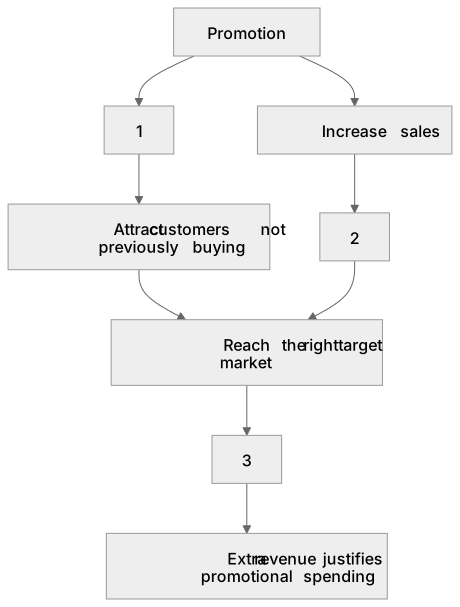
Some boxes have lost their names. Pick the right name for each number.
1Box 1
2Box 2
3Box 3
There is more to this lesson
The full lesson goes on to check your understanding and help you earn the marks. Create a free account to carry on, with your progress saved.
A week of Premium from your first lesson · Then the free plan continues · No card, no charge
Test your understanding of The elements of the marketing mix: price, product, promotion and place (4Ps): create or increase sales
Active recall beats re-reading. Take an instant quiz now to test what you’ve learned and lock it into long-term memory.
A week of Premium from your first lesson · Then the free plan continues · No card, no charge